Al Sulayyim Hadi, Ismail Rohani, Hamid Abdullah Al, Ghafar Noraini Abdul
Interdisciplinary Health Unit, School of Health Science, Universiti Sains Malaysia (Health Campus), Kubang Kerian, Kelantan, Malaysia.
Saudi Ministry of Health, Najran, Saudi Arabia Affiliation.
JAC Antimicrob Resist. 2023 Jun 5;5(3):dlad068. doi: 10.1093/jacamr/dlad068. eCollection 2023 Jun.
During the novel Coronavirus 2019 (COVID-19) outbreak, there was an overuse of antibiotics in hospitals. The improper use of antibiotics during COVID-19 has increased antibiotic resistance (AR), which has been reported in multiple studies.
To assess the healthcare workers' (HCWs) knowledge, attitude and practice (KAP) in relation to AR during the era of COVID-19, and identify the associated factors with good knowledge, positive attitude and good practice.
A cross-sectional design was used to assess the KAP of HCWs in Najran, Kingdom of Saudi Arabia (KSA). A validated questionnaire was used to collect participants' data, which consisted of the following information; socio-demographics, knowledge, attitude and items for practice. Data were presented as percentages and median (IQR). Mann-Whitney and Kruskal Wallis tests were used to compare them. Logistic regression was used to identify the associated factors linked to KAP.
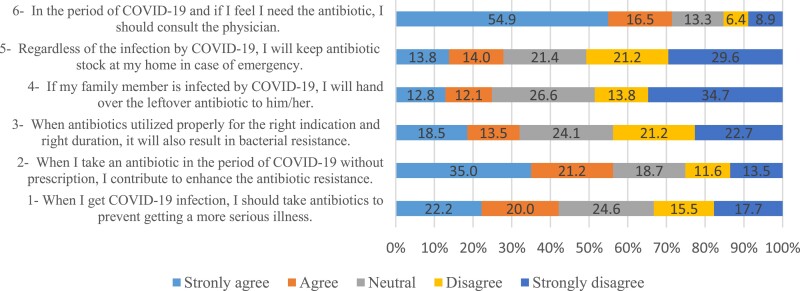
The study included 406 HCWs. Their median (IQR) knowledge score was 72.73% (27.27%-81.82%), attitude score was 71.43% (28.57%-71.43%) and practice score was 50% (0%-66.67%). About 58.1% of the HCWs stated that antibiotics could be used to treat COVID-19 infection; 19.2% of the participants strongly agreed and 20.7% agreed that during the COVID-19 pandemic, antibiotics were overused at their healthcare institutions. Only 18.5% strongly agreed and 15.5% agreed when asked whether antibiotics used properly for the right indication and duration can still result in AR. The significantly associated factors with good knowledge were nationality, cadre and qualification. A positive attitude was significantly associated with age, nationality and qualification. Good practice was significantly associated with age, cadre, qualification and working place.
Although the HCWs had a positive attitude regarding AR during COVID-19, their knowledge and practice need significant improvement. Implementation of effective educational and training programmes are urgently needed. In addition, further prospective and clinical trial studies are needed to better inform these programmes.
在2019年新型冠状病毒(COVID-19)疫情爆发期间,医院存在抗生素过度使用的情况。多项研究报告称,COVID-19期间抗生素的不当使用增加了抗生素耐药性(AR)。
评估在COVID-19时代医护人员(HCWs)关于抗生素耐药性的知识、态度和行为(KAP),并确定与良好知识、积极态度和良好行为相关的因素。
采用横断面设计评估沙特阿拉伯王国纳季兰医护人员的KAP。使用经过验证的问卷收集参与者的数据,问卷包括以下信息:社会人口统计学、知识、态度和行为项目。数据以百分比和中位数(四分位间距)表示。使用曼-惠特尼检验和克鲁斯卡尔-沃利斯检验进行比较。采用逻辑回归确定与KAP相关的因素。
该研究纳入了406名医护人员。他们的知识得分中位数(四分位间距)为72.73%(27.27%-81.82%),态度得分为71.43%(28.57%-71.43%),行为得分为50%(0%-66.67%)。约58.1%的医护人员表示抗生素可用于治疗COVID-19感染;19.2%的参与者强烈同意,20.7%的参与者同意在COVID-19大流行期间,其医疗机构存在抗生素过度使用的情况。当被问及正确适应症和疗程使用抗生素是否仍会导致抗生素耐药性时,只有18.5%的参与者强烈同意,15.5%的参与者同意。与良好知识显著相关的因素是国籍、干部身份和学历。积极态度与年龄、国籍和学历显著相关。良好行为与年龄、干部身份、学历和工作地点显著相关。
尽管医护人员在COVID-19期间对抗生素耐药性持积极态度,但其知识和行为仍需显著改善。迫切需要实施有效的教育和培训计划。此外,还需要进一步的前瞻性和临床试验研究,以便为这些计划提供更充分的信息。