Department of Food Science and Technology, Faculty of Agro-Industry, Kasetsart University, 50 Ngam Wong Wan Road, Chatuchak, Bangkok 10900, Thailand.
Department of Food Science and Technology, Faculty of Science, National University of Singapore, 2 Science Drive 2, 117542, Singapore.
Ultrason Sonochem. 2023 Jul;97:106466. doi: 10.1016/j.ultsonch.2023.106466. Epub 2023 Jun 3.
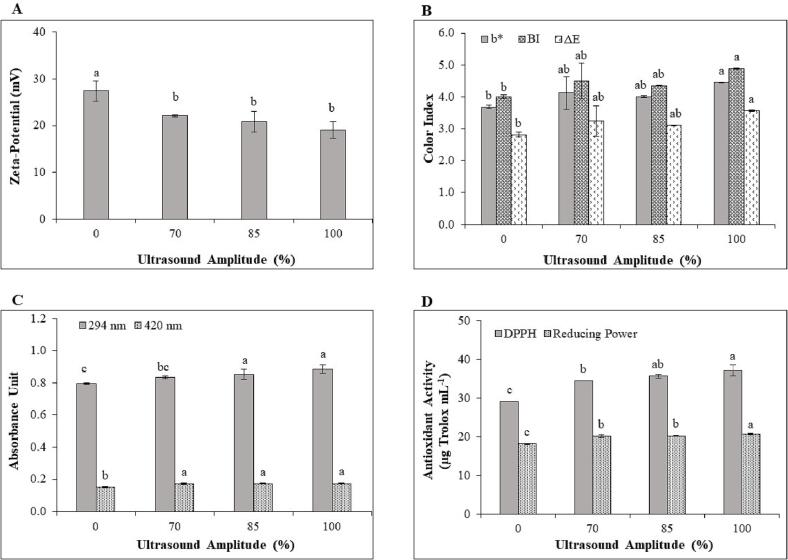
The influence of ultrasonic processing parameters including reaction temperature (60, 70 and 80 °C), time (0, 15, 30, 45 and 60 min) and amplitude (70, 85 and 100%) on the formation and antioxidant activity of Maillard reaction products (MRPs) in a solution of chitosan and glucose (1.5 wt% at mass ratio of 1:1) was investigated. Selected chitosan-glucose MRPs were further studied to determine the effects of solution pH on the fabrication of antioxidative nanoparticles by ionic crosslinking with sodium tripolyphosphate. Results from FT-IR analysis, zeta-potential determination and color measurement indicated that chitosan-glucose MRPs with improved antioxidant activity were successfully produced using an ultrasound-assisted process. The highest antioxidant activity of MRPs was observed at the reaction temperature, time and amplitude of 80 °C, 60 min and 70%, respectively, with ∼ 34.5 and ∼20.2 μg Trolox mL for DPPH scavenging activity and reducing power, respectively. The pH of both MRPs and tripolyphosphate solutions significantly influenced the fabrication and characteristics of the nanoparticles. Using chitosan-glucose MRPs and tripolyphosphate solution at pH 4.0 generated nanoparticles with enhanced antioxidant activity (∼1.6 and ∼ 1.2 μg Trolox mg for reducing power and DPPH scavenging activity, respectively) with the highest percentage yield (∼59%), intermediate particle size (∼447 nm) and zeta-potential ∼ 19.6 mV. These results present innovative findings for the fabrication of chitosan-based nanoparticles with enhanced antioxidant activity by pre-conjugation with glucose via the Maillard reaction aided by ultrasonic processing.
研究了超声处理参数对壳聚糖-葡萄糖(质量比为 1:1,1.5wt%)溶液中美拉德反应产物(MRP)形成和抗氧化活性的影响,这些参数包括反应温度(60、70 和 80°C)、时间(0、15、30、45 和 60min)和幅度(70、85 和 100%)。选择壳聚糖-葡萄糖 MRP 进一步研究,以确定溶液 pH 值对用三聚磷酸钠离子交联制备抗氧化纳米粒子的影响。傅里叶变换红外分析、动电位测定和颜色测量的结果表明,采用超声辅助工艺成功制备了具有改善抗氧化活性的壳聚糖-葡萄糖 MRP。MRP 的最高抗氧化活性出现在反应温度、时间和幅度分别为 80°C、60min 和 70%时,DPPH 清除活性和还原力分别约为 34.5 和 20.2μg Trolox mL。MRP 和三聚磷酸盐水溶液的 pH 值显著影响纳米粒子的制备和特性。使用 pH 值为 4.0 的壳聚糖-葡萄糖 MRP 和三聚磷酸盐水溶液生成具有增强抗氧化活性的纳米粒子(还原力和 DPPH 清除活性分别约为 1.6 和 1.2μg Trolox mg),产率最高(约 59%),粒径中等(约 447nm),动电位约为 19.6mV。这些结果为通过超声处理辅助的美拉德反应预先与葡萄糖缀合来制备具有增强抗氧化活性的壳聚糖基纳米粒子提供了创新性发现。