Lucas Calixto-Hope, Mirchia Kanish, Seo Kyounghee, Najem Hinda, Chen William, Zakimi Naomi, Choudhury Abrar, Liu S John, Phillips Joanna, Magill Stephen, Horbinski Craig, Solomon David, Perry Arie, Vasudevan Harish, Heimberger Amy, Raleigh David
Johns Hopkins University.
Univeristy of California San Francisco.
Res Sq. 2023 May 15:rs.3.rs-2921804. doi: 10.21203/rs.3.rs-2921804/v1.
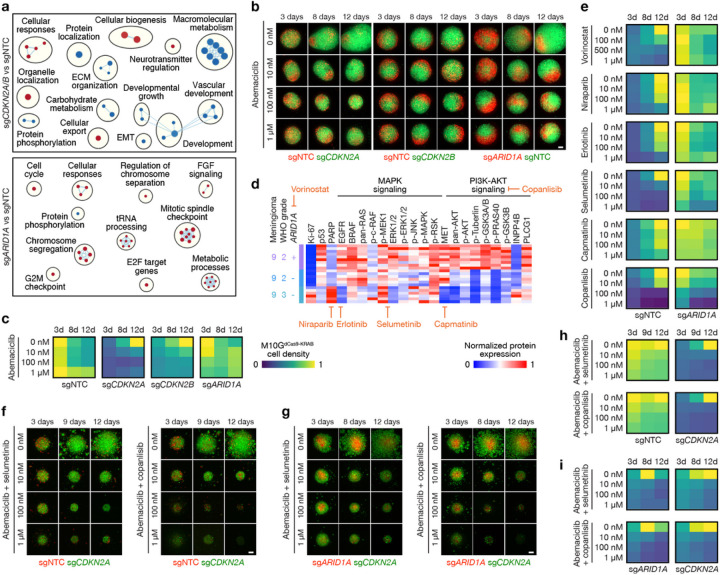
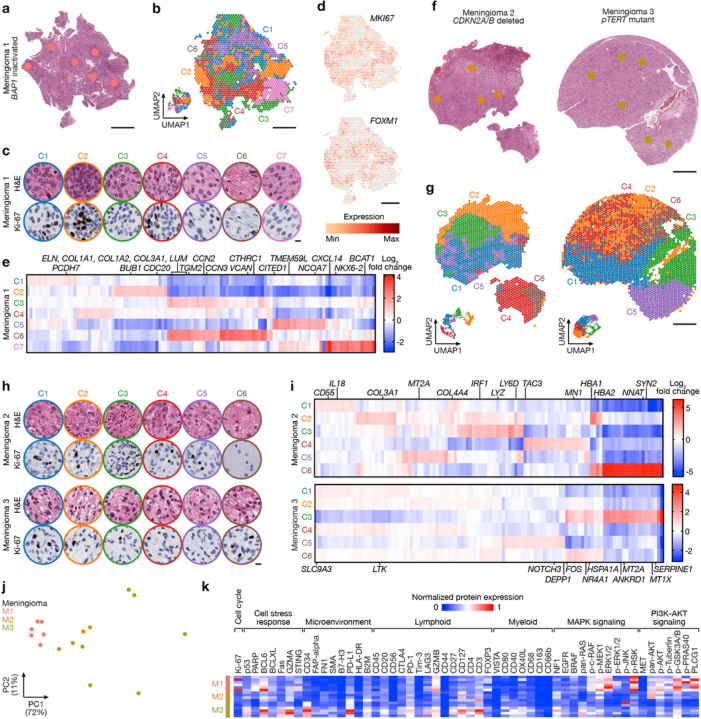
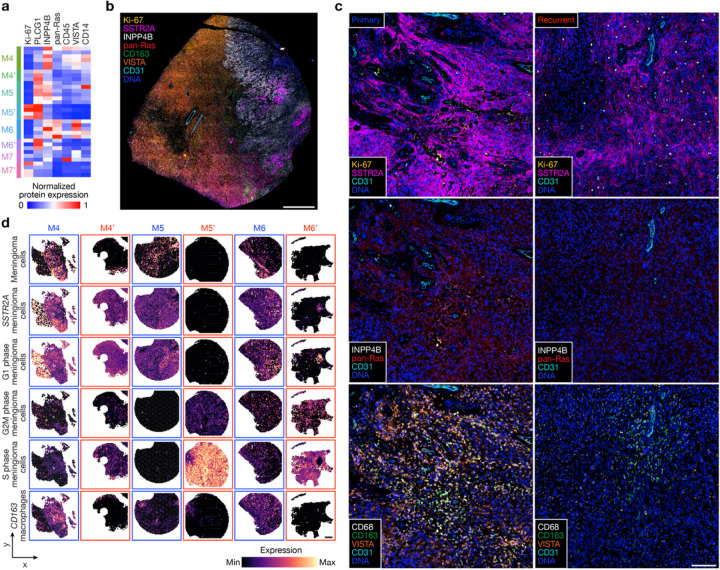
Intratumor heterogeneity underlies cancer evolution and treatment resistance, but targetable mechanisms driving intratumor heterogeneity are poorly understood. Meningiomas are the most common primary intracranial tumors and are resistant to all current medical therapies. High-grade meningiomas cause significant neurological morbidity and mortality and are distinguished from low-grade meningiomas by increased intratumor heterogeneity arising from clonal evolution and divergence. Here we integrate spatial transcriptomic and spatial protein profiling approaches across high-grade meningiomas to identify genomic, biochemical, and cellular mechanisms linking intratumor heterogeneity to the molecular, temporal, and spatial evolution of cancer. We show divergent intratumor gene and protein expression programs distinguish high-grade meningiomas that are otherwise grouped together by current clinical classification systems. Analyses of matched pairs of primary and recurrent meningiomas reveal spatial expansion of sub-clonal copy number variants underlies treatment resistance. Multiplexed sequential immunofluorescence (seqIF) and spatial deconvolution of meningioma single-cell RNA sequencing show decreased immune infiltration, decreased MAPK signaling, increased PI3K-AKT signaling, and increased cell proliferation drive meningioma recurrence. To translate these findings to clinical practice, we use epigenetic editing and lineage tracing approaches in meningioma organoid models to identify new molecular therapy combinations that target intratumor heterogeneity and block tumor growth. Our results establish a foundation for personalized medical therapy to treat patients with high-grade meningiomas and provide a framework for understanding therapeutic vulnerabilities driving intratumor heterogeneity and tumor evolution.
肿瘤内异质性是癌症进化和治疗耐药性的基础,但驱动肿瘤内异质性的可靶向机制仍知之甚少。脑膜瘤是最常见的原发性颅内肿瘤,对目前所有的药物治疗均耐药。高级别脑膜瘤会导致严重的神经功能障碍和死亡,其与低级别脑膜瘤的区别在于,克隆进化和分化导致肿瘤内异质性增加。在这里,我们整合了高级别脑膜瘤的空间转录组学和空间蛋白质谱分析方法,以确定将肿瘤内异质性与癌症的分子、时间和空间进化联系起来的基因组、生化和细胞机制。我们发现,不同的肿瘤内基因和蛋白质表达程序区分了高级别脑膜瘤,而目前的临床分类系统将这些脑膜瘤归为一类。对原发性和复发性脑膜瘤配对样本的分析表明,亚克隆拷贝数变异的空间扩展是治疗耐药性的基础。多重顺序免疫荧光(seqIF)和脑膜瘤单细胞RNA测序的空间反卷积显示,免疫浸润减少、MAPK信号传导减少、PI3K-AKT信号传导增加以及细胞增殖增加驱动了脑膜瘤复发。为了将这些发现转化为临床实践,我们在脑膜瘤类器官模型中使用表观遗传编辑和谱系追踪方法,以确定针对肿瘤内异质性并阻断肿瘤生长的新分子治疗组合。我们的结果为治疗高级别脑膜瘤患者的个性化医学治疗奠定了基础,并为理解驱动肿瘤内异质性和肿瘤进化的治疗脆弱性提供了框架。