Department of Biostatistics, University of Michigan School of Public Health, Ann Arbor, Michigan, United States of America.
Center for Statistical Genetics, University of Michigan School of Public Health, Ann Arbor, Michigan, United States of America.
PLoS Genet. 2021 Sep 16;17(9):e1009670. doi: 10.1371/journal.pgen.1009670. eCollection 2021 Sep.
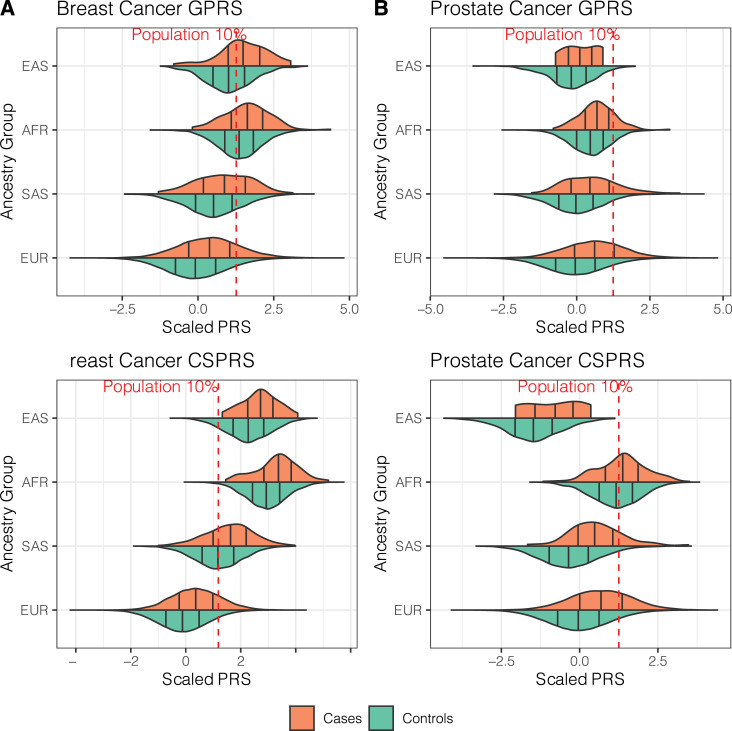
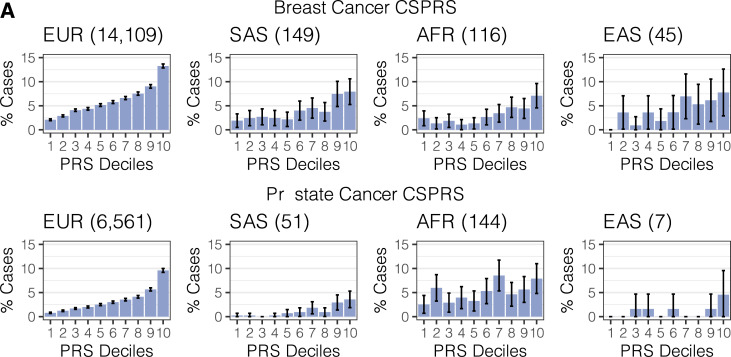
Polygenic risk scores (PRS) can provide useful information for personalized risk stratification and disease risk assessment, especially when combined with non-genetic risk factors. However, their construction depends on the availability of summary statistics from genome-wide association studies (GWAS) independent from the target sample. For best compatibility, it was reported that GWAS and the target sample should match in terms of ancestries. Yet, GWAS, especially in the field of cancer, often lack diversity and are predominated by European ancestry. This bias is a limiting factor in PRS research. By using electronic health records and genetic data from the UK Biobank, we contrast the utility of breast and prostate cancer PRS derived from external European-ancestry-based GWAS across African, East Asian, European, and South Asian ancestry groups. We highlight differences in the PRS distributions of these groups that are amplified when PRS methods condense hundreds of thousands of variants into a single score. While European-GWAS-derived PRS were not directly transferrable across ancestries on an absolute scale, we establish their predictive potential when considering them separately within each group. For example, the top 10% of the breast cancer PRS distributions within each ancestry group each revealed significant enrichments of breast cancer cases compared to the bottom 90% (odds ratio of 2.81 [95%CI: 2.69,2.93] in European, 2.88 [1.85, 4.48] in African, 2.60 [1.25, 5.40] in East Asian, and 2.33 [1.55, 3.51] in South Asian individuals). Our findings highlight a compromise solution for PRS research to compensate for the lack of diversity in well-powered European GWAS efforts while recruitment of diverse participants in the field catches up.
多基因风险评分(PRS)可以为个性化风险分层和疾病风险评估提供有用的信息,尤其是与非遗传风险因素相结合时。然而,PRS 的构建取决于来自全基因组关联研究(GWAS)的汇总统计数据,这些数据与目标样本是相互独立的。为了达到最佳的兼容性,据报道,GWAS 和目标样本在祖先方面应该匹配。然而,GWAS 特别是在癌症领域,往往缺乏多样性,并且以欧洲血统为主。这种偏差是 PRS 研究的一个限制因素。通过使用来自英国生物库的电子健康记录和遗传数据,我们对比了源自外部基于欧洲血统的 GWAS 的乳腺癌和前列腺癌 PRS 在非洲、东亚、欧洲和南亚血统群体中的效用。我们强调了这些群体中 PRS 分布的差异,当 PRS 方法将数十万种变体浓缩为一个单一分数时,这些差异会被放大。虽然欧洲 GWAS 衍生的 PRS 不能在绝对尺度上直接在不同祖先之间转移,但我们在每个群体内分别考虑它们时,确定了它们的预测潜力。例如,在每个祖先群体中,PRS 分布的前 10%与后 90%相比,乳腺癌病例显著增加(在欧洲的比值比为 2.81 [95%CI:2.69,2.93],在非洲为 2.88 [1.85, 4.48],在东亚为 2.60 [1.25, 5.40],在南亚为 2.33 [1.55, 3.51])。我们的研究结果强调了 PRS 研究的一种折衷解决方案,以弥补在功能强大的欧洲 GWAS 研究中缺乏多样性的问题,同时等待该领域招募更多样化的参与者。