Department of Psychiatry and Biobehavioral Sciences, Semel Institute for Neuroscience and Human Behavior, University of California, A7-460 Semel Institute, Los Angeles, CA, 90095, USA.
Neuroscience Interdepartmental Program, University of California, Los Angeles, CA, USA.
J Neurodev Disord. 2022 Jul 10;14(1):41. doi: 10.1186/s11689-022-09450-0.
Sleep disturbance is common, impairing, and may affect symptomatology in developmental neuropsychiatric disorders. Here, we take a genetics-first approach to study the complex role of sleep in psychopathology. Specifically, we examine severity of sleep disturbance in individuals with a reciprocal copy number variant (CNV) at the 22q11.2 locus and determine sleep's effect on psychiatric symptoms. CNVs (deletion or duplication) at this locus confer some of the greatest known risks of neuropsychiatric disorders; recent studies suggest the 22q11.2 deletion negatively impacts sleep, but sleep disruption associated with 22q11.2 duplication has not been investigated.
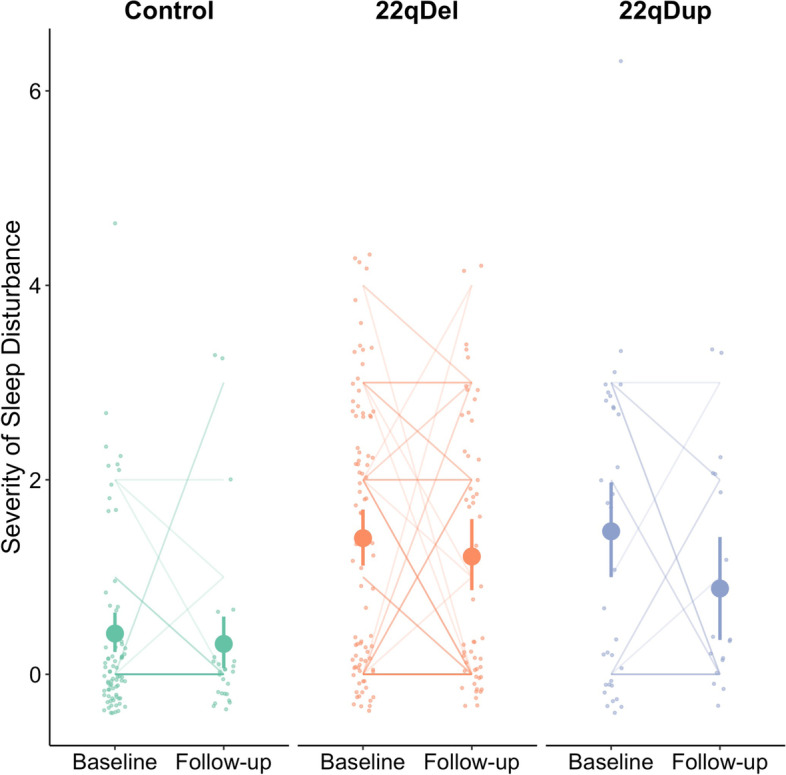
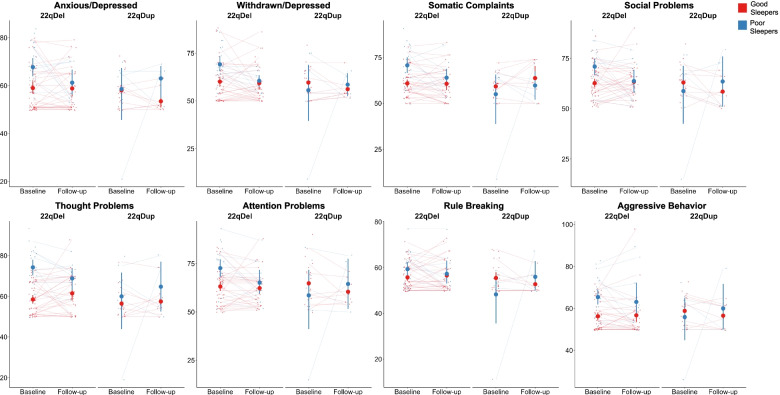
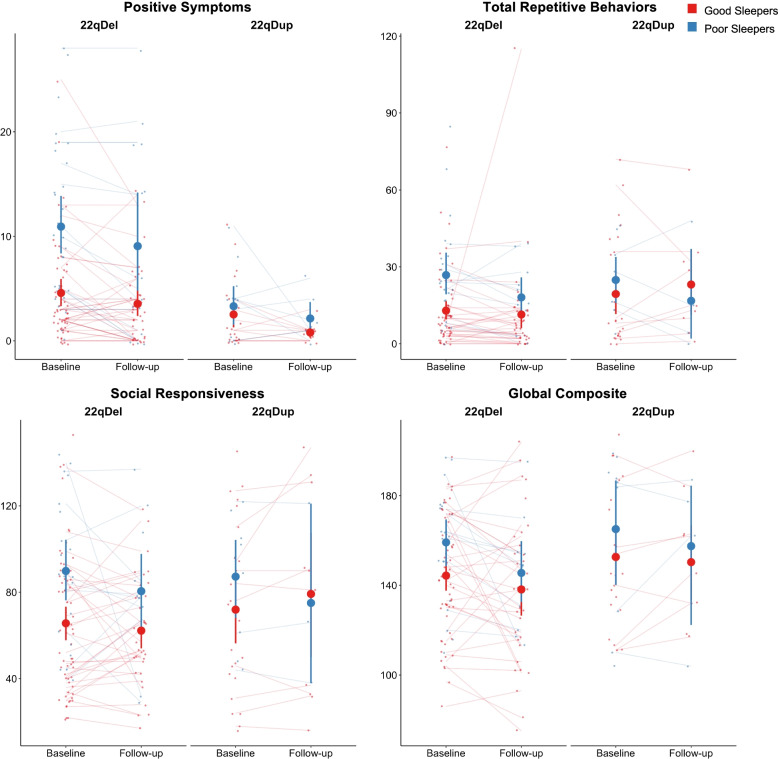
We compared subjective sleep disturbance and its relationship to psychiatric symptoms cross-sectionally and longitudinally over 1 year in 107 22q11.2 deletion (22qDel) carriers (14.56±8.0 years; 50% male), 42 22q11.2 duplication (22qDup) carriers (16.26±13.1 years; 54.8% male), and 88 age- and sex-matched controls (14.65±7.4 years; 47.1% male). Linear mixed models were used to compare sleep disturbance, assessed via the Structured Interview for Psychosis-Risk Syndromes (SIPS), across groups. Next, CNV carriers were categorized as good or poor sleepers to investigate sleep effects on multiple neurobehavioral traits: psychosis-risk symptoms (SIPS), autism-related behaviors (Repetitive Behavior Scale (RBS) and Social Responsiveness Scale (SRS)), real-world executive function (Behavior Rating Inventory of Executive Function (BRIEF)), and emotional/behavioral problems (Child Behavior Checklist (CBCL)). Linear mixed models tested the effect of sleep category and a group-by-sleep interaction on each measure, cross-sectionally and longitudinally.
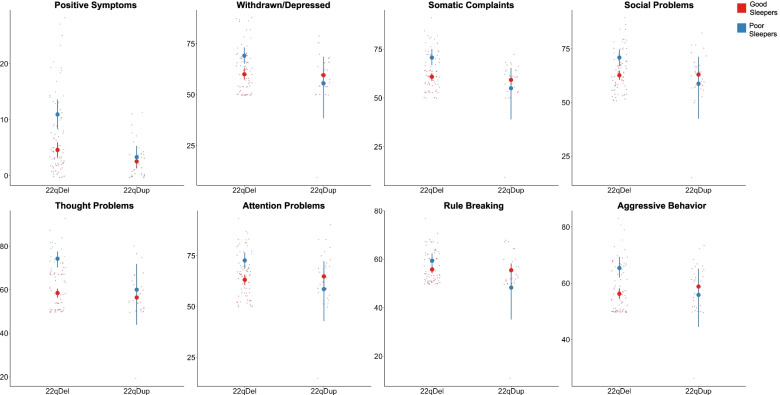
22qDel and 22qDup carriers both reported poorer sleep than controls, but did not differ from each other. Cross-sectionally and longitudinally, poor sleepers scored higher on positive symptoms, anxious/depressed, somatic complaints, thought problems, and aggressive behavior, as well as RBS and SRS total scores. There were significant group-by-sleep interactions for positive symptoms and the majority of CBCL subdomains, in which the difference between good and poor sleepers was larger in 22qDel compared to 22qDup.
Our findings indicate that CNVs at the 22q11.2 locus impact sleep which, in turn, influences psychopathology. Sleep disturbances can differentially impact psychopathology, depending on 22q11.2 gene dosage. Our findings serve as a starting point for exploring a genetic basis for sleep disturbance in developmental neuropsychiatric disorders.
睡眠障碍很常见,会损害健康,并可能影响发育性神经精神疾病的症状。在这里,我们采用遗传学的方法来研究睡眠在精神病理学中的复杂作用。具体来说,我们研究了在 22q11.2 位置发生相互拷贝数变异 (CNV) 的个体中睡眠障碍的严重程度,并确定了睡眠对精神症状的影响。该位置的 CNV(缺失或重复)赋予了一些已知的最大神经精神疾病风险;最近的研究表明,22q11.2 缺失会对睡眠产生负面影响,但尚未研究 22q11.2 重复与睡眠障碍的关系。
我们在 1 年内,通过结构访谈精神病风险综合征(SIPS)对 107 名 22q11.2 缺失(22qDel)携带者(14.56±8.0 岁;50%为男性)、42 名 22q11.2 重复(22qDup)携带者(16.26±13.1 岁;54.8%为男性)和 88 名年龄和性别匹配的对照者(14.65±7.4 岁;47.1%为男性)进行了比较。线性混合模型用于比较各组之间的睡眠障碍,通过 SIPS 进行评估。接下来,根据睡眠情况将 CNV 携带者分为睡眠良好和睡眠不良两类,以研究睡眠对多种神经行为特征的影响:精神病风险症状(SIPS)、自闭症相关行为(重复行为量表(RBS)和社会反应量表(SRS))、现实世界执行功能(行为评定量表(BRIEF))和情绪/行为问题(儿童行为检查表(CBCL))。线性混合模型测试了睡眠类别和组间睡眠交互作用对每个指标的影响,包括横断面和纵向。
22qDel 和 22qDup 携带者的睡眠均比对照组差,但彼此之间没有差异。无论是横断面还是纵向,睡眠不良者在阳性症状、焦虑/抑郁、躯体主诉、思维问题和攻击行为,以及 RBS 和 SRS 总分上的得分都更高。阳性症状和大多数 CBCL 子域都存在显著的组间睡眠交互作用,在 22qDel 中,良好和不良睡眠者之间的差异明显大于 22qDup。
我们的发现表明,22q11.2 位置的 CNV 会影响睡眠,而睡眠反过来又会影响精神病理学。睡眠障碍会根据 22q11.2 基因剂量的不同,对精神病理学产生不同的影响。我们的研究结果为探索发育性神经精神疾病中睡眠障碍的遗传基础提供了一个起点。