Sun Yat-sen University Cancer Center, No. 651 Dongfeng East Road, Yuexiu District, Guangzhou, 510060, China.
The First People's Hospital of Foshan, No. 81 North Lingnan Road, Chancheng District, Foshan, 528000, China.
BMC Cancer. 2020 Feb 18;20(1):131. doi: 10.1186/s12885-020-6557-5.
Colorectal cancer (CRC) is the third most prevalent cancer in China but few large-scale studies were conducted to understand CRC patients. The current study is aimed to gain a real-world perspectives of CRC patients in China.
Using electronic medical records of sampled patients between 2011 and 2016 from 12 hospitals in China, a retrospective cohort study was conducted to describe demographics and disease prognosis of CRC patients, and examine treatment sequences among metastatic CRC (mCRC) patients. Descriptive, comparative and survival analyses were conducted.
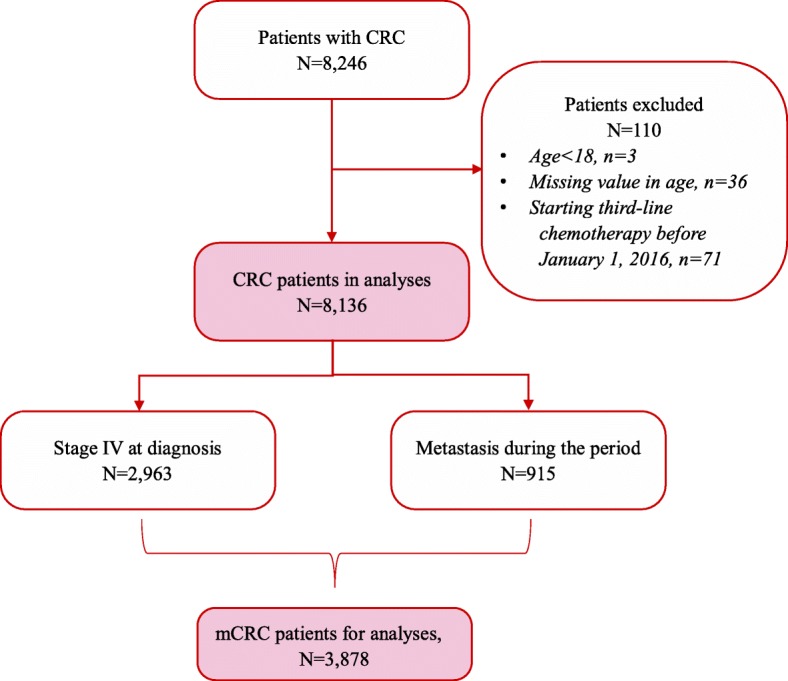
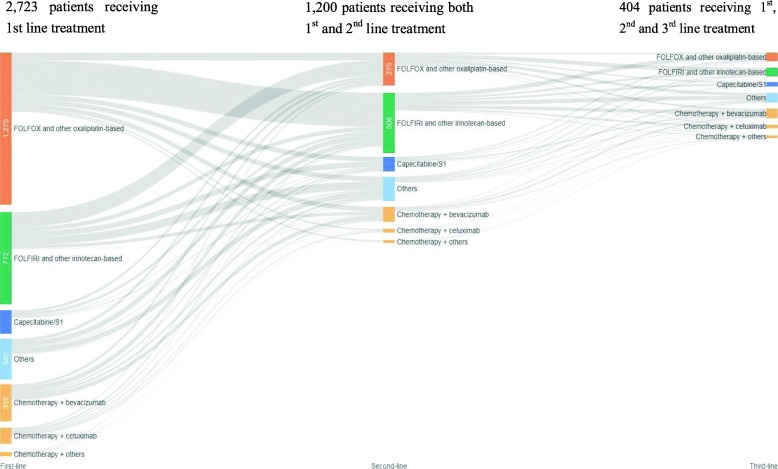
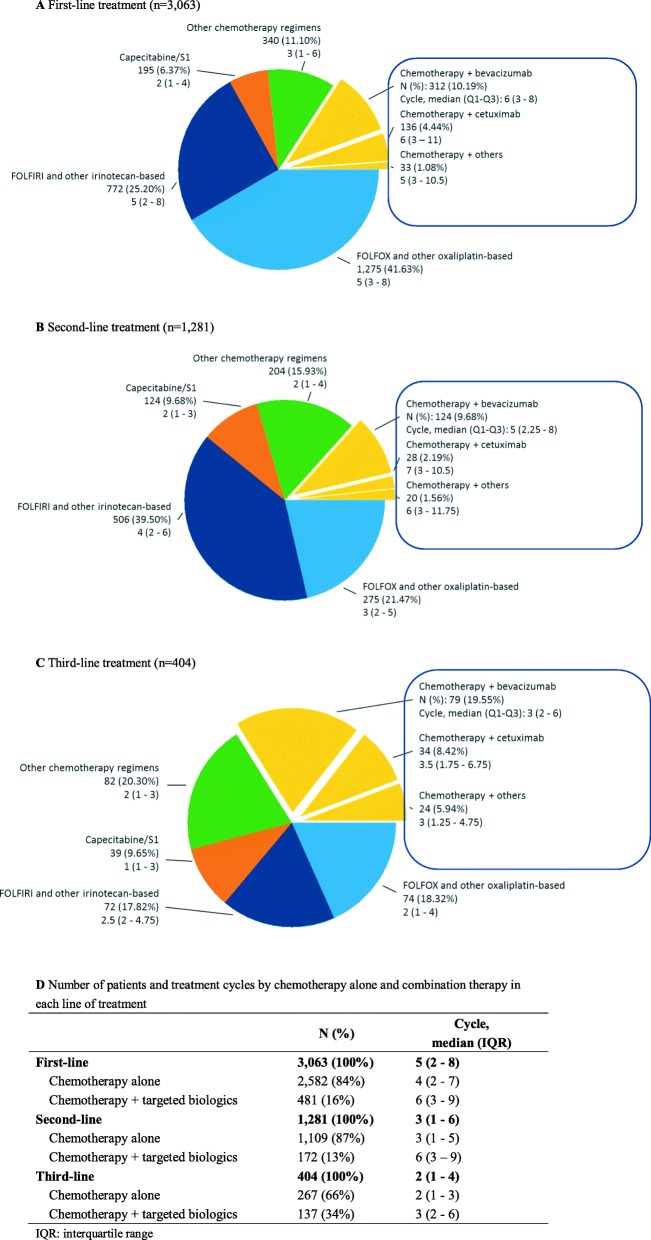
Among mCRC patients (3878/8136, 48%), the fluorouracil, leucovorin, and oxaliplatin (FOLFOX) and other oxaliplatin-based regimens were the most widely-used first-line treatment (42%). Fluorouracil, leucovorin, irinotecan (FOLFIRI) and other irinotecan-based regimens dominated the second-line (40%). There was no a dominated regimen for the third-line. The proportion of patients receiving chemotherapy with targeted biologics increased from less than 20% for the first- and second- lines to 34% for the third-line (p < 0.001). The most common sequence from first- to second-line was from FOLFOX and other oxaliplatin-based regimens to FOLFIRI and other irinotecan-based regimens (286/1200, 24%).
Our findings reflected a lack of consensus on the choice of third-line therapy and limited available options in China. It is evident o continue promoting early CRC diagnosis and to increase the accessibility of treatment options for mCRC patients. As the only nationwide large-scale study among CRC and mCRC patients before more biologics became available in China, our results can also be used as the baseline to assess treatment pattern changes before and after more third-line treatment were approved and covered into the National Health Insurance Plan in China between 2017 and 2018.
结直肠癌(CRC)是中国第三大常见癌症,但很少有大规模的研究来了解 CRC 患者。本研究旨在从真实世界的角度了解中国 CRC 患者的情况。
本研究采用回顾性队列研究,使用中国 12 家医院 2011 年至 2016 年期间抽样患者的电子病历,描述 CRC 患者的人口统计学和疾病预后,并检查转移性 CRC(mCRC)患者的治疗顺序。进行描述性、比较性和生存分析。
在 mCRC 患者(3878/8136,48%)中,氟尿嘧啶、亚叶酸钙和奥沙利铂(FOLFOX)和其他基于奥沙利铂的方案是最广泛使用的一线治疗方案(42%)。氟尿嘧啶、亚叶酸钙、伊立替康(FOLFIRI)和其他基于伊立替康的方案占二线治疗方案的主导地位(40%)。三线治疗方案中没有主导方案。接受化疗联合靶向生物制剂的患者比例从一线和二线治疗方案的不到 20%增加到三线治疗方案的 34%(p<0.001)。从一线到二线最常见的治疗方案是从 FOLFOX 和其他基于奥沙利铂的方案到 FOLFIRI 和其他基于伊立替康的方案(286/1200,24%)。
我们的研究结果反映了中国在三线治疗选择上缺乏共识,且可供选择的方案有限。显然需要继续促进 CRC 的早期诊断,并增加 mCRC 患者治疗方案的可及性。作为中国在更多生物制剂上市前对 CRC 和 mCRC 患者进行的唯一一项全国性大规模研究,我们的研究结果也可以作为基线,用于评估 2017 年至 2018 年期间中国更多三线治疗方案获得批准并纳入国家医疗保险计划前后的治疗模式变化。