Nacheva Lilyana, Dimitrova Nataliya, Koleva-Valkova Lyubka, Stefanova Miroslava, Ganeva Tsveta, Nesheva Marieta, Tarakanov Ivan, Vassilev Andon
Fruit Growing Institute, Agricultural Academy, 12 Ostromila Str., 4004 Plovdiv, Bulgaria.
Department of Plant Physiology, Biochemistry and Genetics, Faculty of Agronomy, Agricultural University, 12 Mendeleev Str., 4000 Plovdiv, Bulgaria.
Plants (Basel). 2023 May 27;12(11):2125. doi: 10.3390/plants12112125.
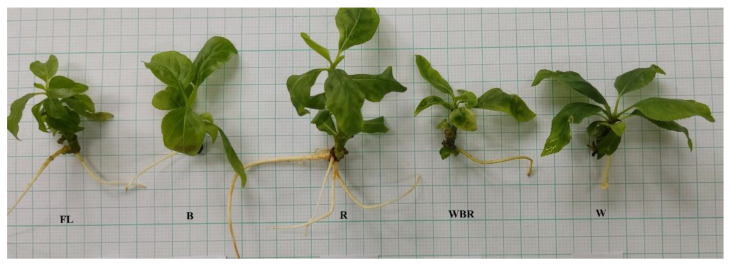
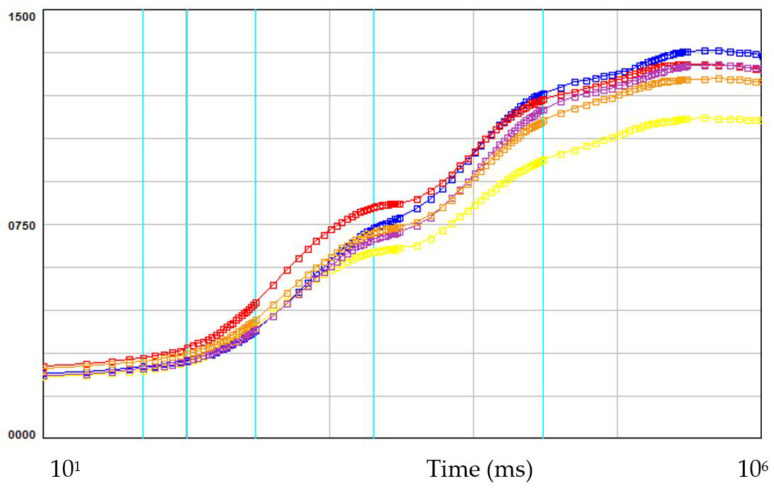
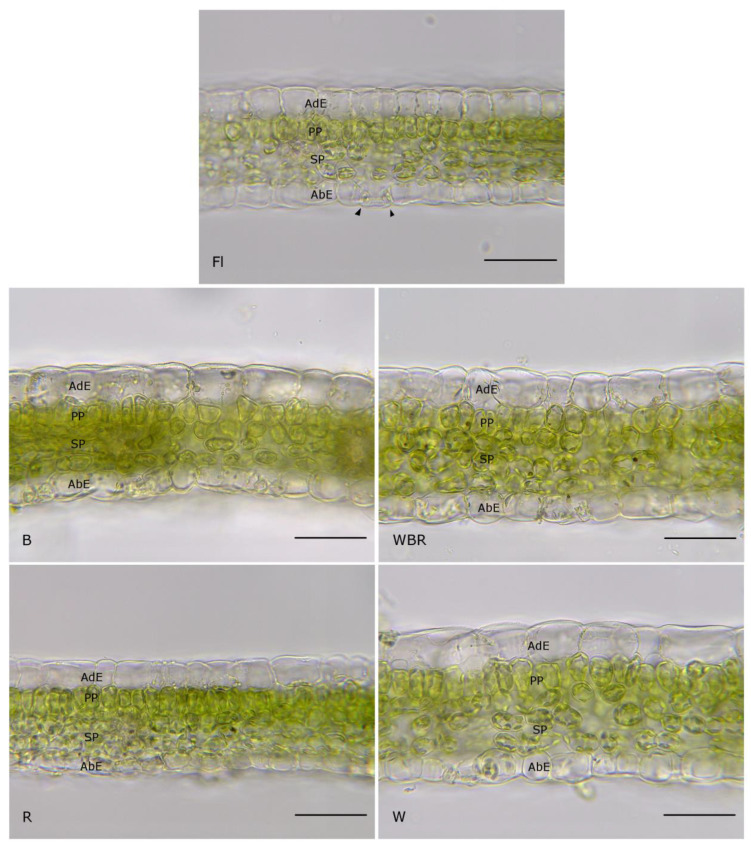
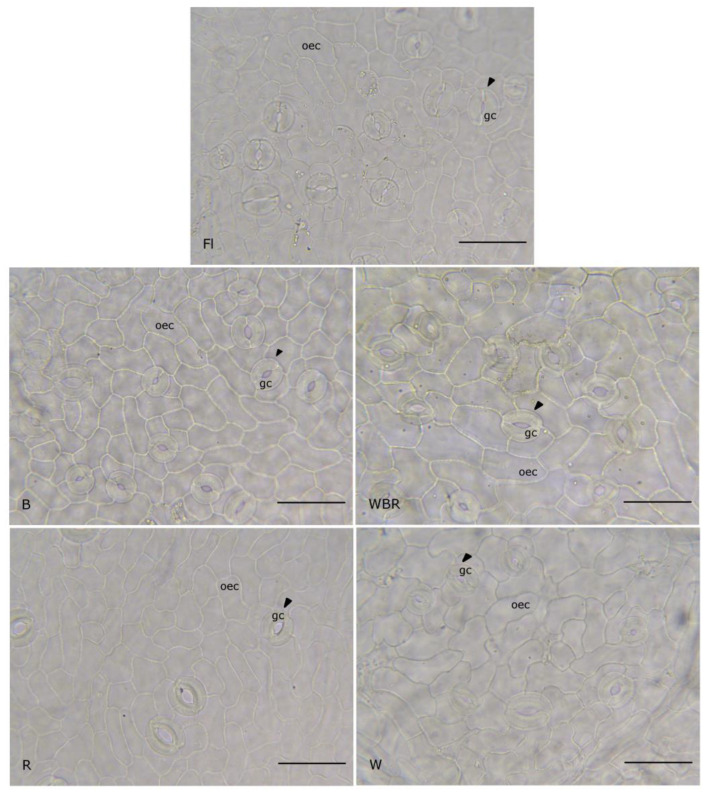
In recent years, light emitting diodes (LEDs), due to their low energy consumption, low heat emission and specific wavelength irradiation, have become an alternative to fluorescent lamps (FLs) in plant tissue culture. The aim of this study was to investigate the effects of various LED light sources on the in vitro growth and rooting of plum rootstock Saint Julien ( subsp. ). The test plantlets were cultivated under a Philips GreenPower LEDs research module illumination system with four spectral regions: white (W), red (R), blue (B) and mixed (W:R:B:far-red = 1:1:1:1). The control plantlets were cultivated under fluorescent lamps (FL) and the photosynthetic photon flux density (PPFD) of all treatments was set at 87 ± 7.5 μmol m s. The effect of light source on the selected physiological, biochemical and growth parameters of plantlets was monitored. Additionally, microscopic observations of leaf anatomy, leaf morphometric parameters and stomata characteristics were carried out. The results showed that the multiplication index (MI) varied from 8.3 (B) to 16.3 (R). The MI of plantlets grown under mixed light (WBR) was 9, lower compared to the control (FL) and white light (W), being 12.7 and 10.7, respectively. In addition, a mixed light (WBR) favored plantlets' stem growth and biomass accumulation at the multiplication stage. Considering these three indicators, we could conclude that under the mixed light, the microplants were of better quality and therefore mixed light (WBR) was more suitable during the multiplication phase. A reduction in both net photosynthesis rate and stomatal conductance in the leaves of plants grown under B were observed. The quantum yield (Yield = F/F), which represents the potential photochemical activity of PS II, ranged from 0.805 to 0.831 and corresponded to the typical photochemical activity (0.750-0.830) in the leaves of unstressed healthy plants. The red light had a beneficial effect on the rooting of plum plants; the rooting was over 98%, significantly higher than for the control (FL, 68%) and the mixed light (WBR, 19%). In conclusion, the mixed light (WBR) turned out to be the best choice during the multiplication phase and the red LED light was more suitable during the rooting stage.
近年来,发光二极管(LED)由于其低能耗、低发热以及特定波长的辐射,已成为植物组织培养中荧光灯(FL)的替代品。本研究的目的是探究不同LED光源对李属砧木圣朱利安(亚种)离体生长和生根的影响。试验组幼苗在飞利浦GreenPower LEDs研究模块照明系统下培养,该系统有四个光谱区域:白色(W)、红色(R)、蓝色(B)和混合光(W:R:B:远红光 = 1:1:1:1)。对照组幼苗在荧光灯下培养,所有处理的光合光子通量密度(PPFD)设定为87±7.5 μmol m² s⁻¹。监测光源对幼苗所选生理、生化和生长参数的影响。此外,还对叶片解剖结构、叶片形态测量参数和气孔特征进行了微观观察。结果表明,增殖指数(MI)在8.3(B)至16.3(R)之间变化。在混合光(WBR)下生长的幼苗的MI为9,低于对照组(FL)和白光(W),对照组和白光下的MI分别为12.7和10.7。此外,混合光(WBR)有利于增殖阶段幼苗的茎生长和生物量积累。综合这三个指标,我们可以得出结论,在混合光下,微型植物质量更好,因此混合光(WBR)在增殖阶段更合适。观察到在蓝光下生长的植物叶片的净光合速率和气孔导度均降低。量子产额(Yield = Fv/Fm)代表PS II的潜在光化学活性,范围在0.805至0.831之间,与未受胁迫的健康植物叶片中的典型光化学活性(0.750 - 0.830)相对应。红光对李属植物的生根有有益影响;生根率超过98%,显著高于对照组(FL,68%)和混合光(WBR,19%)。总之,混合光(WBR)在增殖阶段是最佳选择,而红色LED光在生根阶段更合适。