College of Computer Science & IT, Jazan University, Jazan 45142, Saudi Arabia.
Department of Electrical and Computer Engineering, Lebanese American University, Byblos 13-5053, Lebanon.
Sensors (Basel). 2023 Jun 5;23(11):5349. doi: 10.3390/s23115349.
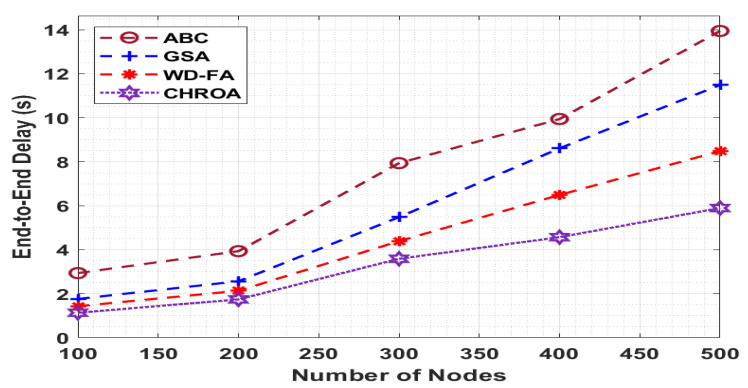
The emergence of the Internet of Things (IoT) and its subsequent evolution into the Internet of Everything (IoE) is a result of the rapid growth of information and communication technologies (ICT). However, implementing these technologies comes with certain obstacles, such as the limited availability of energy resources and processing power. Consequently, there is a need for energy-efficient and intelligent load-balancing models, particularly in healthcare, where real-time applications generate large volumes of data. This paper proposes a novel, energy-aware artificial intelligence (AI)-based load balancing model that employs the Chaotic Horse Ride Optimization Algorithm (CHROA) and big data analytics (BDA) for cloud-enabled IoT environments. The CHROA technique enhances the optimization capacity of the Horse Ride Optimization Algorithm (HROA) using chaotic principles. The proposed CHROA model balances the load, optimizes available energy resources using AI techniques, and is evaluated using various metrics. Experimental results show that the CHROA model outperforms existing models. For instance, while the Artificial Bee Colony (ABC), Gravitational Search Algorithm (GSA), and Whale Defense Algorithm with Firefly Algorithm (WD-FA) techniques attain average throughputs of 58.247 Kbps, 59.957 Kbps, and 60.819 Kbps, respectively, the CHROA model achieves an average throughput of 70.122 Kbps. The proposed CHROA-based model presents an innovative approach to intelligent load balancing and energy optimization in cloud-enabled IoT environments. The results highlight its potential to address critical challenges and contribute to developing efficient and sustainable IoT/IoE solutions.
物联网(IoT)的出现及其随后向万物互联(IoE)的演进,是信息和通信技术(ICT)快速发展的结果。然而,实施这些技术存在一定的障碍,例如能源资源和处理能力的有限可用性。因此,需要节能和智能的负载平衡模型,特别是在医疗保健领域,实时应用程序会生成大量数据。本文提出了一种新颖的基于人工智能(AI)的节能负载平衡模型,该模型在云启用的物联网环境中采用混沌马骑行优化算法(CHROA)和大数据分析(BDA)。混沌原理增强了马骑行优化算法(HROA)的优化能力。所提出的 CHROA 模型使用 AI 技术平衡负载,优化可用能源资源,并使用各种指标进行评估。实验结果表明,CHROA 模型优于现有模型。例如,尽管人工蜂群(ABC)、引力搜索算法(GSA)和带有萤火虫算法(WD-FA)的鲸鱼防御算法的平均吞吐量分别为 58.247 Kbps、59.957 Kbps 和 60.819 Kbps,但 CHROA 模型的平均吞吐量为 70.122 Kbps。基于 CHROA 的模型提出了一种在云启用的物联网环境中进行智能负载平衡和能量优化的创新方法。结果突出了其解决关键挑战和为开发高效和可持续的物联网/物联网解决方案做出贡献的潜力。