Graduate School of Integrated Sciences for Life, Hiroshima University, Higashi-Hiroshima, Japan.
Department of Integrated Global Studies, School of Integrated Arts and Sciences, Hiroshima University, Higashi-Hiroshima, Japan.
PLoS One. 2023 Jun 12;18(6):e0287114. doi: 10.1371/journal.pone.0287114. eCollection 2023.
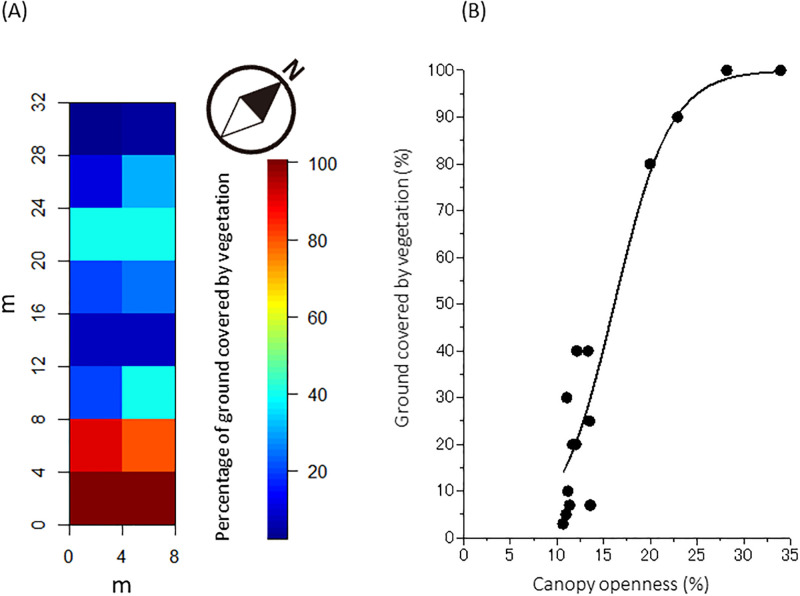
Phyllostachys nigra var. henonis, a monocarpic bamboo with a 120-year flowering interval, is next predicted to flower in Japan in the 2020s. Because a huge area of the country is presently covered by stands of this species, post-flowering dieback of these stands and ensuing drastic changes in land cover may cause serious social and/or environmental problems. No study on the regeneration of this bamboo species was conducted during the last flowering event in the 1900s, and the regeneration process of this species is thus still unknown. In 2020, we encountered a localized flowering of P. nigra var. henonis in Japan and used this discovery as a rare opportunity to study the initial regeneration process of the species. Over 3 years, more than 80% of culms in the study site bloomed, but no seed was produced. In addition, no established seedlings were located. These facts strongly suggest that P. nigra var. henonis lacks the ability to produce seeds and cannot undergo sexual regeneration. Some bamboo culms were produced after flowering but died within 1 year of emergence. Small, weak culms (dwarf ramets) also appeared after flowering, but most died within 1 year as well. Three years after flowering, all culms had died, with no sign of regeneration detected. According to our 3 years of observation, this bamboo appears to be hard to regenerate-an idea completely contradicted by the fact that this species has long persisted in Japan. We thus considered other possible regeneration modes for P. nigra var. henonis.
花旗楠是一种 120 年才会开花一次的单轴散生型竹子,预计将在 2020 年代在日本开花。由于该国目前有大片的这种物种的林地,这些林地开花后的衰退和随之而来的土地覆盖的剧烈变化可能会导致严重的社会和/或环境问题。在上一次 1900 年代的开花事件中,没有对这种竹子的再生进行研究,因此这种物种的再生过程仍然未知。2020 年,我们在日本遇到了花旗楠的局部开花,我们将这一发现作为研究该物种初始再生过程的难得机会。在 3 年多的时间里,研究地点超过 80%的竹秆开花,但没有产生种子。此外,没有发现已建立的幼苗。这些事实强烈表明,花旗楠缺乏产生种子的能力,不能进行有性繁殖。一些竹秆在开花后产生,但在出土后一年内死亡。开花后也出现了一些弱小的竹秆(矮生小枝),但大多数在一年内也死亡了。开花三年后,所有的竹秆都已死亡,没有发现任何再生的迹象。根据我们 3 年的观察,这种竹子似乎很难再生——这与该物种在日本长期存在的事实完全矛盾。因此,我们考虑了花旗楠的其他可能的再生模式。