Takano Kohei Takenaka, Hibino Kenshi, Numata Ayaka, Oguro Michio, Aiba Masahiro, Shiogama Hideo, Takayabu Izuru, Nakashizuka Tohru
Graduate School of Life Sciences Tohoku University Sendai Japan.
Forestry and Forest Products Research Institute Tsukuba Japan.
Ecol Evol. 2017 Oct 18;7(23):9848-9859. doi: 10.1002/ece3.3471. eCollection 2017 Dec.
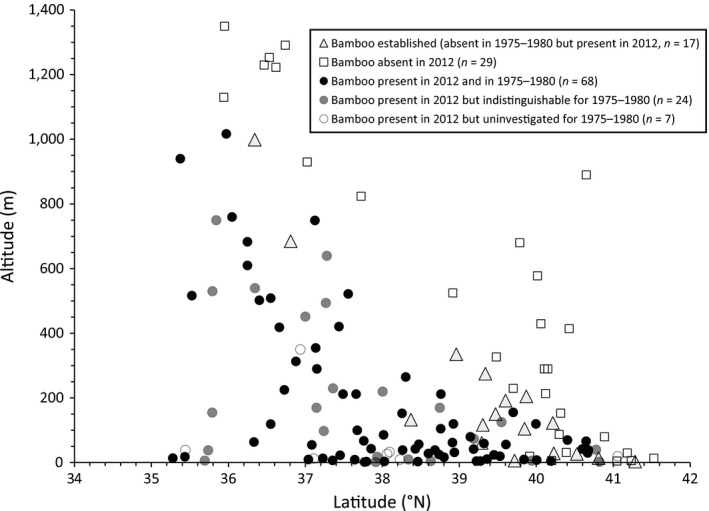
Rapid expansion of exotic bamboos has lowered species diversity in Japan's ecosystems by hampering native plant growth. The invasive potential of bamboo, facilitated by global warming, may also affect other countries with developing bamboo industries. We examined past (1975-1980) and recent (2012) distributions of major exotic bamboos ( and ) in areas adjacent to 145 weather stations in central and northern Japan. Bamboo stands have been established at 17 sites along the latitudinal and altitudinal distributional limit during the last three decades. Ecological niche modeling indicated that temperature had a strong influence on bamboo distribution. Using mean annual temperature and sun radiation data, we reproduced bamboo distribution (accuracy = 0.93 and AUC (area under the receiver operating characteristic curve) = 0.92). These results infer that exotic bamboo distribution has shifted northward and upslope, in association with recent climate warming. Then, we simulated future climate data and projected the climate change impact on the potential habitat distribution of invasive bamboos under different temperature increases (i.e., 1.5°C, 2.0°C, 3.0°C, and 4.0°C) relative to the preindustrial period. Potential habitats in central and northern Japan were estimated to increase from 35% under the current climate (1980-2000) to 46%-48%, 51%-54%, 61%-67%, and 77%-83% under 1.5°C, 2.0°C, 3.0°C, and 4.0°C warming levels, respectively. These infer that the risk areas can increase by 1.3 times even under a 1.5°C scenario and expand by 2.3 times under a 4.0°C scenario. For sustainable ecosystem management, both mitigation and adaptation are necessary: bamboo planting must be carefully monitored in predicted potential habitats, which covers most of Japan.
外来竹子的迅速扩张阻碍了本土植物的生长,从而降低了日本生态系统的物种多样性。全球变暖助长了竹子的入侵潜力,这可能也会影响其他发展竹子产业的国家。我们研究了日本中部和北部145个气象站附近地区主要外来竹子(和)过去(1975 - 1980年)和近期(2012年)的分布情况。在过去三十年里,竹子林已经在沿纬度和海拔分布界限的17个地点形成。生态位建模表明,温度对竹子分布有强烈影响。利用年平均温度和太阳辐射数据,我们再现了竹子分布(准确率 = 0.93,AUC(接受者操作特征曲线下面积)= 0.92)。这些结果推断,外来竹子的分布已随着近期气候变暖向北和向上坡转移。然后,我们模拟了未来气候数据,并预测了相对于工业化前时期不同温度升高幅度(即1.5°C、2.0°C、3.0°C和4.0°C)下气候变化对入侵竹子潜在栖息地分布的影响。据估计,日本中部和北部的潜在栖息地将从当前气候(1980 - 2000年)下的35%分别增加到在1.5°C、2.0°C、3.0°C和4.0°C升温水平下的46% - 48%、51% - 54%、61% - 67%和77% - 83%。这些推断出,即使在1.5°C的情景下,风险区域也可能增加1.3倍,在4.0°C的情景下会扩大2.3倍。为了实现生态系统的可持续管理,减缓措施和适应措施都必不可少:在预测的潜在栖息地(覆盖日本大部分地区)必须仔细监测竹子种植情况。