Division of Pulmonary, Allergy, Critical Care and Sleep Medicine, Emory University, Atlanta, Georgia, United States.
Atlanta Department of Veterans Affairs Healthcare System, Decatur, Georgia, United States.
Am J Physiol Lung Cell Mol Physiol. 2023 Aug 1;325(2):L215-L232. doi: 10.1152/ajplung.00303.2022. Epub 2023 Jun 13.
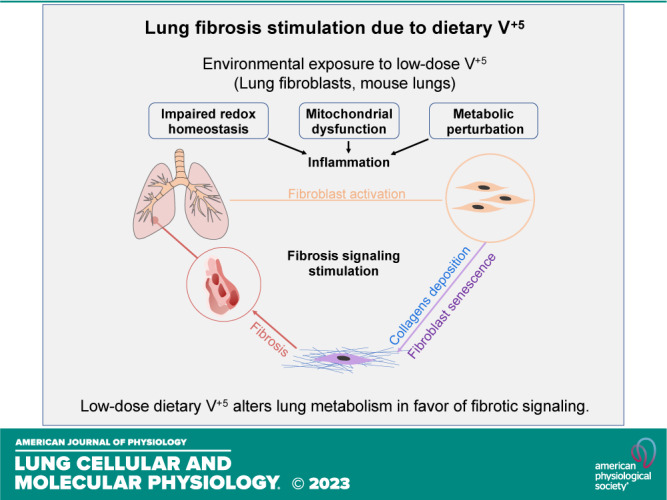
Vanadium is available as a dietary supplement and also is known to be toxic if inhaled, yet little information is available concerning the effects of vanadium on mammalian metabolism when concentrations found in food and water. Vanadium pentoxide (V) is representative of the most common dietary and environmental exposures, and prior research shows that low-dose V exposure causes oxidative stress measured by glutathione oxidation and protein S-glutathionylation. We examined the metabolic impact of V at relevant dietary and environmental doses (0.01, 0.1, and 1 ppm for 24 h) in human lung fibroblasts (HLFs) and male C57BL/6J mice (0.02, 0.2, and 2 ppm in drinking water for 7 mo). Untargeted metabolomics using liquid chromatography-high-resolution mass spectrometry (LC-HRMS) showed that V induced significant metabolic perturbations in both HLF cells and mouse lungs. We noted 30% of the significantly altered pathways in HLF cells, including pyrimidines and aminosugars, fatty acids, mitochondrial and redox pathways, showed similar dose-dependent patterns in mouse lung tissues. Alterations in lipid metabolism included leukotrienes and prostaglandins involved in inflammatory signaling, which have been associated with the pathogenesis of idiopathic pulmonary fibrosis (IPF) and other disease processes. Elevated hydroxyproline levels and excessive collagen deposition were also present in lungs from V-treated mice. Taken together, these results show that oxidative stress from environmental V, ingested at low levels, could alter metabolism to contribute to common human lung diseases. We used relevant dietary and environmental doses of Vanadium pentoxide (V) to examine its metabolic impact in vitro and in vivo. Using liquid chromatography-high-resolution mass spectrometry (LC-HRMS), we found significant metabolic perturbations, with similar dose-dependent patterns observed in human lung fibroblasts and male mouse lungs. Alterations in lipid metabolism included inflammatory signaling, elevated hydroxyproline levels, and excessive collagen deposition were present in V-treated lungs. Our findings suggest that low levels of V could trigger pulmonary fibrotic signaling.
钒作为膳食补充剂是可用的,如果吸入,也已知是有毒的,然而,当浓度在食物和水中时,关于钒对哺乳动物代谢的影响的信息很少。五氧化二钒 (V) 是最常见的饮食和环境暴露的代表,先前的研究表明,低剂量 V 暴露会导致谷胱甘肽氧化和蛋白质 S-谷胱甘肽化测量的氧化应激。我们研究了在相关饮食和环境剂量 (0.01、0.1 和 1 ppm,24 小时) 下 V 对人肺成纤维细胞 (HLFs) 和雄性 C57BL/6J 小鼠 (0.02、0.2 和 2 ppm,饮用水中 7 个月) 的代谢影响。使用液相色谱-高分辨率质谱 (LC-HRMS) 的非靶向代谢组学表明,V 诱导了 HLF 细胞和小鼠肺部的显著代谢紊乱。我们注意到 HLF 细胞中 30%的显著改变途径,包括嘧啶和氨基糖、脂肪酸、线粒体和氧化还原途径,在小鼠肺组织中显示出相似的剂量依赖性模式。脂质代谢的改变包括白细胞三烯和前列腺素,它们与特发性肺纤维化 (IPF) 和其他疾病过程的发病机制有关。在 V 处理的小鼠肺中还存在羟基脯氨酸水平升高和胶原过度沉积。总之,这些结果表明,从环境 V 中摄取的低水平氧化应激可能会改变代谢,从而导致常见的人类肺部疾病。我们使用相关的膳食和环境剂量的五氧化二钒 (V) 来研究其在体外和体内的代谢影响。使用液相色谱-高分辨率质谱 (LC-HRMS),我们发现了显著的代谢紊乱,在人肺成纤维细胞和雄性小鼠肺中观察到相似的剂量依赖性模式。脂质代谢的改变包括炎症信号、羟基脯氨酸水平升高和胶原过度沉积。我们的研究结果表明,低水平的 V 可能引发肺纤维化信号。