Department of Pharmaceutical Services, Hiroshima University Hospital, Hiroshima, Japan.
Division of Rehabilitation, Department of Clinical Practice and Support, Hiroshima University Hospital, Hiroshima, Japan.
PeerJ. 2023 Jun 9;11:e15260. doi: 10.7717/peerj.15260. eCollection 2023.
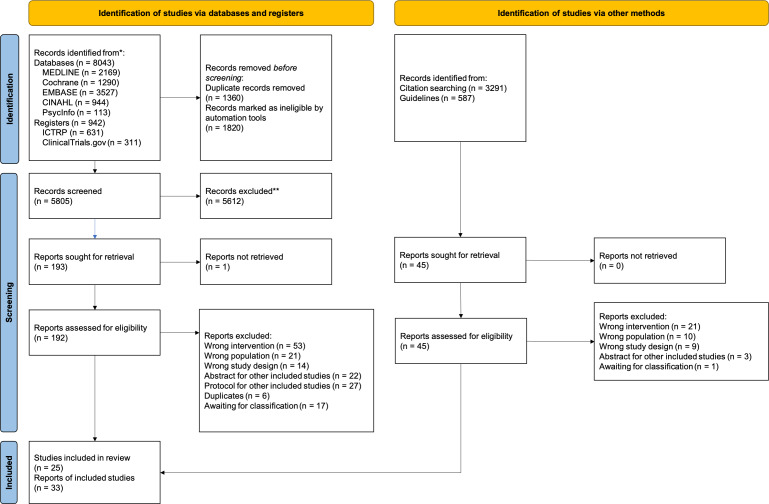
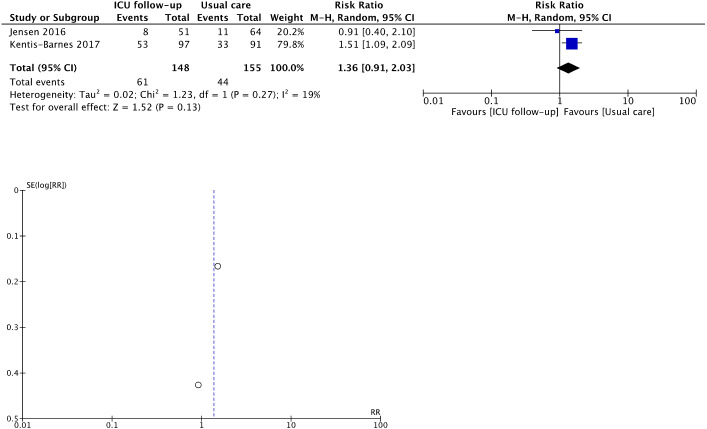
Psychological dysfunction is one of the considerable health-related outcomes among critically-ill patients and their informal caregivers. Follow-up of intensive care unit (ICU) survivors has been conducted in a variety of different ways, with different timing after discharge, targets of interest (physical, psychological, social) and measures used. Of diverse ICU follow-up, the effects of follow-ups which focused on psychological interventions are unknown. Our research question was whether follow-up with patients and their informal caregivers after ICU discharge improved mental health compared to usual care. We published a protocol for this systematic review and meta-analysis in https://www.protocols.io/ (https://dx.doi.org/10.17504/protocols.io.bvjwn4pe). We searched PubMed, Cochrane Library, EMBASE, CINAHL and PsycInfo from their inception to May 2022. We included randomized controlled trials for follow-ups after ICU discharge and focused on psychological intervention for critically ill adult patients and their informal caregivers. We synthesized primary outcomes, including depression, post-traumatic stress disorder (PTSD), and adverse events using the random-effects method. We used the Grading of Recommendations Assessment, Development and Evaluation approach to rate the certainty of evidence. From the 10,471 records, we identified 13 studies ( = 3, 366) focusing on patients and four ( = 538) focusing on informal caregivers. ICU follow-up for patients resulted in little to no difference in the prevalence of depression (RR 0.89, 95% CI [0.59-1.34]; low-certainty evidence) and PTSD (RR 0.84, 95% CI [0.55-1.30]; low-certainty evidence) among patients; however, it increased the prevalence of depression (RR 1.58 95% CI [1.01-2.46]; very low-certainty evidence), PTSD (RR 1.36, 95% CI [0.91-2.03]; very low-certainty evidence) among informal caregivers. The evidence for the effect of ICU follow-up on adverse events among patients was insufficient. Eligible studies for informal caregivers did not define any adverse event. The effect of follow-ups after ICU discharge that focused on psychological intervention should be uncertain.
心理功能障碍是危重症患者及其非专业照护者的重要健康相关结局之一。对重症监护病房(ICU)幸存者的随访采用了各种不同的方法,包括在出院后不同时间、不同关注目标(身体、心理、社会)和使用的措施。在各种 ICU 随访中,针对心理干预的随访效果尚不清楚。我们的研究问题是,与常规护理相比,患者及其非专业照护者在 ICU 出院后的随访是否能改善心理健康。我们在 https://www.protocols.io/ (https://dx.doi.org/10.17504/protocols.io.bvjwn4pe)上发布了这项系统评价和荟萃分析的方案。我们从建库开始检索了 PubMed、Cochrane 图书馆、EMBASE、CINAHL 和 PsycInfo,检索截止到 2022 年 5 月。我们纳入了 ICU 出院后随访的随机对照试验,并重点关注了针对重症成年患者及其非专业照护者的心理干预。我们采用随机效应法综合了主要结局,包括抑郁、创伤后应激障碍(PTSD)和不良事件。我们使用 GRADE 评估、制定与评价方法来评估证据的确定性。从 10471 条记录中,我们确定了 13 项针对患者的研究(共 3366 人)和 4 项针对非专业照护者的研究(共 538 人)。针对患者的 ICU 随访在患者中对抑郁(RR 0.89,95%CI [0.59-1.34];低确定性证据)和 PTSD(RR 0.84,95%CI [0.55-1.30];低确定性证据)的发生率没有差异,但增加了抑郁(RR 1.58,95%CI [1.01-2.46];极低确定性证据)和 PTSD(RR 1.36,95%CI [0.91-2.03];极低确定性证据)的发生率。针对非专业照护者的 ICU 随访对不良事件的影响证据不足。符合条件的非专业照护者研究没有定义任何不良事件。针对 ICU 出院后心理干预的随访效果应不确定。