Department of Pediatrics, Division of Endocrinology, Johns Hopkins University School of Medicine, Baltimore, MD, United States.
Front Endocrinol (Lausanne). 2023 May 29;14:1182260. doi: 10.3389/fendo.2023.1182260. eCollection 2023.
Continuous glucose monitoring (CGM) is beneficial to glycemic control in youth with type 1 diabetes (T1D) and adults with type 2 diabetes (T2D); however, studies in youth with T2D are limited.
Determine if 10-day trial CGM use in youth with T2D improves glycemic control and behavioral modifications.
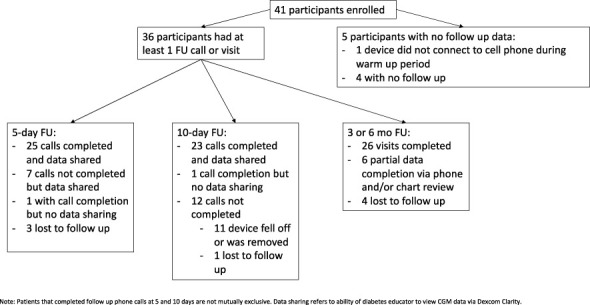
Youth with T2D > 3 months, on insulin, with no prior CGM use were enrolled. Staff placed CGM and provided education. Participants received 5-day and 10-day follow-up phone calls to review CGM data, behavioral modifications, and adjust insulin doses as needed. We compared 5-day to 10-day TIR, and baseline to 3-6 month HbA1c via paired t-test.
Participants (n=41) had median age of 16.2 y, were 61% female, 81% NH Black, median diabetes duration of 0.8 y, and baseline HbA1c of 10.3%. A majority had household income<$50,000 (81%) and parental education level of HS or less (73%). Average 5-day TIR 49% was similar to 10-day TIR 51% (p=0.62). There was no change in HbA1c after 3-6 months (10.2% v 10.3%, p=0.89). Nineteen participants completed full 10-day CGM use; of those, 84% wanted a CGM long-term. Adolescents reported behavioral changes including increased blood sugar checks, increased insulin administration and overall improved diabetes management.
Although 10-day CGM use did not impact short-term or long-term glycemic control in youth with T2D, most participants reported behavioral changes and wanted to continue using CGM. Future studies with longer use of CGM may clarify the potential impact of CGM in youth with T2D.
连续血糖监测(CGM)有益于控制 1 型糖尿病(T1D)青少年和 2 型糖尿病(T2D)成人的血糖;然而,T2D 青少年的相关研究有限。
确定 T2D 青少年使用 10 天 CGM 试验是否改善血糖控制和行为改变。
招募 T2D 超过 3 个月、使用胰岛素、无既往 CGM 使用史的青少年。工作人员放置 CGM 并提供教育。参与者接受 5 天和 10 天的随访电话,以回顾 CGM 数据、行为改变,并根据需要调整胰岛素剂量。我们通过配对 t 检验比较了 5 天和 10 天的 TIR,以及基线和 3-6 个月的 HbA1c。
参与者(n=41)的中位年龄为 16.2 岁,61%为女性,81%为非裔美国人,中位糖尿病病程为 0.8 年,基线 HbA1c 为 10.3%。大多数参与者家庭收入<$50,000(81%),父母教育水平为高中或以下(73%)。平均 5 天的 TIR 为 49%,与 10 天的 TIR 51%相似(p=0.62)。3-6 个月后 HbA1c 无变化(10.2%比 10.3%,p=0.89)。19 名参与者完成了完整的 10 天 CGM 使用;其中,84%希望长期使用 CGM。青少年报告了行为改变,包括增加血糖检查、增加胰岛素给药和整体改善糖尿病管理。
尽管 10 天 CGM 使用并未影响 T2D 青少年的短期或长期血糖控制,但大多数参与者报告了行为改变,并希望继续使用 CGM。未来更长时间使用 CGM 的研究可能会阐明 CGM 在 T2D 青少年中的潜在影响。