Allergy Immunology and Cell Biology Unit, Department of Immunology and Molecular Medicine, University of Sri Jayewardenepura, Nugegoda, Sri Lanka.
National Institute of Infectious Diseases, Angoda, Sri Lanka.
Clin Exp Immunol. 2024 Feb 19;215(3):268-278. doi: 10.1093/cei/uxad066.
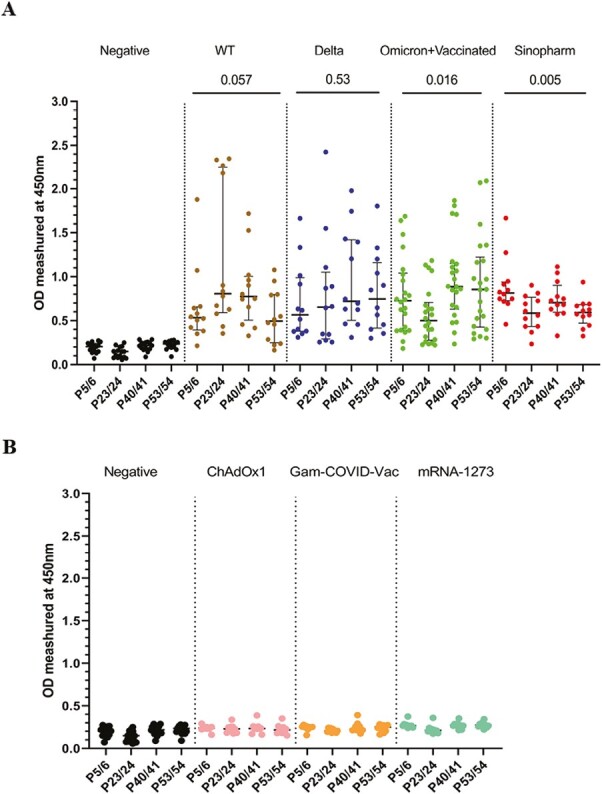
As there are limited data on B-cell epitopes for the nucleocapsid protein in SARS-CoV-2, we sought to identify the immunodominant regions within the N protein, recognized by patients with varying severity of natural infection with the Wuhan strain (WT), delta, omicron, and in those who received the Sinopharm vaccines, which is an inactivated, whole virus vaccine. Using overlapping peptides representing the N protein, with an in-house ELISA, we mapped the immunodominant regions within the N protein, in seronegative (n = 30), WT infected (n = 30), delta infected (n = 30), omicron infected + vaccinated (n = 20) and Sinopharm (BBIBP-CorV) vaccinees (n = 30). We then investigated the sensitivity and specificity of these immunodominant regions and analyzed their conservation with other SARS-CoV-2 variants of concern, seasonal human coronaviruses, and bat Sarbecoviruses. We identified four immunodominant regions aa 29-52, aa 155-178, aa 274-297, and aa 365-388, which were highly conserved within SARS-CoV-2 and the bat coronaviruses. The magnitude of responses to these regions varied based on the infecting SARS-CoV-2 variants, >80% of individuals gave responses above the positive cut-off threshold to many of the four regions, with some differences with individuals who were infected with different VoCs. These regions were found to be 100% specific, as none of the seronegative individuals gave any responses. As these regions were highly specific with high sensitivity, they have a potential to be used to develop diagnostic assays and to be used in development of vaccines.
由于关于 SARS-CoV-2 核衣壳蛋白的 B 细胞表位的数据有限,我们试图确定武汉株(WT)、delta 株、omicron 株自然感染严重程度不同的患者以及接种国药疫苗(一种灭活全病毒疫苗)的患者所识别的 N 蛋白中的免疫优势区域。我们使用代表 N 蛋白的重叠肽,通过内部 ELISA 来绘制 N 蛋白中的免疫优势区域,包括血清阴性者(n=30)、WT 感染者(n=30)、delta 感染者(n=30)、omicron 感染者+接种疫苗者(n=20)和国药(BBIBP-CorV)疫苗接种者(n=30)。然后,我们研究了这些免疫优势区域的敏感性和特异性,并分析了它们与其他 SARS-CoV-2 关注变体、季节性人类冠状病毒和蝙蝠 Sarbecoviruses 的保守性。我们确定了四个免疫优势区域 aa 29-52、aa 155-178、aa 274-297 和 aa 365-388,它们在 SARS-CoV-2 和蝙蝠冠状病毒中高度保守。对这些区域的反应幅度因感染的 SARS-CoV-2 变体而异,>80%的个体对许多四个区域的反应超过阳性截断阈值,与感染不同 VoC 的个体有一些差异。这些区域被发现具有 100%的特异性,因为血清阴性个体没有任何反应。由于这些区域具有高特异性和高敏感性,因此它们有可能被用于开发诊断检测方法,并用于疫苗开发。