Pathirana Sisira L, Deepachandi Bhagya, Gunasekara Peshala, Fernando Narmada, Perera Inoka C, Gangani Dakshika, Thambyarajah James, Dasanayake Dhanushka, de Silva Rajiva, Premawansa Sunil, Nitsche Andreas, Handunnetti Shiroma M
Institute of Biochemistry Molecular Biology and Biotechnology University of Colombo, Colombo, Sri Lanka.
Department of Life Sciences Faculty of Science, NSBM Green University, Mahenwaththa, Pitipana, Homagama, Sri Lanka.
Int J Microbiol. 2024 Sep 19;2024:1331067. doi: 10.1155/2024/1331067. eCollection 2024.
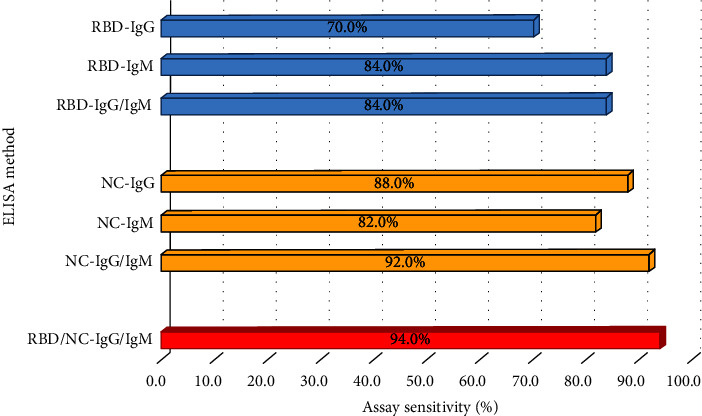
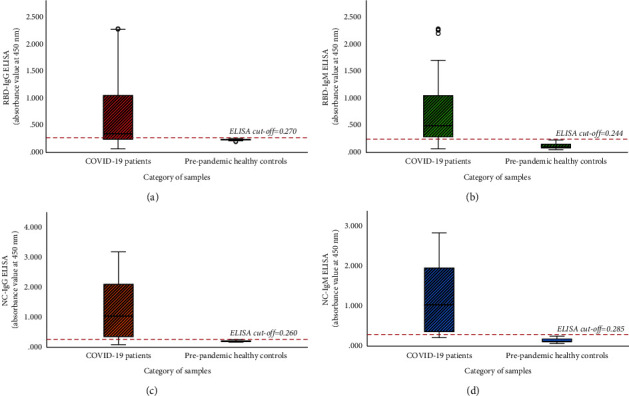
COVID-19 serological tests complement the molecular diagnostics and can be used as important tool for serosurveillance and vaccine efficiency evaluation. The aim of this study was to develop and evaluate the diagnostic performance of an in-house ELISA for retrospective serosurveillance of SARS-CoV-2. Total IgG and IgM levels in sera of PCR positive SARS-CoV-2 patients ( = 50) from North Colombo Teaching Hospital were evaluated and compared with sera ( = 50) collected from prepandemic healthy individuals as controls. Patient sample collection was initiated before vaccination programme was widely started within the country. Seropositivity of 94.0% ( = 47/50) was observed for either IgG or IgM anti-SARS-CoV-2 antibodies against receptor binding domain of spike protein or nucleocapsid protein in confirmed cases while none of controls were seropositive. In contrast, the seropositivity of only 48.0% ( = 24/50) was demonstrated with commercial ELISA kits for detection of IgG or IgM. All samples detected seropositive by commercially available kits remained seropositive with either in-house IgM or IgG ELISA. Significant correlations ( ≤ 0.001) were observed between Ab levels and day of sampling from the onset of illness. The overall sensitivity values of the in-house assays were 66.7%, 96.9%, and 100.0% for the first, second, and third week or longer after onset of symptoms for either in-house IgM or IgG ELISAs. Majority of the patients (>80.0%) were seropositive, regardless of age (<60 vs. >60 years), gender (male vs. female), or clinical severity (mild vs. moderate/severe). These data suggest that the developed in-house ELISAs can be applied to assess anti-SARS-CoV-2 antibody levels induced by either natural infections or vaccination.
新冠病毒血清学检测可补充分子诊断方法,并且能够作为血清学监测和疫苗效果评估的重要工具。本研究的目的是开发并评估一种用于严重急性呼吸综合征冠状病毒2(SARS-CoV-2)回顾性血清学监测的内部酶联免疫吸附测定(ELISA)方法的诊断性能。对来自北科伦坡教学医院的50例PCR检测呈阳性的SARS-CoV-2患者血清中的总IgG和IgM水平进行了评估,并与疫情前作为对照收集的50例健康个体的血清进行了比较。患者样本采集在该国广泛启动疫苗接种计划之前就已开始。在确诊病例中,针对刺突蛋白或核衣壳蛋白受体结合域的IgG或IgM抗SARS-CoV-2抗体的血清阳性率为94.0%(47/50),而对照组均无血清阳性。相比之下,用于检测IgG或IgM的商用ELISA试剂盒的血清阳性率仅为48.0%(24/50)。所有通过市售试剂盒检测为血清阳性的样本在用内部IgM或IgG ELISA检测时仍为血清阳性。抗体水平与发病之日起的采样天数之间存在显著相关性(≤0.001)。对于症状出现后的第一周、第二周和第三周及更长时间,内部IgM或IgG ELISA检测的总体敏感性值分别为66.7%、96.9%和100.0%。大多数患者(>80.0%)呈血清阳性,无论年龄(<60岁与>60岁)、性别(男性与女性)或临床严重程度(轻度与中度/重度)如何。这些数据表明,所开发的内部ELISA可用于评估由自然感染或疫苗接种诱导的抗SARS-CoV-2抗体水平。