Alsuwairi Feda A, Alsaleh Asma N, Alsanea Madain S, Al-Qahtani Ahmed A, Obeid Dalia, Almaghrabi Reem S, Alahideb Basma M, AlAbdulkareem Maha A, Mutabagani Maysoon S, Althawadi Sahar I, Altamimi Sara A, Alshukairi Abeer N, Alhamlan Fatimah S
Department of Infection and Immunity, King Faisal Specialist Hospital and Research Center, Riyadh 11211, Saudi Arabia.
Botany and Microbiology Department, College of Science, King Saud University, Riyadh 11451, Saudi Arabia.
Microorganisms. 2023 May 15;11(5):1288. doi: 10.3390/microorganisms11051288.
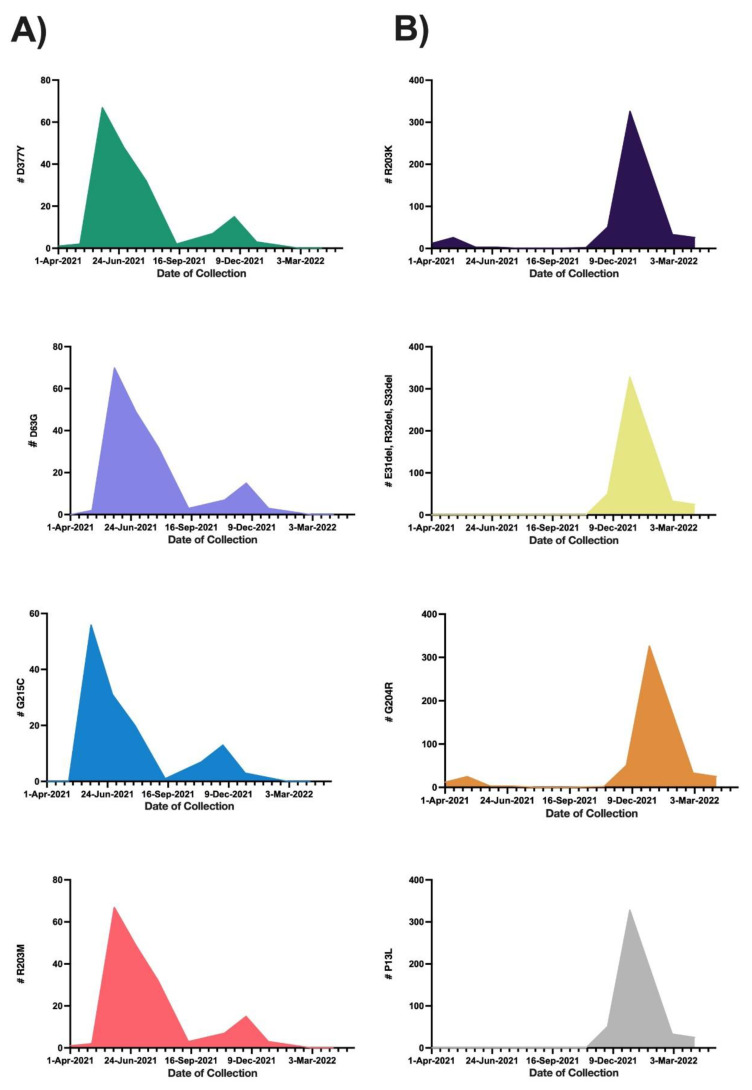
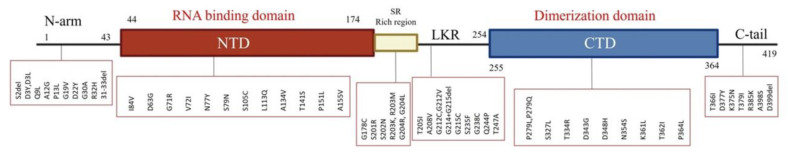
SARS-CoV-2 genomic mutations outside the spike protein that may increase transmissibility and disease severity have not been well characterized. This study identified mutations in the nucleocapsid protein and their possible association with patient characteristics. We analyzed 695 samples from patients with confirmed COVID-19 in Saudi Arabia between 1 April 2021, and 30 April 2022. Nucleocapsid protein mutations were identified through whole genome sequencing. 𝜒 tests and tests assessed associations between mutations and patient characteristics. Logistic regression estimated the risk of intensive care unit (ICU) admission or death. Of the 60 mutations identified, R203K was the most common, followed by G204R, P13L, E31del, R32del, and S33del. These mutations were associated with reduced risk of ICU admission. P13L, E31del, R32del, and S33del were also associated with reduced risk of death. By contrast, D63G, R203M, and D377Y were associated with increased risk of ICU admission. Most mutations were detected in the SR-rich region, which was associated with low risk of death. The C-tail and central linker regions were associated with increased risk of ICU admission, whereas the N-arm region was associated with reduced ICU admission risk. Consequently, mutations in the N protein must be observed, as they may exacerbate viral infection and disease severity. Additional research is needed to validate the mutations' associations with clinical outcomes.
严重急性呼吸综合征冠状病毒2(SARS-CoV-2)刺突蛋白以外可能增加传播性和疾病严重程度的基因组突变尚未得到充分表征。本研究鉴定了核衣壳蛋白中的突变及其与患者特征的可能关联。我们分析了2021年4月1日至2022年4月30日期间沙特阿拉伯695例确诊新型冠状病毒肺炎(COVID-19)患者的样本。通过全基因组测序鉴定核衣壳蛋白突变。卡方检验和其他检验评估了突变与患者特征之间的关联。逻辑回归估计了入住重症监护病房(ICU)或死亡的风险。在鉴定出的60种突变中,R203K最为常见,其次是G204R、P13L、E31del、R32del和S33del。这些突变与入住ICU风险降低相关。P13L、E31del、R32del和S33del也与死亡风险降低相关。相比之下,D63G、R203M和D377Y与入住ICU风险增加相关。大多数突变在富含丝氨酸(SR)的区域被检测到,该区域与低死亡风险相关。C末端和中央连接区与入住ICU风险增加相关,而N臂区与入住ICU风险降低相关。因此,必须观察核蛋白中的突变,因为它们可能会加剧病毒感染和疾病严重程度。需要进一步的研究来验证这些突变与临床结局之间的关联。