• 文献检索
  • 文档翻译
  • 深度研究
  • 学术资讯
  • Suppr Zotero 插件Zotero 插件
  • 邀请有礼
  • 套餐&价格
  • 历史记录
应用&插件
Suppr Zotero 插件Zotero 插件浏览器插件Mac 客户端Windows 客户端微信小程序
定价
高级版会员购买积分包购买API积分包
服务
文献检索文档翻译深度研究API 文档MCP 服务
关于我们
关于 Suppr公司介绍联系我们用户协议隐私条款
关注我们

Suppr 超能文献

核心技术专利:CN118964589B侵权必究
粤ICP备2023148730 号-1Suppr @ 2026

文献检索

告别复杂PubMed语法,用中文像聊天一样搜索,搜遍4000万医学文献。AI智能推荐,让科研检索更轻松。

立即免费搜索

文件翻译

保留排版,准确专业,支持PDF/Word/PPT等文件格式,支持 12+语言互译。

免费翻译文档

深度研究

AI帮你快速写综述,25分钟生成高质量综述,智能提取关键信息,辅助科研写作。

立即免费体验

从进化角度看,严重急性呼吸综合征冠状病毒2(SARS-CoV-2)逃避天然免疫系统的策略

Strategies Used by SARS-CoV-2 to Evade the Innate Immune System in an Evolutionary Perspective.

作者信息

Fan Hong, Tian Mingfu, Liu Siyu, Ye Chenglin, Li Zhiqiang, Wu Kailang, Zhu Chengliang

机构信息

Department of Clinical Laboratory, Institute of Translational Medicine, Renmin Hospital of Wuhan University, Wuhan 430060, China.

State Key Laboratory of Virology, College of Life Sciences, Wuhan University, Wuhan 430072, China.

出版信息

Pathogens. 2024 Dec 17;13(12):1117. doi: 10.3390/pathogens13121117.

DOI:10.3390/pathogens13121117
PMID:39770376
原文链接:https://pmc.ncbi.nlm.nih.gov/articles/PMC11677916/
Abstract

By the end of 2019, the COVID-19 pandemic, resulting from the Severe Acute Respiratory Syndrome Coronavirus 2 (SARS-CoV-2), had diffused widely across the globe, with 770 million infected individuals and over 7 million deaths reported. In addition to its high infectivity and pathogenicity and its rapid mutation rate, the unique capacity of SARS-CoV-2 to circumvent the immune system has also contributed to the widespread nature of this pandemic. SARS-CoV-2 elicits the onset of innate immune system activation and initiates antiviral responses once it has infected the host. While battling the host's immune responses, SARS-CoV-2 has established many countermeasures to evade attack and clearance. As the exploration of SARS-CoV-2 continues, substantial evidence has revealed that the 29 proteins synthesized by the SARS-CoV-2 genome are integral to the viral infection process. They not only facilitate viral replication and transmission, but also assist SARS-CoV-2 in escaping the host's immune defenses, positioning them as promising therapeutic targets that have attracted considerable attention in recent studies. This review summarizes the manner in which SARS-CoV-2 interfaces with the innate immune system, with a particular focus on the continuous evolution of SARS-CoV-2 and the implications of mutations.

摘要

截至2019年底,由严重急性呼吸综合征冠状病毒2(SARS-CoV-2)引发的新冠疫情已在全球广泛传播,报告的感染人数达7.7亿,死亡人数超过700万。除了具有高传染性、高致病性以及快速突变率外,SARS-CoV-2规避免疫系统的独特能力也促使了这场疫情的广泛传播。SARS-CoV-2一旦感染宿主,就会引发先天性免疫系统激活并启动抗病毒反应。在对抗宿主免疫反应的同时,SARS-CoV-2也建立了许多应对措施来逃避攻击和清除。随着对SARS-CoV-2研究的不断深入,大量证据表明,SARS-CoV-2基因组合成的29种蛋白质对于病毒感染过程至关重要。它们不仅促进病毒复制和传播,还帮助SARS-CoV-2逃避宿主的免疫防御,使其成为近年来研究中备受关注的有前景的治疗靶点。本综述总结了SARS-CoV-2与先天性免疫系统相互作用的方式,特别关注SARS-CoV-2的持续进化及其突变的影响。
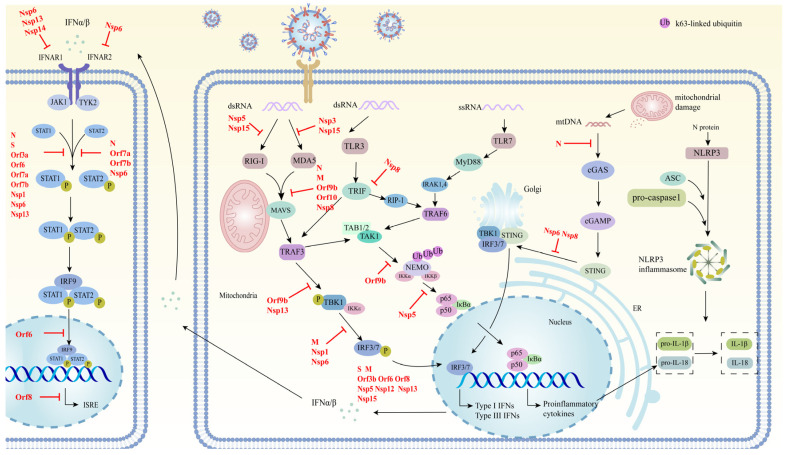
https://cdn.ncbi.nlm.nih.gov/pmc/blobs/942d/11677916/e2e3c0622550/pathogens-13-01117-g003.jpg
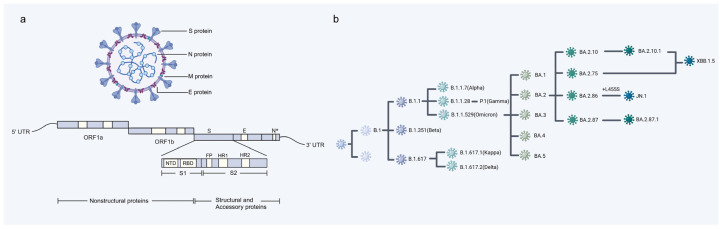
https://cdn.ncbi.nlm.nih.gov/pmc/blobs/942d/11677916/660de5419e24/pathogens-13-01117-g001.jpg
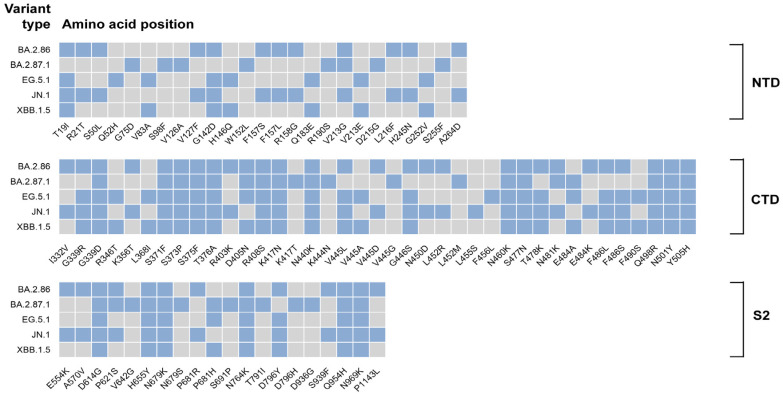
https://cdn.ncbi.nlm.nih.gov/pmc/blobs/942d/11677916/f7fb37cffac9/pathogens-13-01117-g002.jpg
https://cdn.ncbi.nlm.nih.gov/pmc/blobs/942d/11677916/e2e3c0622550/pathogens-13-01117-g003.jpg
https://cdn.ncbi.nlm.nih.gov/pmc/blobs/942d/11677916/660de5419e24/pathogens-13-01117-g001.jpg
https://cdn.ncbi.nlm.nih.gov/pmc/blobs/942d/11677916/f7fb37cffac9/pathogens-13-01117-g002.jpg
https://cdn.ncbi.nlm.nih.gov/pmc/blobs/942d/11677916/e2e3c0622550/pathogens-13-01117-g003.jpg

相似文献

1
Strategies Used by SARS-CoV-2 to Evade the Innate Immune System in an Evolutionary Perspective.从进化角度看,严重急性呼吸综合征冠状病毒2(SARS-CoV-2)逃避天然免疫系统的策略
Pathogens. 2024 Dec 17;13(12):1117. doi: 10.3390/pathogens13121117.
2
Antagonism of Type I Interferon by Severe Acute Respiratory Syndrome Coronavirus 2.严重急性呼吸综合征冠状病毒 2 型对 I 型干扰素的拮抗作用。
J Interferon Cytokine Res. 2020 Dec;40(12):543-548. doi: 10.1089/jir.2020.0214.
3
Innate immune evasion by SARS-CoV-2: Comparison with SARS-CoV.SARS-CoV-2 的先天免疫逃避:与 SARS-CoV 的比较。
Rev Med Virol. 2020 Nov;30(6):1-9. doi: 10.1002/rmv.2135. Epub 2020 Jul 30.
4
The battle between host and SARS-CoV-2: Innate immunity and viral evasion strategies.宿主与 SARS-CoV-2 的较量:固有免疫与病毒逃逸策略。
Mol Ther. 2022 May 4;30(5):1869-1884. doi: 10.1016/j.ymthe.2022.02.014. Epub 2022 Feb 14.
5
SARS-CoV-2-mediated evasion strategies for antiviral interferon pathways.SARS-CoV-2 介导的抗病毒干扰素途径的逃逸策略。
J Microbiol. 2022 Mar;60(3):290-299. doi: 10.1007/s12275-022-1525-1. Epub 2022 Feb 5.
6
An Update on Innate Immune Responses during SARS-CoV-2 Infection.关于 SARS-CoV-2 感染期间固有免疫反应的最新研究进展。
Viruses. 2021 Oct 14;13(10):2060. doi: 10.3390/v13102060.
7
Differences and similarities between innate immune evasion strategies of human coronaviruses.人类冠状病毒固有免疫逃避策略的异同。
Curr Opin Microbiol. 2024 Jun;79:102466. doi: 10.1016/j.mib.2024.102466. Epub 2024 Mar 30.
8
Human Nasal and Lung Tissues Infected with SARS-CoV-2 Provide Insights into Differential Tissue-Specific and Virus-Specific Innate Immune Responses in the Upper and Lower Respiratory Tract.人鼻腔和肺部组织感染 SARS-CoV-2 提供了在上呼吸道和下呼吸道中不同组织特异性和病毒特异性先天免疫反应的见解。
J Virol. 2021 Jun 24;95(14):e0013021. doi: 10.1128/JVI.00130-21.
9
Control of Innate Immune Activation by Severe Acute Respiratory Syndrome Coronavirus 2 and Other Coronaviruses.严重急性呼吸综合征冠状病毒 2 型和其他冠状病毒对固有免疫激活的控制。
J Interferon Cytokine Res. 2021 Jun;41(6):205-219. doi: 10.1089/jir.2021.0060.
10
Pressure to evade cell-autonomous innate sensing reveals interplay between mitophagy, IFN signaling, and SARS-CoV-2 evolution.逃避细胞自主天然感应的压力揭示了线粒体自噬、干扰素信号传导和新冠病毒进化之间的相互作用。
Cell Rep. 2025 Jan 28;44(1):115115. doi: 10.1016/j.celrep.2024.115115. Epub 2024 Dec 20.

引用本文的文献

1
The Clinical and Laboratory Landscape of COVID-19 During the Initial Period of the Pandemic and at the Beginning of the Omicron Era.新冠疫情初期及奥密克戎时代伊始时COVID-19的临床与实验室情况
Viruses. 2025 Mar 27;17(4):481. doi: 10.3390/v17040481.

本文引用的文献

1
A specific phosphorylation-dependent conformational switch in SARS-CoV-2 nucleocapsid protein inhibits RNA binding.SARS-CoV-2 核衣壳蛋白中特定的磷酸化依赖构象转换抑制 RNA 结合。
Sci Adv. 2024 Aug 2;10(31):eaax2323. doi: 10.1126/sciadv.aax2323.
2
SARS-CoV-2 nsp15 endoribonuclease antagonizes dsRNA-induced antiviral signaling.SARS-CoV-2 nsp15 内切核酸酶拮抗 dsRNA 诱导的抗病毒信号。
Proc Natl Acad Sci U S A. 2024 Apr 9;121(15):e2320194121. doi: 10.1073/pnas.2320194121. Epub 2024 Apr 3.
3
ACE2-dependent and -independent SARS-CoV-2 entries dictate viral replication and inflammatory response during infection.
ACE2 依赖性和非依赖性 SARS-CoV-2 进入决定了感染过程中的病毒复制和炎症反应。
Nat Cell Biol. 2024 Apr;26(4):628-644. doi: 10.1038/s41556-024-01388-w. Epub 2024 Mar 21.
4
Distinct evolution of SARS-CoV-2 Omicron XBB and BA.2.86/JN.1 lineages combining increased fitness and antibody evasion.奥密克戎 XBB 和 BA.2.86/JN.1 分支的 SARS-CoV-2 具有不同的进化特征,表现为适应性增强和抗体逃避能力提高。
Nat Commun. 2024 Mar 13;15(1):2254. doi: 10.1038/s41467-024-46490-7.
5
Evolution of enhanced innate immune suppression by SARS-CoV-2 Omicron subvariants.奥密克戎亚变种增强的先天免疫抑制作用的进化。
Nat Microbiol. 2024 Feb;9(2):451-463. doi: 10.1038/s41564-023-01588-4. Epub 2024 Jan 16.
6
Antiviral humoral immunity against SARS-CoV-2 omicron subvariants induced by XBB.1.5 monovalent vaccine in infection-naive and XBB-infected individuals.XBB.1.5单价疫苗在未感染过新冠病毒及感染过XBB的个体中诱导产生的针对新冠病毒奥密克戎亚变体的抗病毒体液免疫。
Lancet Infect Dis. 2024 Mar;24(3):e147-e148. doi: 10.1016/S1473-3099(23)00784-3. Epub 2024 Jan 8.
7
Virological characteristics of the SARS-CoV-2 JN.1 variant.严重急性呼吸综合征冠状病毒2 JN.1变体的病毒学特征。
Lancet Infect Dis. 2024 Feb;24(2):e82. doi: 10.1016/S1473-3099(23)00813-7. Epub 2024 Jan 3.
8
SARS-CoV-2 variants evolve convergent strategies to remodel the host response.SARS-CoV-2 变体进化出趋同策略来重塑宿主反应。
Cell. 2023 Oct 12;186(21):4597-4614.e26. doi: 10.1016/j.cell.2023.08.026. Epub 2023 Sep 21.
9
SARS-CoV-2 nonstructural protein 6 triggers endoplasmic reticulum stress-induced autophagy to degrade STING1.SARS-CoV-2 非结构蛋白 6 触发内质网应激诱导的自噬以降解 STING1。
Autophagy. 2023 Dec;19(12):3113-3131. doi: 10.1080/15548627.2023.2238579. Epub 2023 Jul 23.
10
SARS-CoV-2 nonstructural protein 6 from Alpha to Omicron: evolution of a transmembrane protein.SARS-CoV-2 的非结构蛋白 6 从 Alpha 到奥密克戎:一种跨膜蛋白的进化。
mBio. 2023 Aug 31;14(4):e0068823. doi: 10.1128/mbio.00688-23. Epub 2023 Jul 21.