Xu Shuhua, Ge Jingjun, Liu Xiaoli, He Qiyu, Xu Dongjin, Cao Weikang, Ding Junning, Kai Xinghua, Zhou Guoping
Department of Cardiothoracic Surgery, Dongtai Hospital of Traditional Chinese Medicine, Dongtai, China.
Department of Radiology Imaging, Dongtai Hospital of Traditional Chinese Medicine, Dongtai, China.
J Thorac Dis. 2023 May 30;15(5):2668-2679. doi: 10.21037/jtd-23-250. Epub 2023 May 24.
Invasive puncture biopsy is currently the main method of identifying benign and malignant pulmonary nodules (PNs). This study aimed to investigate the application effect of chest computed tomography (CT) images, tumor markers (TMs), and metabolomics in the identification of benign and malignant PNs (MPNs).
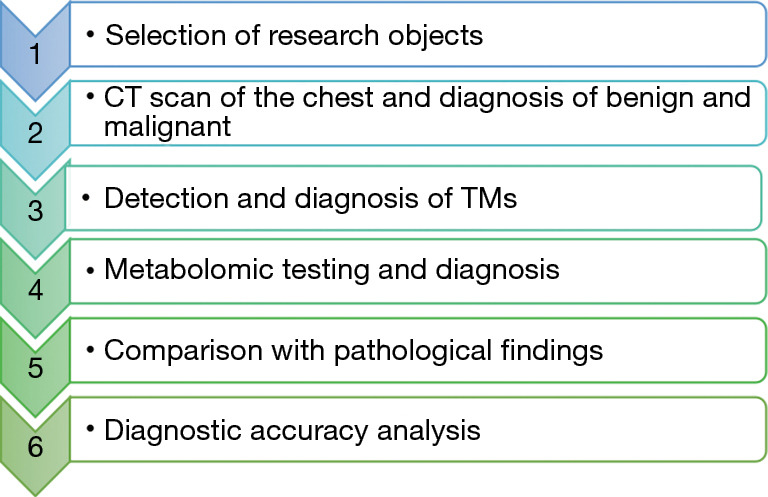
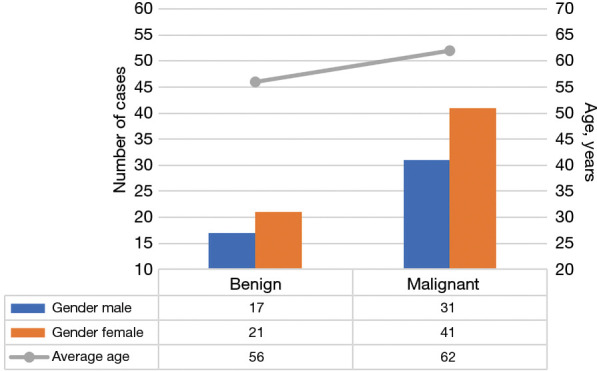
A total of 110 patients with PNs who were hospitalized in Dongtai Hospital of Traditional Chinese Medicine from March 2021 to March 2022 were selected as the study cohort. A retrospective analysis study of chest CT imaging, serum TMs testing, and plasma fatty acid (FA) metabolomics was performed on all participants.
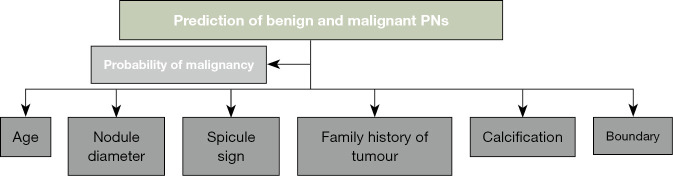
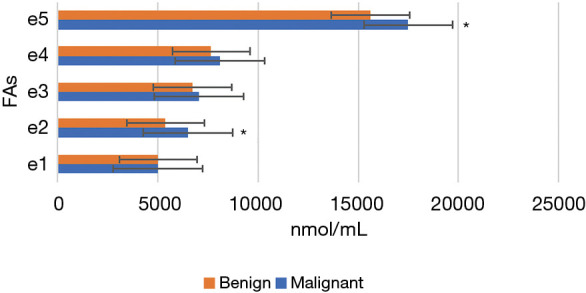
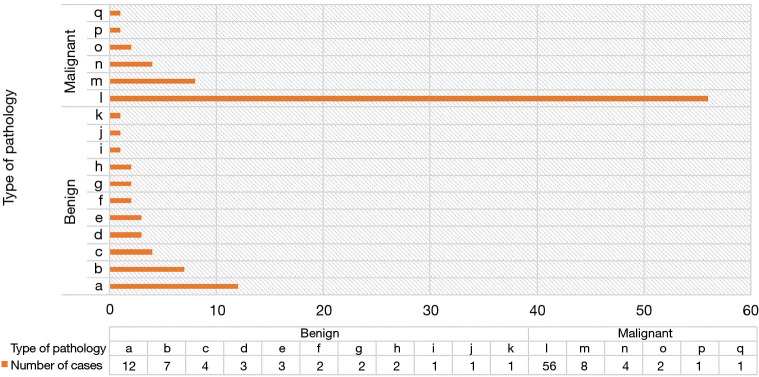
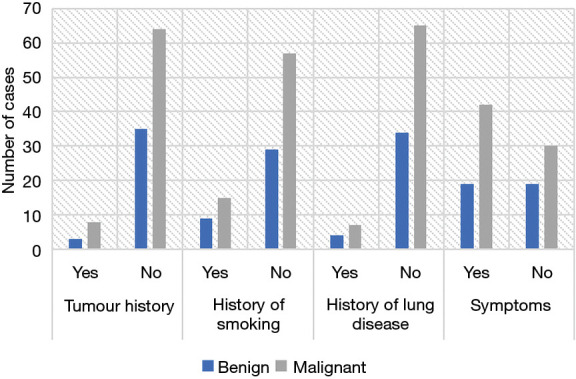
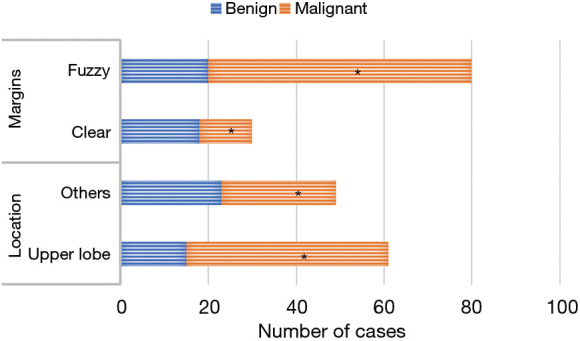
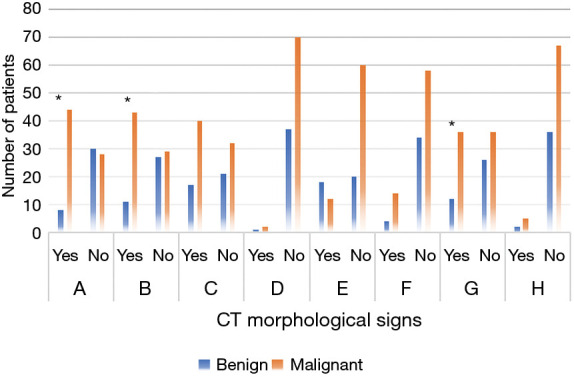
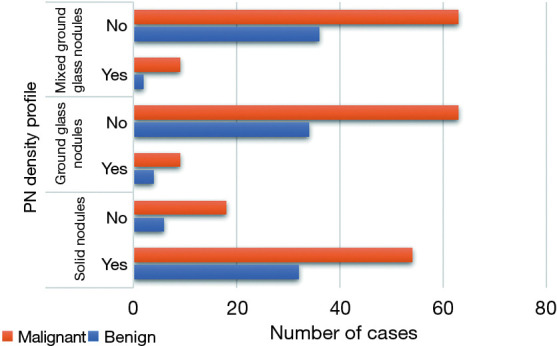
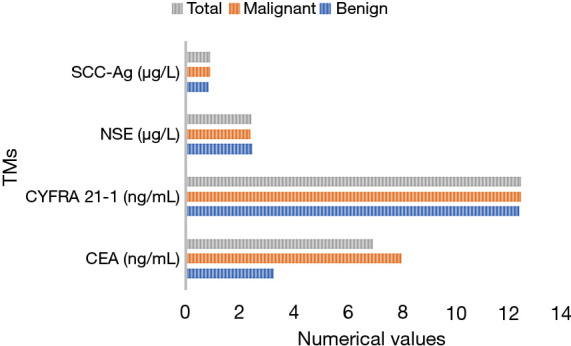
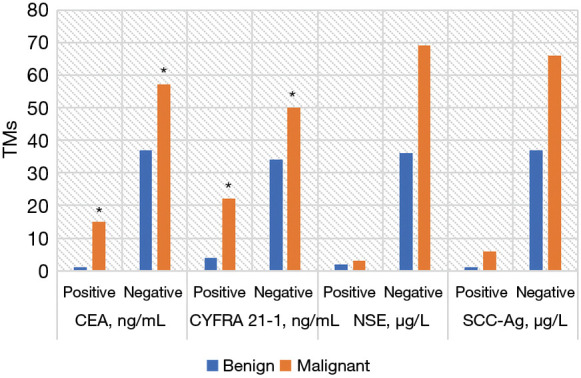
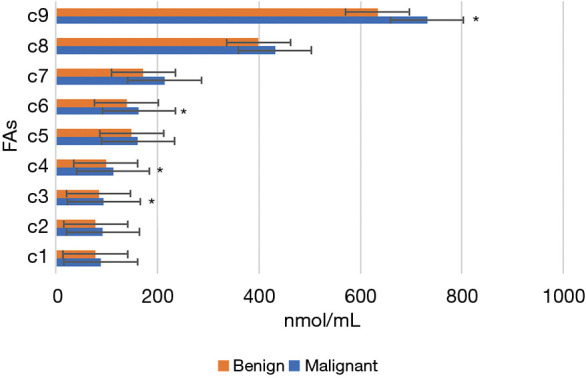
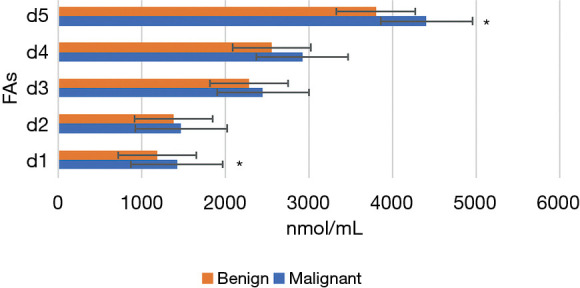
According to the pathological results, participants were divided into a MPN group (n=72) and a benign PN (BPN) group (n=38). The morphological signs of CT images, the levels and positive rate of serum TMs, and the plasma FA indicator were compared between groups. There were significant differences between the MPN group and the BPN group in the CT morphological signs, including location of PN and the number of patients with or without lobulation sign, spicule sign, and vessel convergence sign (P<0.05). Serum carcinoembryonic antigen (CEA), cytokeratin-19 fragment (CYFRA 21-1), neuron-specific enolase (NSE), and squamous cell carcinoma antigen (SCC-Ag) were not significantly different between the 2 groups. The serum contents of CEA and CYFRA 21-1 in the MPN group were remarkably higher than those in the BPN group (P<0.05). The plasma levels of palmitic acid, total omega-3 polyunsaturated FA (W3), nervonic acid, stearic acid, docosatetraenoic acid, linolenic acid, eicosapentaenoic acid, total saturated FA, and total FA were much higher in the MPN group than the BPN group (P<0.05).
In conclusion, chest CT images and TMs, combined with metabolomics, has a good application effect in the diagnosis of BPNs and MPNs, and is worthy of further promotion.
侵入性穿刺活检是目前鉴别肺结节(PNs)良恶性的主要方法。本研究旨在探讨胸部计算机断层扫描(CT)图像、肿瘤标志物(TMs)和代谢组学在鉴别良恶性PNs(MPNs)中的应用效果。
选取2021年3月至2022年3月在东台市中医院住院的110例PNs患者作为研究队列。对所有参与者进行胸部CT成像、血清TMs检测和血浆脂肪酸(FA)代谢组学的回顾性分析研究。
根据病理结果,参与者分为MPN组(n = 72)和良性PN(BPN)组(n = 38)。比较两组间CT图像的形态学征象、血清TMs水平及阳性率和血浆FA指标。MPN组和BPN组在CT形态学征象方面存在显著差异,包括PN的位置以及有或无分叶征、毛刺征和血管集束征的患者数量(P < 0.05)。两组间血清癌胚抗原(CEA)、细胞角蛋白19片段(CYFRA 21 - 1)、神经元特异性烯醇化酶(NSE)和鳞状细胞癌抗原(SCC - Ag)无显著差异。MPN组血清CEA和CYFRA 21 - 1含量明显高于BPN组(P < 0.05)。MPN组血浆棕榈酸、总ω - 3多不饱和脂肪酸(W3)、神经酸、硬脂酸、二十二碳四烯酸、亚麻酸、二十碳五烯酸、总饱和脂肪酸和总脂肪酸水平均显著高于BPN组(P < 0.05)。
总之,胸部CT图像和TMs,结合代谢组学,在BPNs和MPNs的诊断中具有良好的应用效果,值得进一步推广。