Barvaliya Manish J, Chetan A C, Chandan N, Ray Suman Kumar, Hegde Harsha V, Unger Banappa S, Patel Tejas K, Roy Subarna
ICMR-National Institute of Traditional Medicine, Belagavi, Karnataka, India.
Department of Pharmacology, All India Institute of Medical Sciences, Gorakhpur, Uttar Pradesh, India.
Front Pharmacol. 2023 May 30;14:1088841. doi: 10.3389/fphar.2023.1088841. eCollection 2023.
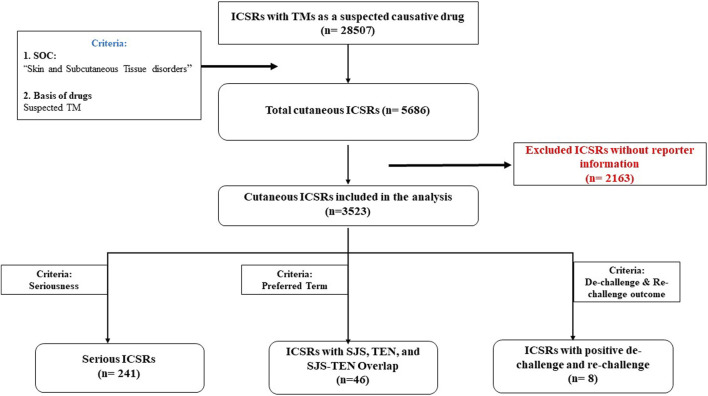
Data on traditional medicine-induced cutaneous adverse drug reactions (ADRs) is very scarce. The current secondary analysis based on the WHO database (VigiBase) of individual case safety reports (ICSRs) focuses on the suspected cutaneous ADRs linked to traditional medicines (TMs). All the ICSRs reported between 1st January 2016 and 30th June 2021 from the UN Asia region in VigiBase where at least one TM was suspected to cause cutaneous ADRs were included in the study. Data regarding demographic details, suspected drug, adverse reaction as per MedDRA term, the seriousness of the reaction, de-challenge, re-challenge, and clinical outcome for suspected cutaneous ADRs associated with TM were obtained from VigiBase and analyzed for frequency of reported events and suspected medicines. Total 3,523 ICSRs with 5,761 ADRs related to "skin and subcutaneous tissue disorders" were included in the analysis. Amongst these, 6.8% of ICSRs were reported as serious. Pruritus (29.6%), rash (20.3%), urticaria (18.9%), and hyperhidrosis (3.3%) were commonly reported ADRs. H.Lév. and Vaniot. (14.9%), L. (5.1%), L. (4%), L. (3.8%), (L.), Gaertn (3.5%), and L. (2.7%) were some commonly suspected TMs for cutaneous ADRs. There were 46 cases of Stevens-Johnson syndrome and toxic epidermal necrolysis reported with TMs during the study period. Death was reported in 5 ICSRs. TMs are linked with various cutaneous ADRS ranging from pruritus to toxic epidermal necrolysis which may have serious consequences. TMs listed as suspected offending agents in this analysis, should be kept in mind while dealing with suspected cutaneous ADRs. Clinicians should be more vigilant in detecting and reporting events associated with TMs.
关于传统药物引起的皮肤药物不良反应(ADR)的数据非常稀少。当前基于世界卫生组织数据库(VigiBase)中个体病例安全报告(ICSR)的二次分析聚焦于与传统药物(TM)相关的疑似皮肤ADR。本研究纳入了2016年1月1日至2021年6月30日期间在VigiBase中报告的、来自联合国亚洲区域且至少有一种TM被怀疑导致皮肤ADR的所有ICSR。从VigiBase获取了与TM相关的疑似皮肤ADR的人口统计学细节、疑似药物、根据MedDRA术语的不良反应、反应的严重程度、撤药、再激发以及临床结局等数据,并对报告事件和疑似药物的频率进行了分析。分析共纳入了3523份与“皮肤和皮下组织疾病”相关的5761例ADR的ICSR。其中,6.8%的ICSR报告为严重不良反应。瘙痒(29.6%)、皮疹(20.3%)、荨麻疹(1