Choi Yujin, Shin Hyeun-Kyoo
KM Science Research Division, Korea Institute of Oriental Medicine, Daejeon, Republic of Korea.
Front Pharmacol. 2024 Oct 21;15:1378208. doi: 10.3389/fphar.2024.1378208. eCollection 2024.
Systematic collection of diverse adverse events during herbal medicine administration is crucial. The Korea Adverse Event Reporting System (KAERS) compiles spontaneously reported adverse event data for medicinal products including herbal medicines. This study focused on extracting and analyzing adverse event data specifically related to herbal medicine products from the KAERS database.
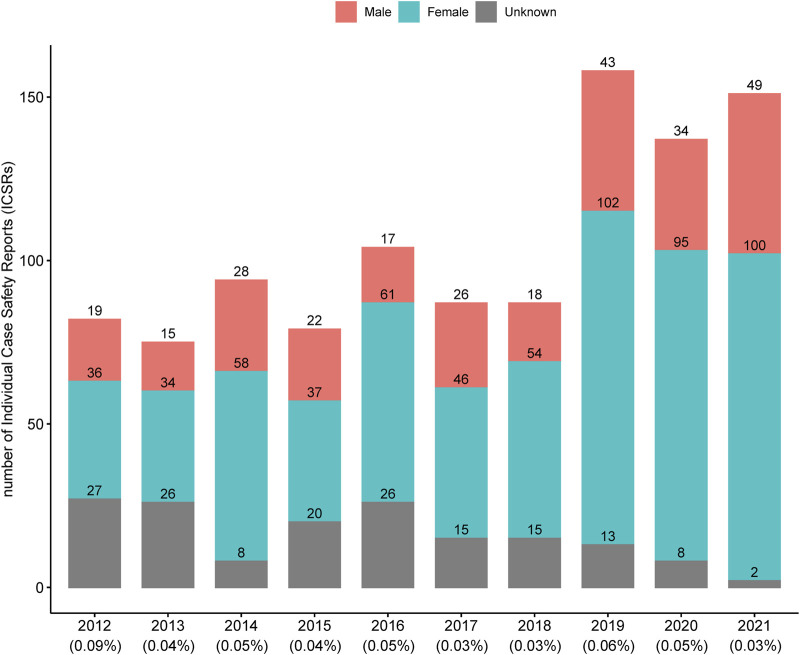
Individual case safety reports (ICSRs) encompassing 84 types of herbal medicine products, identified by item codes from 2012 to 2021, were extracted from the KAERS database. Descriptive statistics were employed to analyze the characteristics of the extracted reports, and adverse event information was systematically categorized and analyzed based on the MedDRA System Organ Class and preferred term classification.
In total, 1,054 ICSRs were extracted, with some documenting multiple adverse events in a single ICSR, resulting in 1,629 extracted adverse events. When categorized by the MedDRA System Organ Class, gastrointestinal disorders were the most prevalent (28.7%), followed by skin and subcutaneous tissue disorders (20.1%). Based on the preferred terms, the most frequently reported adverse events were diarrhea (5.8%), urticaria (5.3%), pruritus (4.7%), rash (4.4%), and abdominal discomfort (4.2%). The most frequently reported herbal medicines were Bangpungtongseong-san (297 cases), Kyeongok-go (144 cases), and Eunkyo-san (108 cases).
Spontaneously reported adverse events associated with herbal medicine products were systematically documented using the KAERS database. This study, which focused on voluntarily reported adverse reactions, underscores the need for additional research to estimate the incidence rate of adverse events and assess causality.
系统收集草药给药过程中的各种不良事件至关重要。韩国不良事件报告系统(KAERS)汇编了包括草药在内的药品自发报告的不良事件数据。本研究重点从KAERS数据库中提取和分析与草药产品具体相关的不良事件数据。
从KAERS数据库中提取2012年至2021年通过项目代码识别的涵盖84种草药产品的个体病例安全报告(ICSR)。采用描述性统计分析提取报告的特征,并根据MedDRA系统器官分类和首选术语分类对不良事件信息进行系统分类和分析。
共提取了1054份ICSR,有些在一份ICSR中记录了多个不良事件,导致提取出1629起不良事件。按MedDRA系统器官分类,胃肠道疾病最为常见(28.7%),其次是皮肤和皮下组织疾病(20.1%)。根据首选术语,报告最频繁的不良事件是腹泻(5.8%)、荨麻疹(5.3%)、瘙痒(4.7%)、皮疹(4.4%)和腹部不适(4.2%)。报告最频繁的草药是防风通圣散(297例)、青龙散(144例)和恩教散(108例)。
利用KAERS数据库系统记录了与草药产品相关的自发报告不良事件。本研究聚焦于自愿报告的不良反应,强调需要进一步研究以估计不良事件的发生率并评估因果关系。