Moschovis Peter P, Lombay Jesiel, Rooney Jennifer, Schenkel Sara R, Singh Dilpreet, Rezaei Shawheen J, Salo Nora, Gong Amanda, Yonker Lael M, Shah Jhill, Hayden Douglas, Hibberd Patricia L, Demokritou Philip, Kinane T Bernard
Department of Pediatrics Massachusetts General Hospital and Harvard Medical School Boston Massachusetts USA.
Department of Environmental Health Harvard T. H. Chan School of Public Health Boston Massachusetts USA.
Pediatr Investig. 2023 May 3;7(2):75-85. doi: 10.1002/ped4.12376. eCollection 2023 Jun.
Despite the high burden of respiratory infections among children, the production of exhaled particles during common activities and the efficacy of face masks in children have not been sufficiently studied.
To determine the effect of type of activity and mask usage on exhaled particle production in children.
Healthy children were asked to perform activities that ranged in intensity (breathing quietly, speaking, singing, coughing, and sneezing) while wearing no mask, a cloth mask, or a surgical mask. The concentration and size of exhaled particles were assessed during each activity.
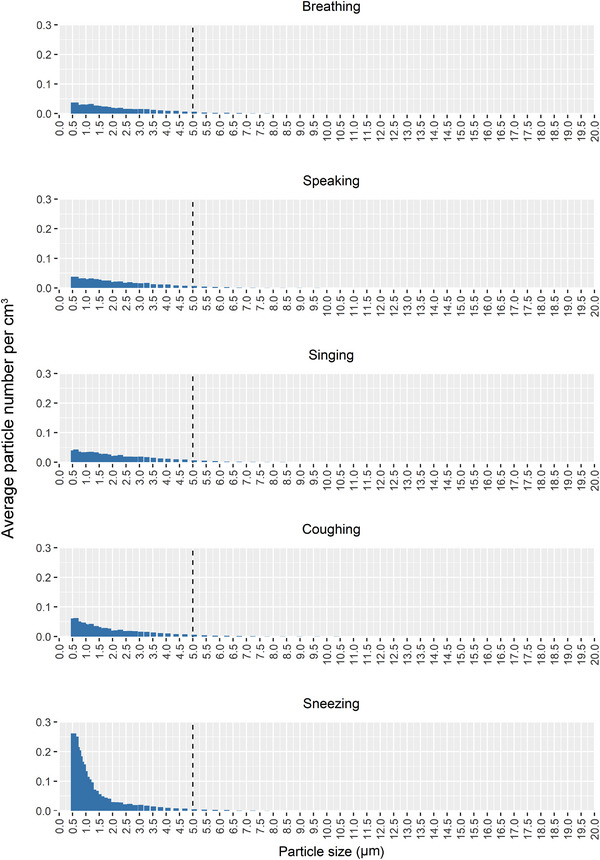
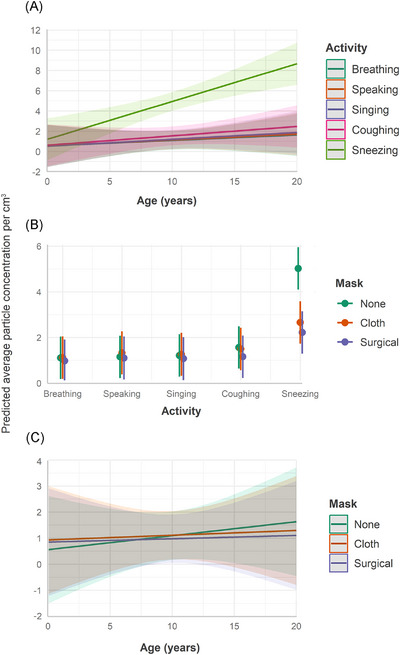
Twenty-three children were enrolled in the study. Average exhaled particle concentration increased by intensity of activity, with the lowest particle concentration during tidal breathing (1.285 particles/cm [95% CI 0.943, 1.627]) and highest particle concentration during sneezing (5.183 particles/cm [95% CI 1.911, 8.455]). High-intensity activities were associated with an increase primarily in the respirable size (≤ 5 µm) particle fraction. Surgical and cloth masks were associated with lower average particle concentration compared to no mask ( = 0.026 for sneezing). Surgical masks outperformed cloth masks across all activities, especially within the respirable size fraction. In a multivariable linear regression model, we observed significant effect modification of activity by age and by mask type.
Similar to adults, children produce exhaled particles that vary in size and concentration across a range of activities. Production of respirable size fraction particles (≤ 5 µm), the dominant mode of transmission of many respiratory viruses, increases significantly with coughing and sneezing and is most effectively reduced by wearing surgical face masks.
尽管儿童呼吸道感染负担沉重,但常见活动期间呼出颗粒的产生情况以及儿童佩戴口罩的效果尚未得到充分研究。
确定活动类型和口罩使用对儿童呼出颗粒产生的影响。
要求健康儿童在不戴口罩、戴布口罩或戴外科口罩的情况下进行强度不同的活动(安静呼吸、说话、唱歌、咳嗽和打喷嚏)。在每项活动期间评估呼出颗粒的浓度和大小。
23名儿童参与了该研究。呼出颗粒的平均浓度随活动强度增加而升高,潮气呼吸时颗粒浓度最低(1.285颗粒/立方厘米[95%置信区间0.943, 1.627]),打喷嚏时颗粒浓度最高(5.183颗粒/立方厘米[95%置信区间1.911, 8.455])。高强度活动主要与可吸入大小(≤5微米)的颗粒分数增加有关。与不戴口罩相比,外科口罩和布口罩与较低的平均颗粒浓度相关(打喷嚏时P = 0.026)。在所有活动中,外科口罩的表现均优于布口罩,尤其是在可吸入大小分数范围内。在多变量线性回归模型中,我们观察到年龄和口罩类型对活动有显著的效应修正作用。
与成年人相似,儿童在一系列活动中会产生大小和浓度各异的呼出颗粒。许多呼吸道病毒的主要传播方式——可吸入大小分数颗粒(≤5微米)的产生,在咳嗽和打喷嚏时会显著增加,而佩戴外科口罩能最有效地减少这种情况。