Capriotti Luca, Ricci Angela, Molesini Barbara, Mezzetti Bruno, Pandolfini Tiziana, Piunti Irene, Sabbadini Silvia
Department of Agricultural, Food and Environmental Sciences, Marche Polytechnic University, Ancona, Italy.
Department of Biotechnology, University of Verona, Verona, Italy.
Front Plant Sci. 2023 May 31;14:1172758. doi: 10.3389/fpls.2023.1172758. eCollection 2023.
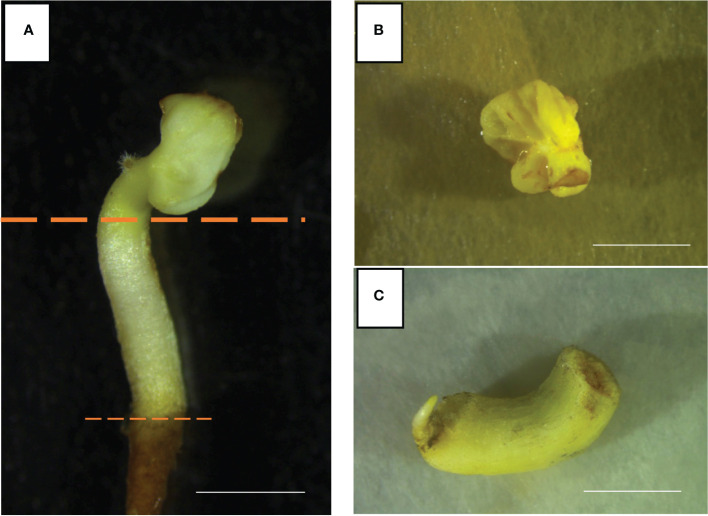
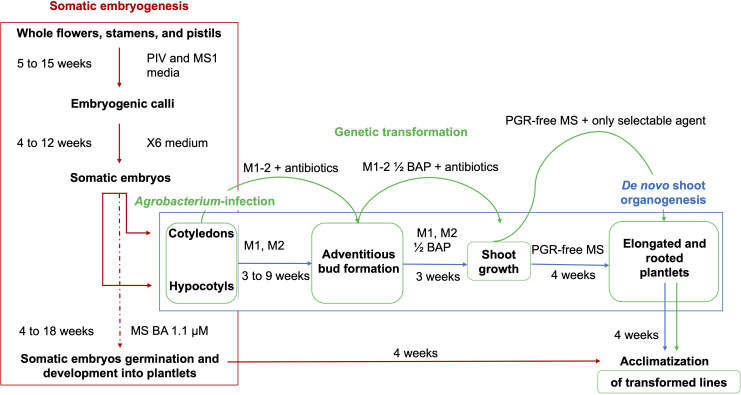
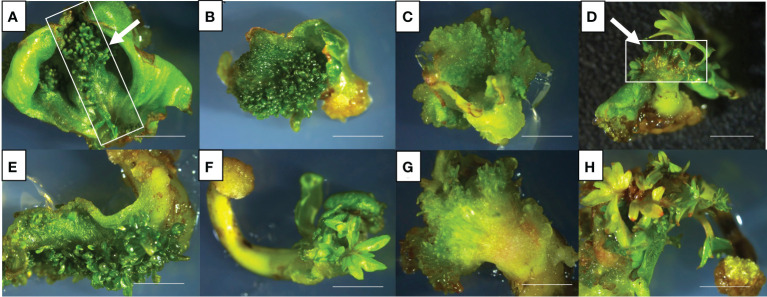
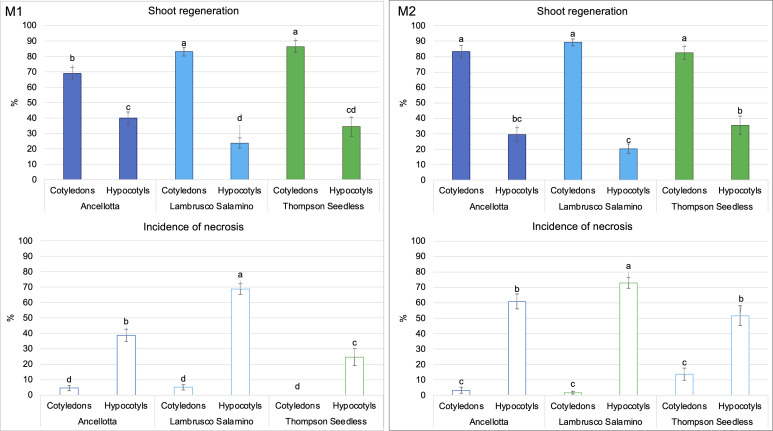
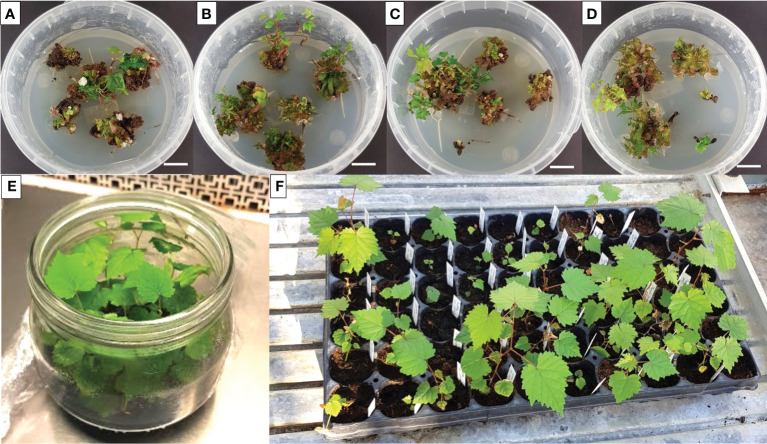
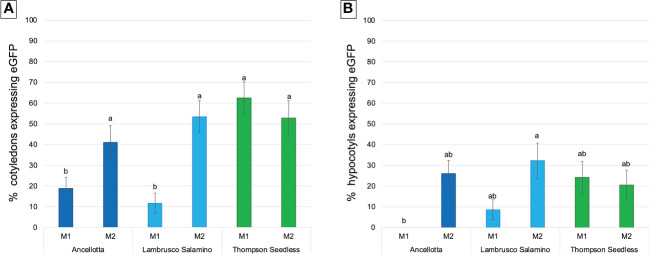
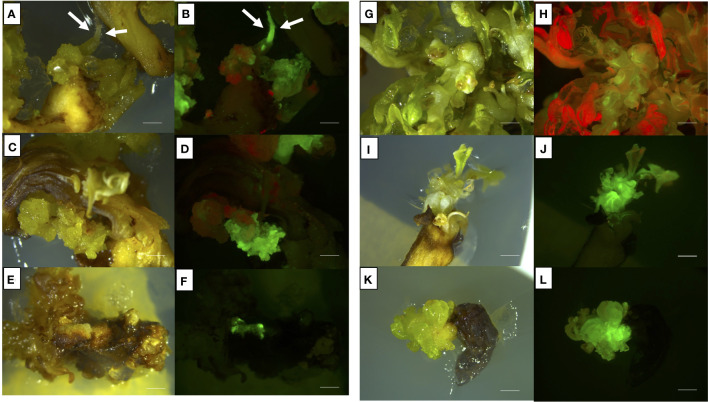
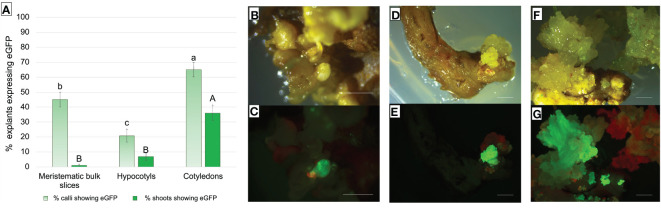
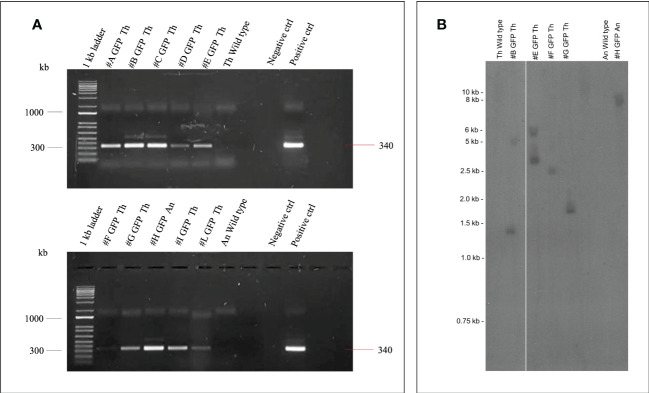
Plant genetic transformation is a powerful tool that can facilitate breeding programs for disease tolerance, abiotic stress, fruit production, and quality by preserving the characteristics of fruit tree elite genotypes. However, most grapevine cultivars worldwide are considered recalcitrant, and most available genetic transformation protocols involve regeneration by somatic embryogenesis, which often requires the continuous production of new embryogenic calli. Cotyledons and hypocotyls derived from flower-induced somatic embryos of the Vitis vinifera cultivars Ancellotta and Lambrusco Salamino, in comparison with the model cultivar Thompson Seedless, are here validated for the first time as starting explants for regeneration and transformation trials. Explants were cultured on two different MS-based culture media, one having a combination of 4.4 µM BAP and 0.49 µM IBA (M1), and the other only supplemented with 13.2 µM BAP (M2). The competence to regenerate adventitious shoots was higher in cotyledons than in hypocotyls on both M1 and M2. M2 medium increased significantly the average number of shoots only in Thompson Seedless somatic embryo-derived explants. This efficient regeneration strategy, that proposes a combination of somatic embryogenesis and organogenesis, has been successfully exploited in genetic engineering experiments. Ancellotta and Lambrusco Salamino cotyledons and hypocotyls produced the highest number of calli expressing eGFP when cultured on M2 medium, while for Thompson Seedless both media tested were highly efficient. The regeneration of independent transgenic lines of Thompson Seedless was observed from cotyledons cultured on both M1 and M2 with a transformation efficiency of 12 and 14%, respectively, and from hypocotyls on M1 and M2 with a transformation efficiency of 6 and 12%, respectively. A single eGFP fluorescent adventitious shoot derived from cotyledons cultured on M2 was obtained for Ancellotta, while Lambrusco Salamino showed no regeneration of transformed shoots. In a second set of experiments, using Thompson Seedless as the model cultivar, we observed that the highest number of transformed shoots was obtained from cotyledons explants, followed by hypocotyls and meristematic bulk slices, confirming the high regeneration/transformation competences of somatic embryo-derived cotyledons. The independent transformed shoots obtained from the cultivars Thompson Seedless and Ancellotta were successfully acclimatized in the greenhouse and showed a true-to-type phenotype. The novel regeneration and genetic transformation protocols optimized in this study will be useful for the application of new and emerging modern biotechnologies also to other recalcitrant grapevine genotypes.
植物遗传转化是一种强大的工具,通过保留果树优良基因型的特征,可促进抗病性、非生物胁迫、果实产量和品质方面的育种计划。然而,全球大多数葡萄品种被认为是顽拗型的,现有的大多数遗传转化方案都涉及体细胞胚胎发生再生,这通常需要持续产生新的胚性愈伤组织。首次验证了葡萄品种安切洛塔(Ancellotta)和萨拉米诺蓝布鲁斯科(Lambrusco Salamino)花诱导体细胞胚胎衍生的子叶和下胚轴,与模式品种无核白(Thompson Seedless)相比,可作为再生和转化试验的起始外植体。外植体在两种不同的基于MS的培养基上培养,一种含有4.4 μM 苄氨基嘌呤(BAP)和0.49 μM 吲哚丁酸(IBA)的组合(M1),另一种仅添加13.2 μM BAP(M2)。在M1和M2上,子叶再生不定芽的能力均高于下胚轴。M2培养基仅在无核白体细胞胚胎衍生的外植体中显著增加了平均芽数。这种将体细胞胚胎发生和器官发生相结合的高效再生策略已在基因工程实验中成功应用。当在M2培养基上培养时,安切洛塔和萨拉米诺蓝布鲁斯科的子叶和下胚轴产生表达增强绿色荧光蛋白(eGFP)的愈伤组织数量最多,而对于无核白,所测试的两种培养基都非常高效。从在M1和M2上培养的子叶中观察到无核白独立转基因系的再生,转化效率分别为12%和14%,从在M1和M2上培养的下胚轴中再生,转化效率分别为6%和12%。从在M2上培养的子叶中获得了安切洛塔的单个eGFP荧光不定芽,而萨拉米诺蓝布鲁斯科未显示转化芽的再生。在第二组实验中,以无核白为模式品种,我们观察到从子叶外植体获得的转化芽数量最多,其次是下胚轴和分生组织块切片,证实了体细胞胚胎衍生子叶的高再生/转化能力。从无核白和安切洛塔品种获得的独立转化芽在温室中成功驯化,并表现出典型的表型。本研究中优化的新型再生和遗传转化方案将有助于将新兴的现代生物技术应用于其他顽拗型葡萄基因型。