Division of Gynecologic Oncology, Department of Obstetrics and Gynecology, University of Southern California, Los Angeles.
Norris Comprehensive Cancer Center, University of Southern California, Los Angeles.
JAMA Netw Open. 2023 Jun 1;6(6):e2318602. doi: 10.1001/jamanetworkopen.2023.18602.
Randomized clinical trials examining the effectiveness of neoadjuvant chemotherapy (NACT) for advanced ovarian cancer predominantly included patients with high-grade serous carcinomas. The use and outcomes of NACT in less common epithelial carcinomas are understudied.
To investigate the uptake and survival outcomes in treatment with NACT for less common histologic subtypes of epithelial ovarian cancer.
DESIGN, SETTING, AND PARTICIPANTS: A retrospective cohort study and systematic literature review with meta-analysis was conducted using the National Cancer Database from 2006 to 2017 and the National Cancer Institute's Surveillance, Epidemiology, and End Results Program from 2006 to 2019. Data analysis was performed from July 2022 to April 2023. The evaluation included patients with stage III to IV ovarian cancer with clear cell, mucinous, or low-grade serous histologic subtypes who received multimodal treatment with surgery and chemotherapy.
Exposure assignment per the sequence of treatment: primary debulking surgery (PDS) followed by chemotherapy (PDS group) or NACT followed by interval surgery (NACT group).
Temporal trends and characteristics of NACT use were assessed using multivariable analysis, and overall survival (OS) was assessed with the inverse probability of treatment weighting propensity score.
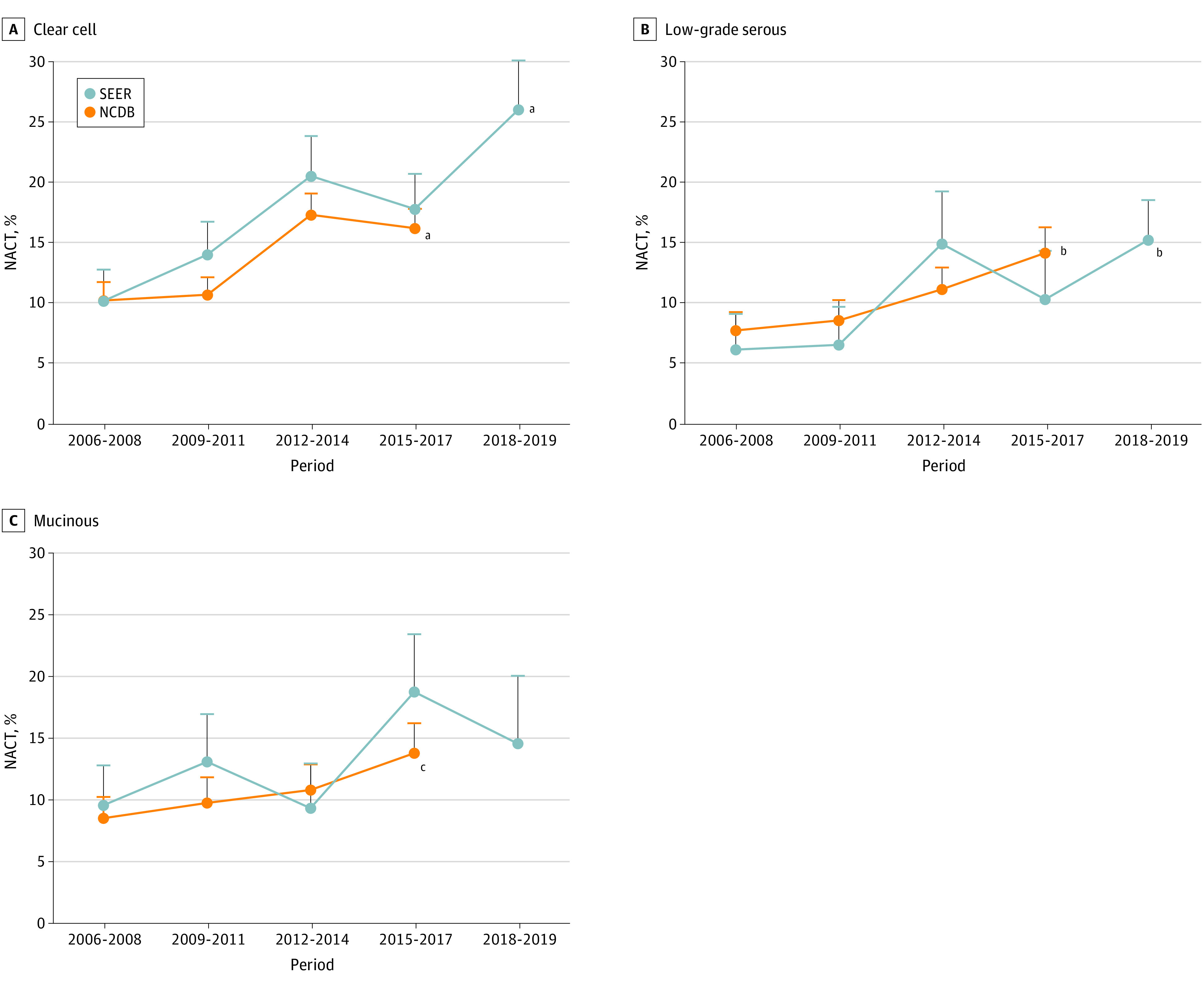
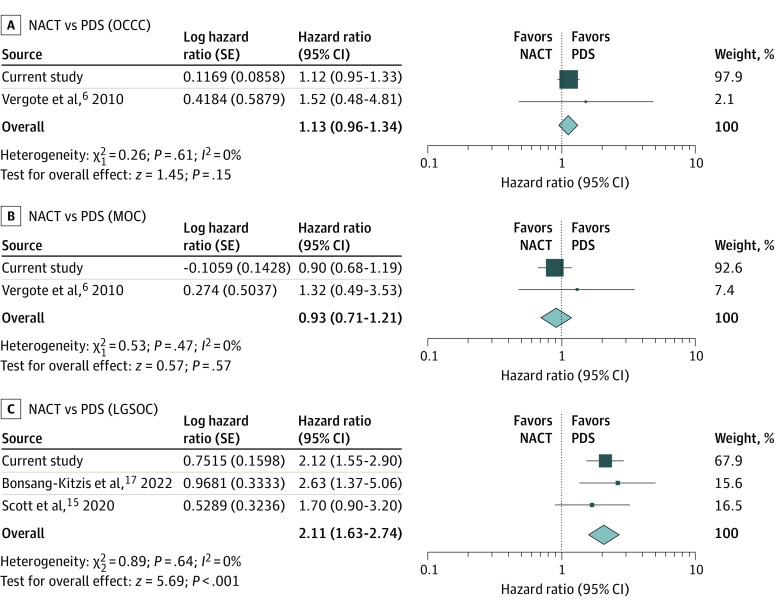
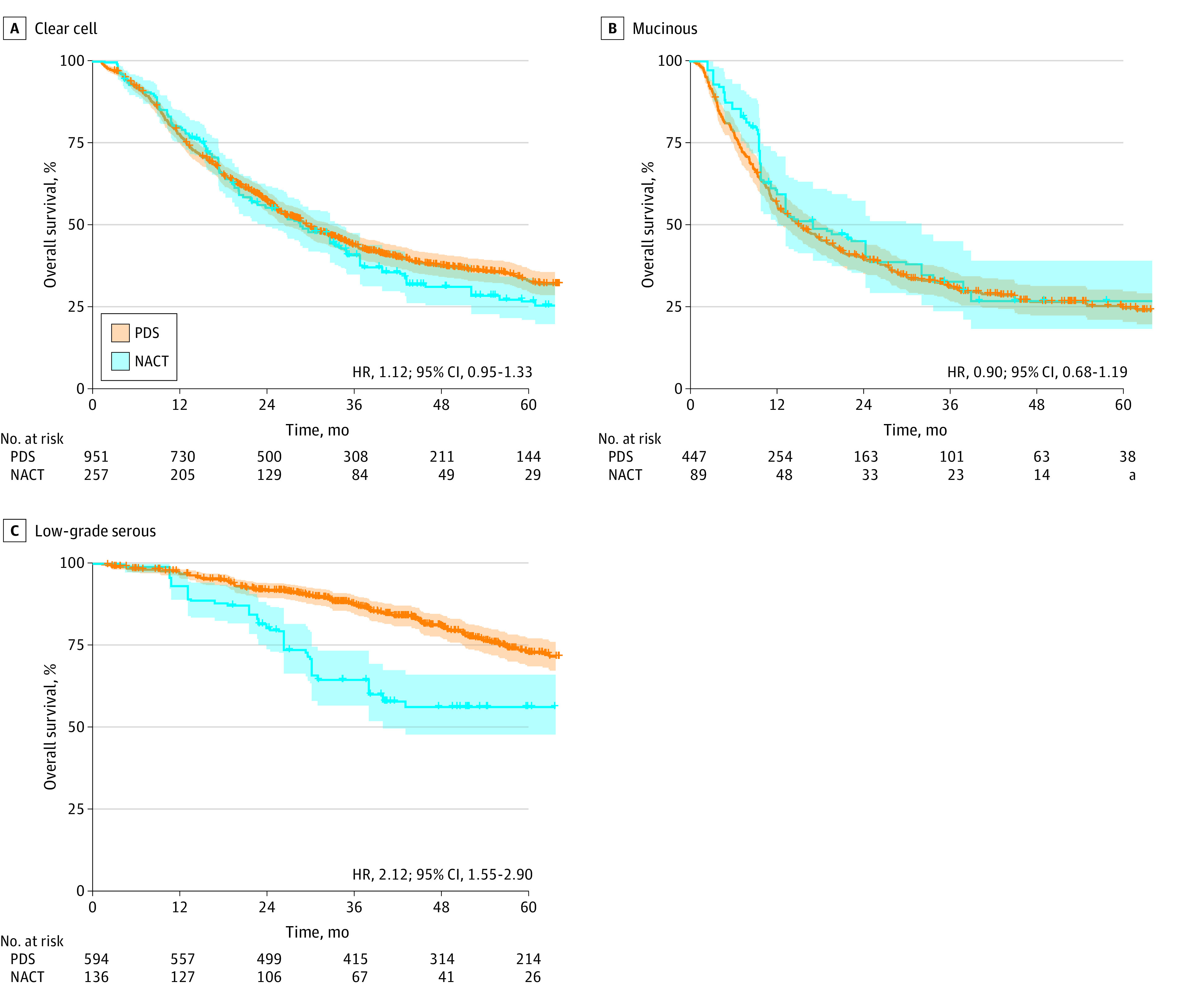
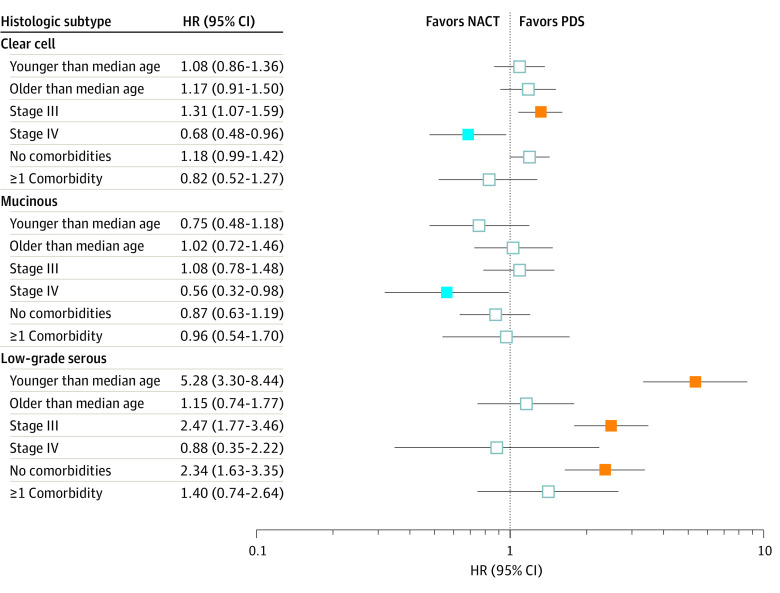
A total of 3880 patients were examined in the National Cancer Database including 1829 women (median age, 56 [IQR, 49-63] years) with clear cell, 1156 women (median age, 53 [IQR, 42-64] years) with low-grade serous, and 895 women (median age, 57 [IQR, 48-66] years) with mucinous carcinomas. NACT use increased in patients with clear cell (from 10.2% to 16.2%, 58.8% relative increase; P < .001 for trend) or low-grade serous (from 7.7% to 14.2%, 84.4% relative increase; P = .007 for trend) carcinoma during the study period. This association remained consistent in multivariable analysis. NACT use also increased, but nonsignificantly, in mucinous carcinomas (from 8.6% to 13.9%, 61.6% relative increase; P = .07 for trend). Across the 3 histologic subtypes, older age and stage IV disease were independently associated with NACT use. In a propensity score-weighted model, the NACT and PDS groups had comparable OS for clear cell (4-year rates, 31.4% vs 37.7%; hazard ratio [HR], 1.12; 95% CI, 0.95-1.33) and mucinous (27.0% vs 26.7%; HR, 0.90; 95% CI, 0.68-1.19) carcinomas. For patients with low-grade serous carcinoma, NACT was associated with decreased OS compared with PDS (4-year rates, 56.4% vs 81.0%; HR, 2.12; 95% CI, 1.55-2.90). Increasing NACT use and histologic subtype-specific survival association were also found in the Surveillance, Epidemiology, and End Results Program cohort (n = 1447). A meta-analysis of 4 studies, including the current study, observed similar OS associations for clear cell (HR, 1.13; 95% CI, 0.96-1.34; 2 studies), mucinous (HR, 0.93; 95% CI, 0.71-1.21; 2 studies), and low-grade serous (HR, 2.11; 95% CI, 1.63-2.74; 3 studies) carcinomas.
Despite the lack of data on outcomes of NACT among patients with less common carcinomas, this study noted that NACT use for advanced disease has gradually increased in the US. Primary chemotherapy for advanced-stage, low-grade serous ovarian cancer may be associated with worse survival compared with PDS.
评估新辅助化疗 (NACT) 对高级卵巢癌有效性的随机临床试验主要纳入了高级别浆液性癌患者。较少见的上皮性癌的 NACT 使用情况和结果研究较少。
研究较少见组织学亚型上皮性卵巢癌接受 NACT 治疗的使用率和生存结局。
设计、设置和参与者: 本研究为回顾性队列研究和系统文献综述,使用了 2006 年至 2017 年期间的国家癌症数据库和 2006 年至 2019 年期间的国家癌症研究所监测、流行病学和最终结果计划,数据分析于 2022 年 7 月至 2023 年 4 月进行。评估包括患有 III 期至 IV 期卵巢癌且组织学类型为透明细胞、黏液或低级别浆液性的患者,这些患者接受了手术和化疗的多模态治疗。
按治疗顺序进行暴露分配:初次肿瘤细胞减灭术(PDS)加化疗(PDS 组)或新辅助化疗加间隔手术(NACT 组)。
使用多变量分析评估 NACT 使用的时间趋势和特征,并使用逆概率治疗加权倾向评分评估总生存(OS)。
在国家癌症数据库中检查了 3880 名患者,包括 1829 名透明细胞癌患者(中位年龄,56 [IQR,49-63] 岁)、1156 名低级别浆液性癌患者(中位年龄,53 [IQR,42-64] 岁)和 895 名黏液性癌患者(中位年龄,57 [IQR,48-66] 岁)。透明细胞癌(从 10.2%增加到 16.2%,相对增加 58.8%;趋势 P <.001)或低级别浆液性癌(从 7.7%增加到 14.2%,相对增加 84.4%;趋势 P =.007)患者的 NACT 使用有所增加。在多变量分析中,这种关联仍然一致。NACT 的使用也有所增加,但在黏液性癌中无统计学意义(从 8.6%增加到 13.9%,相对增加 61.6%;趋势 P =.07)。在这 3 种组织学类型中,年龄较大和 IV 期疾病与 NACT 的使用独立相关。在倾向评分加权模型中,NACT 组和 PDS 组的透明细胞癌(4 年生存率,31.4% vs 37.7%;危险比 [HR],1.12;95%CI,0.95-1.33)和黏液性癌(27.0% vs 26.7%;HR,0.90;95%CI,0.68-1.19)的 OS 相当。对于低级别浆液性癌患者,与 PDS 相比,NACT 与降低的 OS 相关(4 年生存率,56.4% vs 81.0%;HR,2.12;95%CI,1.55-2.90)。在 Surveillance,Epidemiology,and End Results Program 队列中也发现了 NACT 使用增加与组织学亚型特异性生存的关联(n=1447)。包括本研究在内的 4 项研究的荟萃分析观察到透明细胞癌(HR,1.13;95%CI,0.96-1.34;2 项研究)、黏液性癌(HR,0.93;95%CI,0.71-1.21;2 项研究)和低级别浆液性癌(HR,2.11;95%CI,1.63-2.74;3 项研究)的 OS 关联相似。
尽管缺乏 NACT 在少见癌患者中结局的数据,但本研究指出,美国对晚期疾病的 NACT 使用已逐渐增加。与 PDS 相比,晚期低级别浆液性卵巢癌的一线化疗可能与生存较差相关。