Center for Plant Science and Biodiversity, University of Swat, Charbagh Swat, 19120, Pakistan.
Department of Genetics and Development, Columbia University Irving Medical Center, New York, NY, 10032, USA.
BMC Plant Biol. 2023 Jun 19;23(1):326. doi: 10.1186/s12870-023-04278-9.
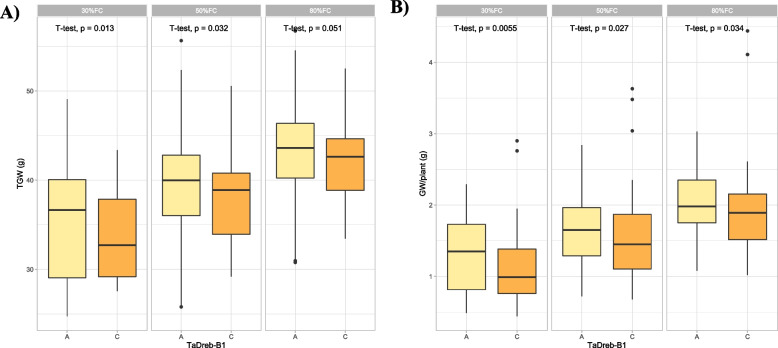
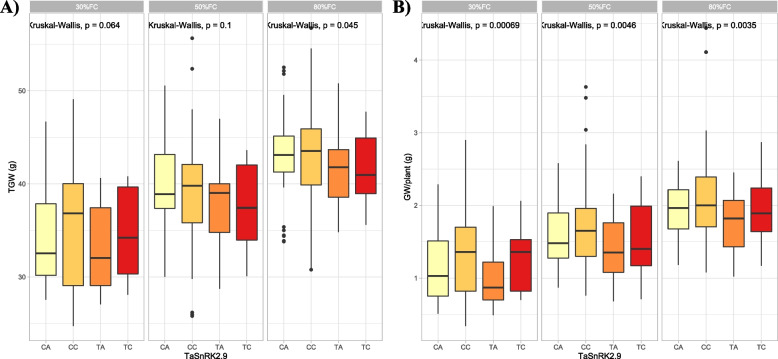
Drought is one of the most important wheat production limiting factor, and can lead to severe yield losses. This study was designed to examine the effect of drought stress on wheat physiology and morphology under three different field capacities (FC) viz. 80% (control), 50% (moderate) and 30% (severe drought stress) in a diverse collection of wheat germplasm including cultivars, landraces, synthetic hexaploid and their derivatives. Traits like grain weight, thousand grain weight and biomass were reduced by 38.23%, 18.91% and 26.47% respectively at 30% FC, whereas the reduction rate for these traits at 50% FC were 19.57%, 8.88% and 18.68%. In principal component analysis (PCA), the first two components PC1 and PC2 accounted for 58.63% of the total variation and separated the cultivars and landraces from synthetic-based germplasm. Landraces showed wide range of phenotypic variations at 30% FC compared to synthetic-based germplasm and improved cultivars. However, least reduction in grain weight was observed in improved cultivars which indicated the progress in developing drought resilient cultivars. Allelic variations of the drought-related genes including TaSnRK2.9-5A, TaLTPs-11, TaLTPs-12, TaSAP-7B-, TaPPH-13, Dreb-B1 and 1fehw3 were significantly associated with the phenological traits under drought stress in all 91 wheats including 40 landraces, 9 varieties, 34 synthetic hexaploids and 8 synthetic derivatives. The favorable haplotypes of 1fehw3, Dreb-B1, TaLTPs-11 and TaLTPs-12 increased grain weight, and biomass. Our results iterated the fact that landraces could be promising source to deploy drought adaptability in wheat breeding. The study further identified drought tolerant wheat genetic resources across various backgrounds and identified favourable haplotypes of water-saving genes which should be considered to develop drought tolerant varieties.
干旱是影响小麦产量的最重要因素之一,会导致严重的减产。本研究旨在探讨在不同田间持水量(FC)下,即 80%(对照)、50%(中度)和 30%(严重干旱胁迫),对小麦生理和形态的影响。在包括品种、地方品种、合成六倍体及其衍生物在内的小麦种质资源中,发现粒重、千粒重和生物量分别减少了 38.23%、18.91%和 26.47%,而在 50%FC 下,这些性状的减少率分别为 19.57%、8.88%和 18.68%。主成分分析(PCA)结果表明,前两个主成分 PC1 和 PC2 占总变异的 58.63%,将品种和地方品种与基于合成的种质资源区分开来。与基于合成的种质资源和改良品种相比,地方品种在 30%FC 下表现出广泛的表型变异。然而,改良品种的粒重减少最少,这表明在培育耐旱品种方面取得了进展。在包括 40 个地方品种、9 个品种、34 个合成六倍体和 8 个合成衍生品种在内的 91 个小麦中,TaSnRK2.9-5A、TaLTPs-11、TaLTPs-12、TaSAP-7B-、TaPPH-13、Dreb-B1 和 1fehw3 等与干旱胁迫下的物候性状显著相关。在所有 91 个小麦中,1fehw3、Dreb-B1、TaLTPs-11 和 TaLTPs-12 的有利单倍型增加了粒重和生物量。研究结果表明,地方品种可能是在小麦育种中部署耐旱性的有前途的来源。研究进一步鉴定了不同背景下具有耐旱性的小麦遗传资源,并鉴定了节水基因的有利单倍型,这些单倍型应被考虑用于培育耐旱品种。