CAS Key Laboratory of Molecular Virology and Immunology, Institut Pasteur of Shanghai, Chinese Academy of Sciences, Shanghai, 210031, China.
The Third People's Hospital of Shenzhen, Shenzhen, 518112, China.
Signal Transduct Target Ther. 2023 Jun 19;8(1):236. doi: 10.1038/s41392-023-01438-z.
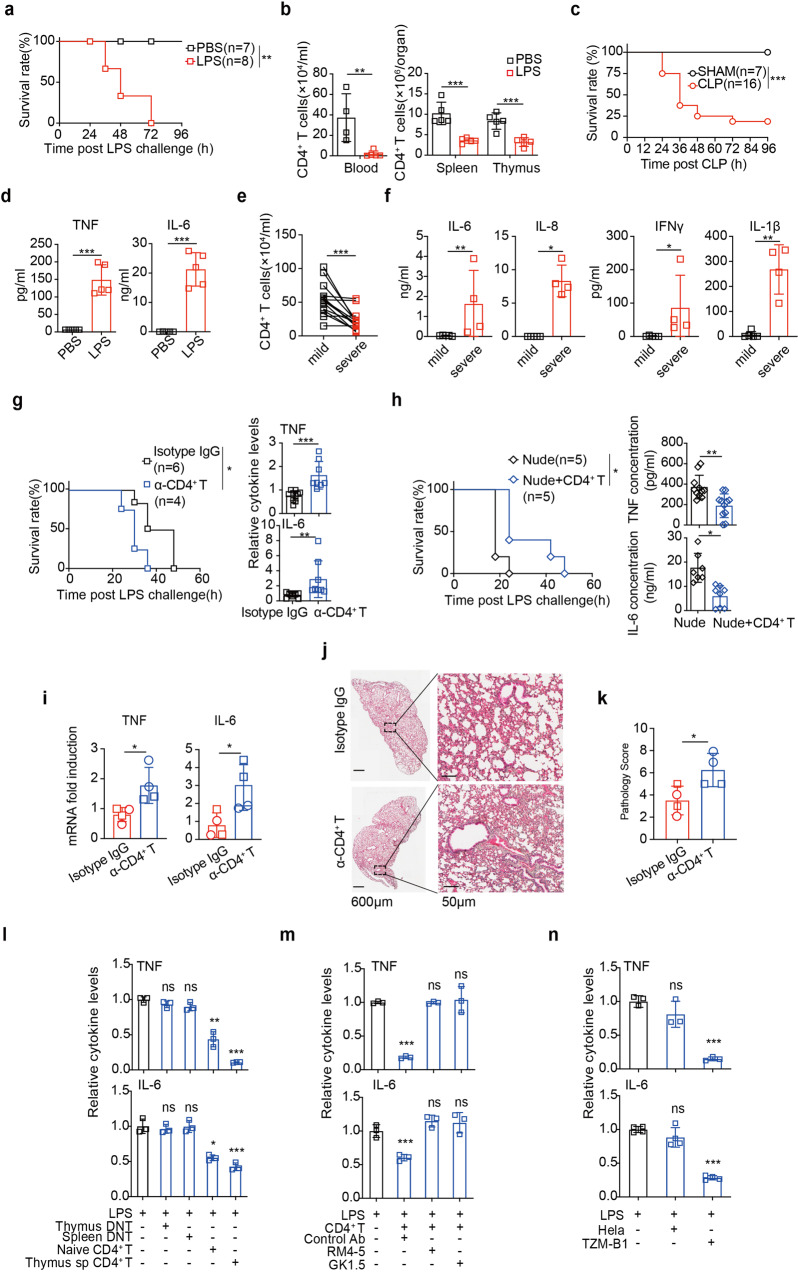
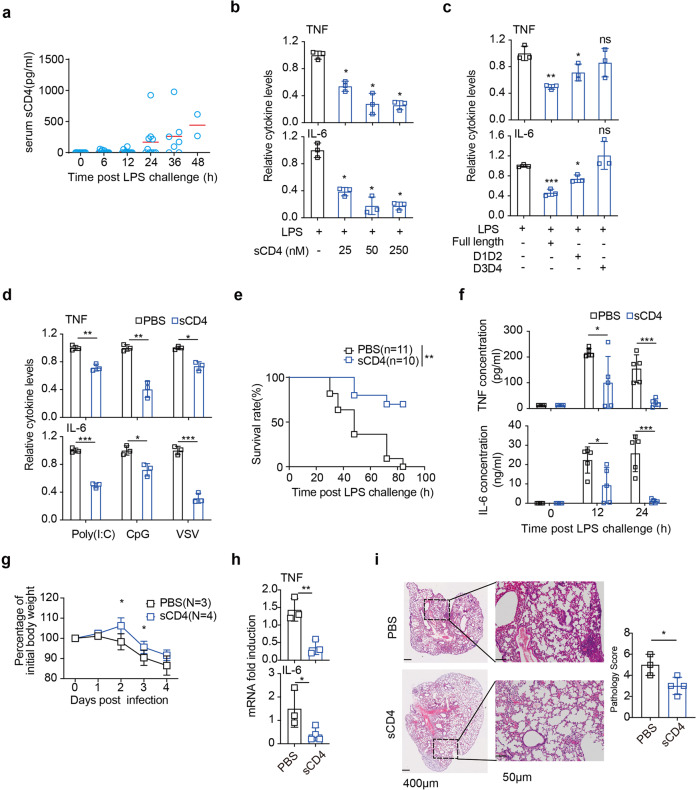
T lymphopenia, occurring in the early phase of sepsis in response to systemic inflammation, is commonly associated with morbidity and mortality of septic infections. We have previously shown that a sufficient number of T cells is required to constrain Toll-like receptors (TLRs) mediated hyperinflammation. However, the underlying mechanisms remains unsolved. Herein, we unveil that CD4 T cells engage with MHC II of macrophages to downregulate TLR pro-inflammatory signaling. We show further that the direct contact between CD4 molecule of CD4 T cells or the ectodomain of CD4 (soluble CD4, sCD4), and MHC II of resident macrophages is necessary and sufficient to prevent TLR4 overactivation in LPS and cecal ligation puncture (CLP) sepsis. sCD4 serum concentrations increase after the onset of LPS sepsis, suggesting its compensatory inhibitive effects on hyperinflammation. sCD4 engagement enables the cytoplasmic domain of MHC II to recruit and activate STING and SHP2, which inhibits IRAK1/Erk and TRAF6/NF-κB activation required for TLR4 inflammation. Furthermore, sCD4 subverts pro-inflammatory plasma membrane anchorage of TLR4 by disruption of MHC II-TLR4 raft domains that promotes MHC II endocytosis. Finally, sCD4/MHCII reversal signaling specifically interferes with TLR4 but not TNFR hyperinflammation, and independent of the inhibitive signaling of CD40 ligand of CD4 cells on macrophages. Therefore, a sufficient amount of soluble CD4 protein can prevent excessive inflammatory activation of macrophages via alternation of MHC II-TLR signaling complex, that might benefit for a new paradigm of preventive treatment of sepsis.
T 细胞减少症发生于脓毒症的早期阶段,是全身性炎症反应的结果,与脓毒症感染的发病率和死亡率密切相关。我们之前已经证明,需要足够数量的 T 细胞来限制 Toll 样受体(TLR)介导的过度炎症反应。然而,其潜在机制仍未解决。在此,我们揭示了 CD4 T 细胞与巨噬细胞的 MHC II 结合,以下调 TLR 促炎信号。我们进一步表明,CD4 T 细胞的 CD4 分子或 CD4 的细胞外结构域(可溶性 CD4,sCD4)与驻留巨噬细胞的 MHC II 之间的直接接触是防止 LPS 和盲肠结扎穿刺(CLP)脓毒症中 TLR4 过度激活所必需且充分的。sCD4 血清浓度在 LPS 脓毒症发作后升高,表明其对过度炎症具有补偿性抑制作用。sCD4 结合使 MHC II 的细胞质结构域能够招募和激活 STING 和 SHP2,从而抑制 TLR4 炎症所需的 IRAK1/Erk 和 TRAF6/NF-κB 激活。此外,sCD4 通过破坏促进 MHC II 内吞的 MHC II-TLR4 筏结构域,使 TLR4 从促炎质膜锚定中解偶联。最后,sCD4/MHCII 逆转信号特异性干扰 TLR4 而不是 TNFR 的过度炎症,且不依赖于 CD4 细胞的 CD40 配体对巨噬细胞的抑制信号。因此,足够量的可溶性 CD4 蛋白可通过改变 MHC II-TLR 信号复合物来防止巨噬细胞过度炎症激活,这可能为脓毒症的预防治疗提供一个新的范例。