Bramante Carolyn T, Beckman Kenneth B, Mehta Tanvi, Karger Amy B, Odde David J, Tignanelli Christopher J, Buse John B, Johnson Darrell M, Watson Ray H B, Daniel Jerry J, Liebovitz David M, Nicklas Jacinda M, Cohen Kenneth, Puskarich Michael A, Belani Hrishikesh K, Siegel Lianne K, Klatt Nichole R, Anderson Blake, Hartman Katrina M, Rao Via, Hagen Aubrey A, Patel Barkha, Fenno Sarah L, Avula Nandini, Reddy Neha V, Erickson Spencer M, Fricton Regina D, Lee Samuel, Griffiths Gwendolyn, Pullen Matthew F, Thompson Jennifer L, Sherwood Nancy, Murray Thomas A, Rose Michael R, Boulware David R, Huling Jared D
General Internal Medicine, University of Minnesota, Minneapolis, MN.
Genomics Center, University of Minnesota, Minneapolis, MN.
medRxiv. 2023 Jun 7:2023.06.06.23290989. doi: 10.1101/2023.06.06.23290989.
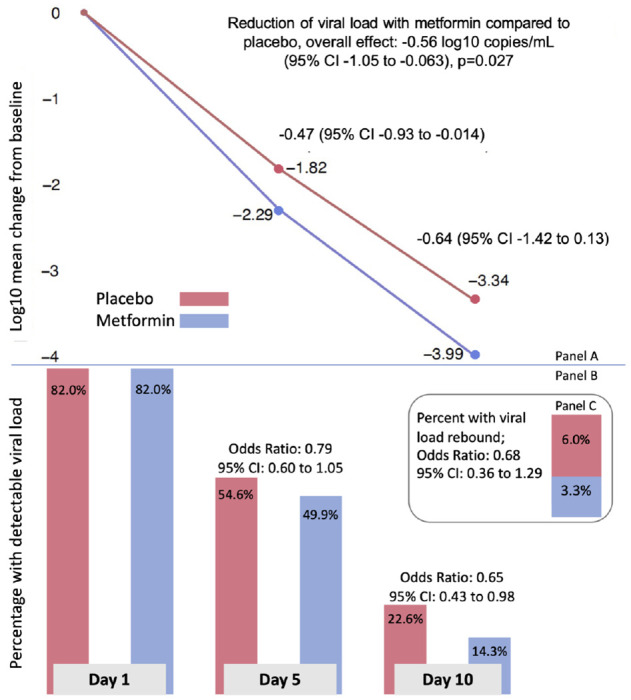
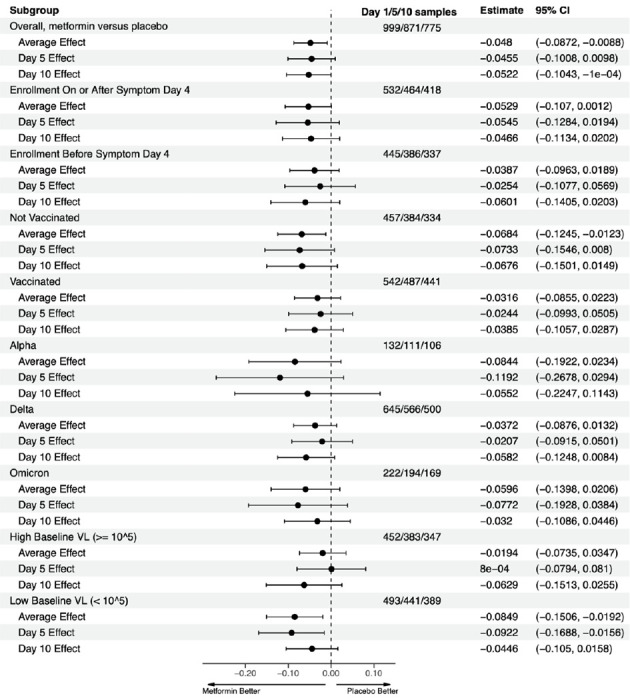
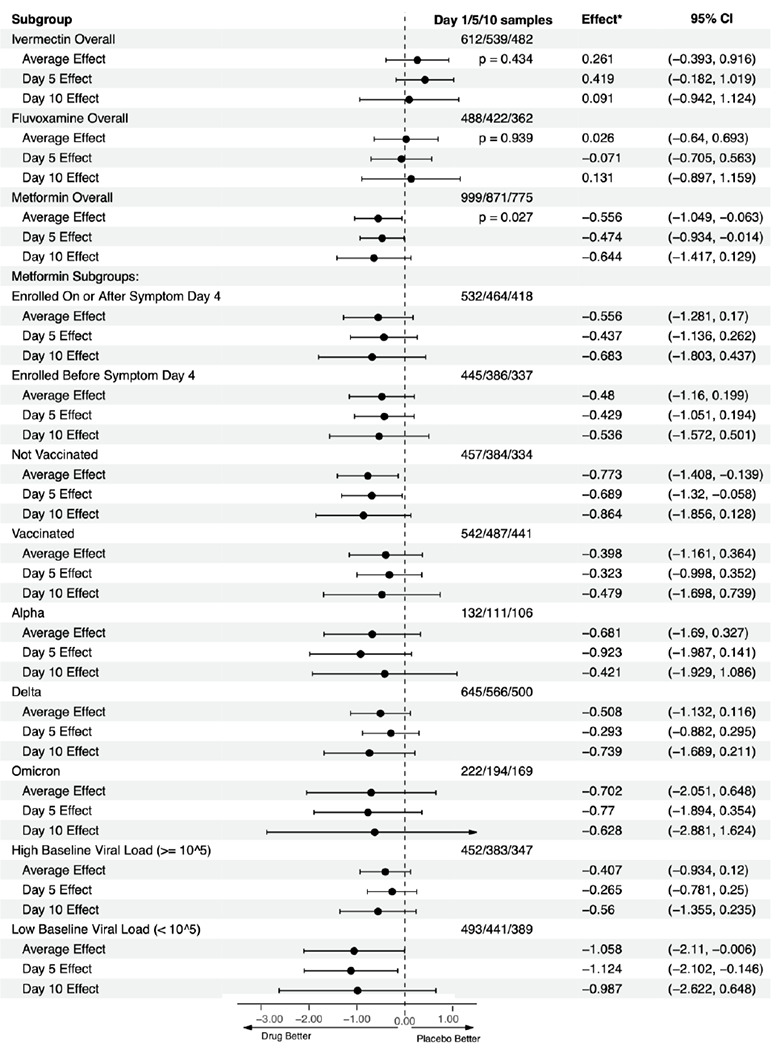
Current antiviral treatment options for SARS-CoV-2 infections are not available globally, cannot be used with many medications, and are limited to virus-specific targets. Biophysical modeling of SARS-CoV-2 replication predicted that protein translation is an especially attractive target for antiviral therapy. Literature review identified metformin, widely known as a treatment for diabetes, as a potential suppressor of protein translation via targeting of the host mTor pathway. In vitro, metformin has antiviral activity against RNA viruses including SARS-CoV-2. In the COVID-OUT phase 3, randomized, placebo-controlled trial of outpatient treatment of COVID-19, metformin had a 42% reduction in ER visits/hospitalizations/death through 14 days; a 58% reduction in hospitalizations/death through 28 days, and a 42% reduction in Long COVID through 10 months. Here we show viral load analysis of specimens collected in the COVID-OUT trial that the mean SARS-CoV-2 viral load was reduced 3.6-fold with metformin relative to placebo (-0.56 log copies/mL; 95%CI, -1.05 to -0.06, p=0.027) while there was no virologic effect for ivermectin or fluvoxamine vs placebo. The metformin effect was consistent across subgroups and with emerging data. Our results demonstrate, consistent with model predictions, that a safe, widely available, well-tolerated, and inexpensive oral medication, metformin, can be repurposed to significantly reduce SARS-CoV-2 viral load.
目前针对SARS-CoV-2感染的抗病毒治疗方案在全球范围内并不普及,不能与多种药物联合使用,且仅限于针对病毒特异性靶点。对SARS-CoV-2复制的生物物理模型预测,蛋白质翻译是抗病毒治疗特别有吸引力的靶点。文献综述确定,广为人知的糖尿病治疗药物二甲双胍可能通过靶向宿主mTor途径来抑制蛋白质翻译。在体外,二甲双胍对包括SARS-CoV-2在内的RNA病毒具有抗病毒活性。在COVID-OUT这项针对COVID-19门诊治疗的3期随机、安慰剂对照试验中,二甲双胍使14天内急诊就诊/住院/死亡人数减少了42%;28天内住院/死亡人数减少了58%,10个月内长期COVID症状减少了42%。在此,我们展示了对COVID-OUT试验中收集的样本进行的病毒载量分析,结果显示,与安慰剂相比,二甲双胍使SARS-CoV-2平均病毒载量降低了3.6倍(-0.56 log拷贝/mL;95%CI,-1.05至-0.06,p=0.027),而伊维菌素或氟伏沙明与安慰剂相比则没有病毒学效应。二甲双胍的效果在各亚组中一致,且与新出现的数据相符。我们的结果表明,与模型预测一致,一种安全、广泛可得、耐受性良好且价格低廉的口服药物二甲双胍可被重新用于显著降低SARS-CoV-2病毒载量。