French Simone A, Fan Yingling, Kunin-Batson Alicia S, Berge Jerica M, Kohli Nidhi, Lamm Rik Z, Sherwood Nancy E
School of Public Health, Division of Epidemiology and Community Health, University of Minnesota, Minneapolis, MN.
Humphrey School of Public Affairs, University of Minnesota, Minneapolis, MN.
J Pediatr X. 2021 Mar 4;6:100066. doi: 10.1016/j.ympdx.2021.100066. eCollection 2021 Spring.
To prospectively evaluate parent supportive behaviors (PSB) for child physical activity (PA) and neighborhood environment variables on changes in child PA over 3 years.
Secondary data analysis of the Now Everybody Together for Amazing and Healthful Kids-Works study with 534 parent-child (age 2-4 years) dyads randomized to a community-based pediatric obesity prevention intervention for 3 years (92% retention). PSB and neighborhood environmental variables were examined in relation to changes in child moderate-to-vigorous PA (MVPA), light and sedentary activity, and screen time. Child and parent accelerometry data were collected at visit 0, 12, 24, and 36 months. Mixed multivariate models were used to examine independent and interactive effects of parent-level and neighborhood-level variables on changes in child PA outcomes.
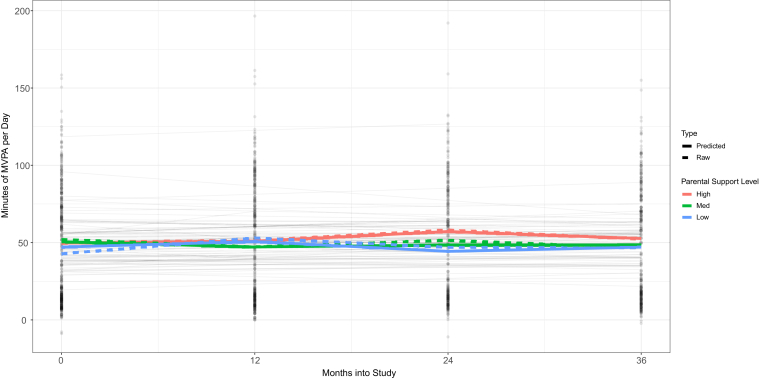
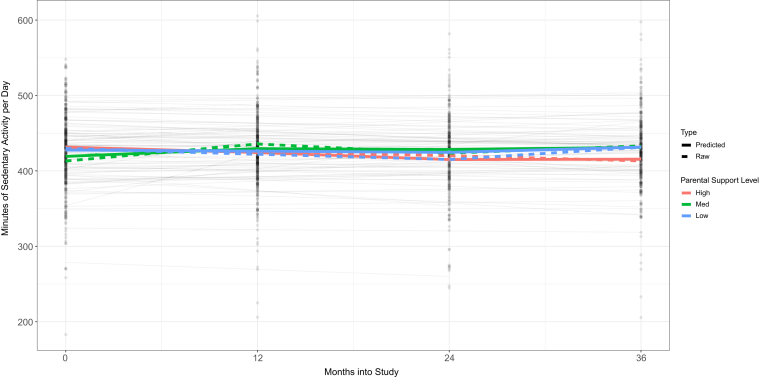
PSB significantly interacted with visit on change in child MVPA (β = 0.12) and sedentary behaviors (β = -0.18). Over 3 years, a 1-unit increase in PSB was associated with an average increase of 4.3 minutes/day of MVPA and an average decrease of 6.5 minutes/day of sedentary time. Significant main effects were observed for PSB and 3-year change in child screen time (β = -0.05). The children of parents with higher PSB at baseline watched an average of 1.8 fewer minutes/day of screen time compared with parents with lower baseline PSB. Neighborhood-level variables were not significantly associated with changes in child PA outcomes.
Parents who increase their supportive behaviors for their child's PA have children who are more physically active and less sedentary over time. Interventions to increase preschool-age children's PA may enhance their effectiveness by targeting parents' supportive behaviors for their child's PA.
前瞻性评估父母支持行为(PSB)对儿童身体活动(PA)的影响以及邻里环境变量对儿童3年期间PA变化的影响。
对“现在人人携手共创精彩健康儿童”研究进行二次数据分析,该研究有534对亲子(年龄2至4岁),随机分配至一项基于社区的儿童肥胖预防干预措施,为期3年(保留率92%)。研究考察了PSB和邻里环境变量与儿童中度至剧烈身体活动(MVPA)、轻度和久坐活动以及屏幕时间变化之间的关系。在第0、12、24和36个月时收集儿童和父母的加速度计数据。使用混合多变量模型来检验父母层面和邻里层面变量对儿童PA结果变化的独立和交互作用。
PSB与儿童MVPA变化(β = 0.12)和久坐行为变化(β = -0.18)存在显著交互作用。在3年期间,PSB增加1个单位与MVPA平均每天增加4.3分钟以及久坐时间平均每天减少6.5分钟相关。观察到PSB和儿童屏幕时间3年变化存在显著主效应(β = -0.05)。与基线PSB较低的父母相比,基线PSB较高的父母的孩子平均每天看屏幕的时间少1.8分钟。邻里层面变量与儿童PA结果变化无显著关联。
随着时间推移,那些增加对孩子PA支持行为的父母,其孩子的身体活动更多,久坐时间更少。增加学龄前儿童PA的干预措施,通过针对父母对孩子PA的支持行为,可能会提高其有效性。