Schmutz Einat A, Leeger-Aschmann Claudia S, Radtke Thomas, Muff Stefanie, Kakebeeke Tanja H, Zysset Annina E, Messerli-Bürgy Nadine, Stülb Kerstin, Arhab Amar, Meyer Andrea H, Munsch Simone, Puder Jardena J, Jenni Oskar G, Kriemler Susi
Epidemiology, Biostatistics and Prevention Institute, University of Zurich, Hirschengraben 84, 8001, Zurich, Switzerland.
Department of Evolutionary Biology and Environmental Studies, University of Zurich, Winterthurerstrasse 190, 8057, Zurich, Switzerland.
Int J Behav Nutr Phys Act. 2017 Jan 5;14(1):1. doi: 10.1186/s12966-016-0456-9.
Identifying ways to promote physical activity and decrease sedentary time during childhood is a key public health issue. Research on the putative influences on preschool children's physical activity (PA) and sedentary behavior (SB) is limited and has yielded inconsistent results. Our aim was to identify correlates of PA and SB in preschool children.
Cross-sectional data were drawn from the Swiss Preschoolers' Health Study (SPLASHY), a Swiss population-based cohort study. Of 476 two to six year old children, 394 (54% boys) had valid PA data assessed by accelerometry. Information on exposure data was directly measured or extracted from parental questionnaires. Multilevel linear regression modeling was used to separately assess associations between 35 potential correlates and total PA (TPA), moderate-to-vigorous PA (MVPA) and SB.
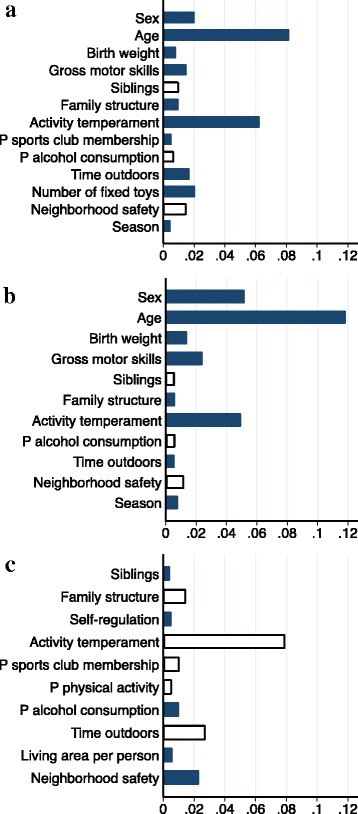
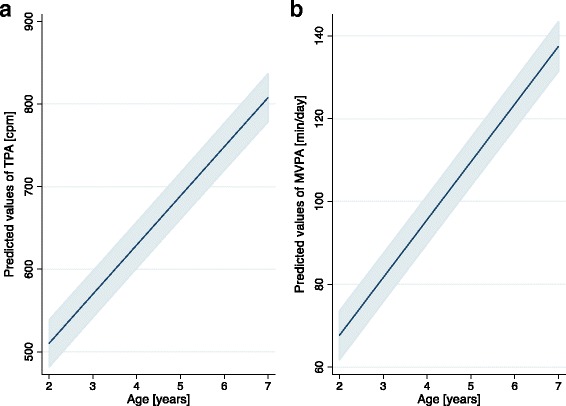
In total, 12 correlates from different domains were identified. TPA and MVPA were greater in boys than girls, increased with age and were positively associated with gross motor skills. Children from single parent families had a higher level of TPA and spent less time sedentary than those living with two parents. Time spent outdoors was positively associated with TPA and negatively with SB. The child's activity temperament was related all three outcomes, whereas parental sports club membership, living area per person and neighborhood safety were associated with SB only. Fixed and random factors in the final models accounted for 28%, 32% and 22% of the total variance in TPA, MVPA and SB, respectively. Variance decomposition revealed that age, sex and activity temperament were the most influential correlates of both, TPA and MVPA, whereas the child's activity temperament, time outdoors and neighborhood safety were identified as the most important correlates of SB.
A multidimensional set of correlates of young children's activity behavior has been identified. Personal factors had the greatest influence on PA, whereas environmental-level factors had the greatest influence on SB. Moreover, we identified a number of previously unreported, potentially modifiable correlates of young children's PA and SB. These factors could serve to define target groups or become valuable targets for change in future interventions.
Current Controlled Trials ISRCTN41045021 (date of registration: 21.03.14).
确定促进儿童期身体活动及减少久坐时间的方法是一个关键的公共卫生问题。关于对学龄前儿童身体活动(PA)和久坐行为(SB)的假定影响的研究有限,且结果不一致。我们的目的是确定学龄前儿童PA和SB的相关因素。
横断面数据取自瑞士学龄前儿童健康研究(SPLASHY),这是一项基于瑞士人群的队列研究。在476名2至6岁儿童中,394名(54%为男孩)有通过加速度计评估的有效PA数据。暴露数据信息直接测量或从家长问卷中提取。采用多水平线性回归模型分别评估35个潜在相关因素与总PA(TPA)、中度至剧烈PA(MVPA)和SB之间的关联。
总共确定了来自不同领域的12个相关因素。TPA和MVPA在男孩中高于女孩,随年龄增加,且与粗大运动技能呈正相关。单亲家庭的儿童TPA水平较高,久坐时间比与双亲生活的儿童少。户外活动时间与TPA呈正相关,与SB呈负相关。儿童的活动气质与所有三项结果相关,而父母的体育俱乐部会员资格、人均居住面积和社区安全性仅与SB相关。最终模型中的固定因素和随机因素分别占TPA、MVPA和SB总方差的28%、32%和22%。方差分解显示,年龄、性别和活动气质是TPA和MVPA最具影响力的相关因素,而儿童的活动气质、户外活动时间和社区安全性被确定为SB最重要的相关因素。
已确定了一组与幼儿活动行为相关的多维度因素。个人因素对PA影响最大,而环境层面因素对SB影响最大。此外,我们确定了一些以前未报告的、幼儿PA和SB的潜在可改变相关因素。这些因素可用于确定目标群体或成为未来干预措施中有价值的改变目标。
当前受控试验ISRCTN41045021(注册日期:2014年3月21日)。