Department of Health, Human Performance, and Recreation, Baylor University, Waco, Texas, United States.
Department of Health, Human Performance, and Recreation, University of Arkansas, Fayetteville, Arkansas, United States.
Am J Physiol Cell Physiol. 2023 Jul 1;325(1):C324-C331. doi: 10.1152/ajpcell.00553.2022. Epub 2023 Jun 19.
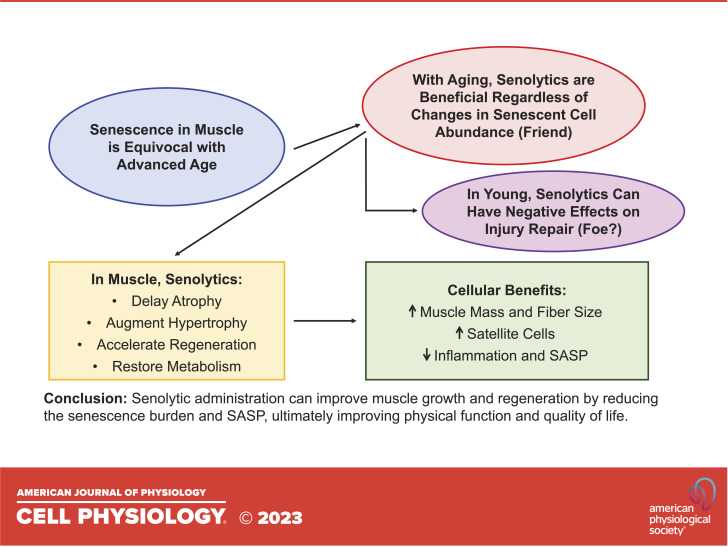
A gradual decline in skeletal muscle mass and function is closely tied to increased mortality and disease risk during organismal aging. Exercise training is the most effective way to enhance muscle health, but the adaptive response to exercise as well as muscle repair potential is blunted in older individuals. Numerous mechanisms contribute to the loss of muscle mass and plasticity as aging progresses. An emerging body of recent evidence implicates an accumulation of senescent ("zombie") cells in muscle as a contributing factor to the aging phenotype. Senescent cells cannot divide but can release inflammatory factors and create an unfavorable environment for homeostasis and adaptation. On balance, some evidence indicates that cells with senescent characteristics can be beneficial for the muscle adaptive process, specifically at younger ages. Emerging evidence also suggests that multinuclear muscle fibers could become senescent. In this review, we summarize current literature on the prevalence of senescent cells in skeletal muscle and highlight the consequences of senescent cell removal on muscle mass, function, and adaptability. We examine key limitations in the field of senescence specifically in skeletal muscle and identify areas of research that require future investigation. There is evidence to suggest that senescent "zombie" cells may or may not accrue in aging skeletal muscle. When muscle is perturbed regardless of age, senescent-like cells do appear, and the benefits of removing them could be age-dependent. More work is needed to determine the magnitude of accumulation and source of senescent cells in muscle. Regardless, pharmacological senolytic treatment of aged muscle is beneficial for adaptation.
骨骼肌质量和功能的逐渐下降与机体衰老过程中死亡率和疾病风险的增加密切相关。运动训练是增强肌肉健康最有效的方法,但在老年人中,运动的适应性反应和肌肉修复潜力会减弱。随着年龄的增长,许多机制导致肌肉质量和可塑性的丧失。最近越来越多的证据表明,衰老(“僵尸”)细胞在肌肉中的积累是衰老表型的一个促成因素。衰老细胞不能分裂,但可以释放炎症因子,并为体内平衡和适应创造不利环境。总的来说,一些证据表明,具有衰老特征的细胞可能对肌肉适应过程有益,特别是在较年轻时。新出现的证据还表明,多核肌纤维可能会衰老。在这篇综述中,我们总结了目前关于骨骼肌中衰老细胞流行程度的文献,并强调了去除衰老细胞对肌肉质量、功能和适应性的影响。我们检查了衰老领域,特别是在骨骼肌中的关键局限性,并确定了需要进一步研究的研究领域。有证据表明,衰老的“僵尸”细胞可能会或可能不会在衰老的骨骼肌中积累。无论年龄大小,当肌肉受到干扰时,都会出现类似衰老的细胞,而去除这些细胞的好处可能是年龄依赖性的。需要更多的工作来确定肌肉中衰老细胞的积累程度和来源。无论如何,衰老肌肉的药理学衰老疗法对适应是有益的。