Department of Psychiatry, University of Oxford, Oxford, United Kingdom.
Centre for Mental Health, School of Population and Global Health, University of Melbourne, Melbourne, Australia.
JMIR Public Health Surveill. 2023 Jun 19;9:e42963. doi: 10.2196/42963.
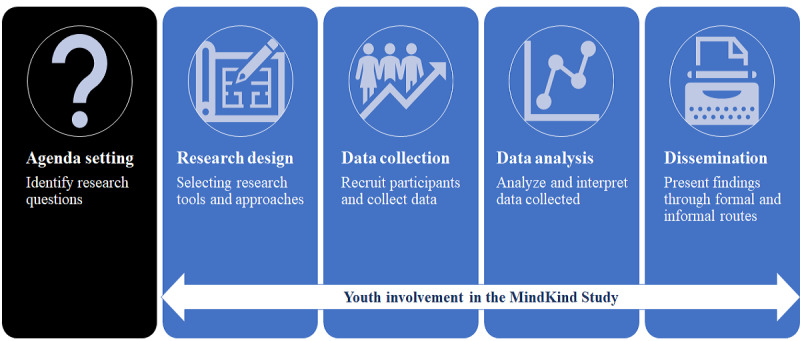
Public involvement in research is a growing phenomenon as well as a condition of research funding, and it is often referred to as coproduction. Coproduction involves stakeholder contributions at every stage of research, but different processes exist. However, the impact of coproduction on research is not well understood. Web-based young people's advisory groups (YPAGs) were established as part of the MindKind study at 3 sites (India, South Africa, and the United Kingdom) to coproduce the wider research study. Each group site, led by a professional youth advisor, conducted all youth coproduction activities collaboratively with other research staff.
This study aimed to evaluate the impact of youth coproduction in the MindKind study.
To measure the impact of web-based youth coproduction on all stakeholders, the following methods were used: analysis of project documents, capturing the views of stakeholders using the Most Significant Change technique, and impact frameworks to assess the impact of youth coproduction on specific stakeholder outcomes. Data were analyzed in collaboration with researchers, advisors, and YPAG members to explore the impact of youth coproduction on research.
The impact was recorded on 5 levels. First, at the paradigmatic level, a novel method of conducting research allowed for a widely diverse group of YPAG representations, influencing study priorities, conceptualization, and design. Second, at the infrastructural level, the YPAG and youth advisors meaningfully contributed to the dissemination of materials; infrastructural constraints of undertaking coproduction were also identified. Third, at the organizational level, coproduction necessitated implementing new communication practices, such as a web-based shared platform. This meant that materials were easily accessible to the whole team and communication streams remained consistent. Fourth, at the group level, authentic relationships developed between the YPAG members, advisors, and the rest of the team, facilitated by regular web-based contact. Finally, at the individual level, participants reported enhanced insights into mental well-being and appreciation for the opportunity to engage in research.
This study revealed several factors that shape the creation of web-based coproduction, with clear positive outcomes for advisors, YPAG members, researchers, and other project staff. However, several challenges of coproduced research were also encountered in multiple contexts and amid pressing timelines. For systematic reporting of the impact of youth coproduction, we propose that monitoring, evaluation, and learning systems be designed and implemented early.
公众参与研究是研究资助的一个日益增长的现象,通常也被称为共同生产。共同生产涉及利益相关者在研究的每个阶段的贡献,但存在不同的过程。然而,共同生产对研究的影响还没有被很好地理解。网络青年顾问小组(YPAG)是作为 MindKind 研究的一部分在 3 个地点(印度、南非和英国)建立的,目的是共同制作更广泛的研究。每个小组由一名专业的青年顾问领导,与其他研究人员一起合作,共同开展所有青年共同生产活动。
本研究旨在评估 MindKind 研究中青年共同生产的影响。
为了衡量网络青年共同生产对所有利益相关者的影响,使用了以下方法:分析项目文件,使用最显著变化技术捕捉利益相关者的观点,以及影响框架来评估青年共同生产对特定利益相关者结果的影响。数据与研究人员、顾问和 YPAG 成员合作进行分析,以探讨青年共同生产对研究的影响。
记录了 5 个层面的影响。首先,在范式层面上,一种新的研究方法允许广泛多样化的 YPAG 代表参与,影响了研究的优先事项、概念化和设计。其次,在基础设施层面上,YPAG 和青年顾问有意义地促进了材料的传播;也确定了进行共同生产的基础设施限制。第三,在组织层面上,共同生产需要实施新的沟通实践,例如基于网络的共享平台。这意味着团队中的每个人都可以轻松访问材料,并且沟通流保持一致。第四,在小组层面上,YPAG 成员、顾问和团队其他成员之间建立了真实的关系,这得益于定期的网络联系。最后,在个人层面上,参与者报告说对心理健康有了更深入的了解,并感谢有机会参与研究。
本研究揭示了塑造网络共同生产的几个因素,对顾问、YPAG 成员、研究人员和其他项目人员都有明显的积极影响。然而,在多个背景下和紧迫的时间表下,也遇到了共同生产研究的一些挑战。为了系统地报告青年共同生产的影响,我们建议尽早设计和实施监测、评估和学习系统。