Department of Clinical Nursing, School of Nursing and Public Health, University of Dodoma, Dodoma, Tanzania.
Department of Nursing Management and Education, School of Nursing and Public Health, University of Dodoma, Dodoma, Tanzania.
Medicine (Baltimore). 2023 Jun 9;102(23):e33944. doi: 10.1097/MD.0000000000033944.
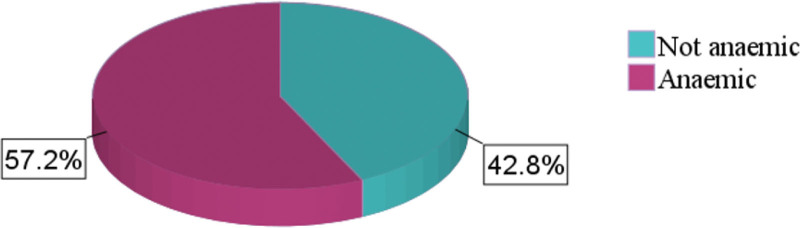
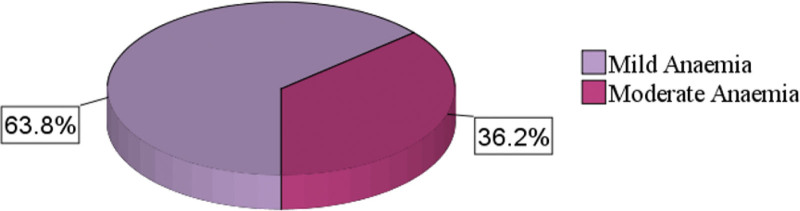
Anaemia during pregnancy is still 1 of the leading causes of maternal and neonatal mortality in low and middle-income countries. Initiatives to address this need evidence on trends and their relevant factors, as they vary from 1 area to another. This study determined the prevalence of anemia and its associated factors among pregnant women in Ilala, Tanzania. This community-based, analytical cross-sectional study was conducted in April 2022 involving 367 randomly selected pregnant women. An interviewer-administered questionnaire and a HemoCue analyzer were used for data collection The data was described using descriptive statistics (frequency distributions, percentages, etc) and inferential statistics (Chi-square tests and logistic regression) were used to explore the associations between the study's outcome and its explanatory variables, with a significance level of P < .05. The mean age of participants was 26.2 (standard deviation = 5.2) years, 58.0% had a secondary education level, and 45.2 were prime-para. About half (57.2%) of all participants had low hemoglobin level, among which, 36.2% had moderate anemia. Having a primary education level (adjusted odds ratio [AOR] = 2.3, confidence interval [CI] = 1.1-4.7), having an inter-pregnancy interval of <18 months (AOR = 2.6, CI = 1.2-5.5), being in the third trimester (AOR = 2.4, CI = 1.2-4.7), not taking Intermittent Prophylaxis Treatment (AOR = 3.7, CI = 1.3-10), not taking iron supplement and folic acid (AOR = 3.7, CI = 1.3-10), and having a moderate appetite(AOR = 1.6, CI = 1.0-2.6) were predictors of anemia. Nutritionally related factors were not consuming on a daily basis dairy food (AOR = 3.7, CI = 1.4-9.3), meat/fish (AOR = 6.6, CI = 3-14), dark green and other vegetables (AOR = 6.6, CI = 3.1-14), fruits (AOR = 4.2, CI = 1.4-12) and having a lower dietary diversity score (AOR = 84, CI = 37-188). Approximately half of pregnant women in Ilala municipality were anemic with 1 third of them having moderate anemia. The associated factors varied from nutritional, obstetric, and socio-demographic factors. The targeted interventions should focus on health promotion campaign to sensitize the population on the dangers of anemia in pregnancy and preventive measures that must be adhered to.
在中低收入国家,孕期贫血仍然是导致产妇和新生儿死亡的主要原因之一。为了解决这一问题,需要有针对这一需求的证据,因为不同地区的情况有所不同。本研究旨在确定坦桑尼亚伊拉拉区孕妇贫血的患病率及其相关因素。这是一项基于社区的分析性横断面研究,于 2022 年 4 月进行,共纳入 367 名随机选择的孕妇。采用访谈者管理的问卷和 HemoCue 分析仪收集数据。使用描述性统计(频率分布、百分比等)描述数据,并使用卡方检验和逻辑回归探索研究结果与解释变量之间的关联,显著性水平为 P <.05。参与者的平均年龄为 26.2(标准差=5.2)岁,58.0%接受过中等教育,45.2 人为初产妇。大约一半(57.2%)的参与者血红蛋白水平较低,其中 36.2%患有中度贫血。接受初等教育(调整后的优势比[OR] = 2.3,置信区间[CI] = 1.1-4.7)、两次妊娠间隔<18 个月(OR = 2.6,CI = 1.2-5.5)、处于孕晚期(OR = 2.4,CI = 1.2-4.7)、未进行间歇性预防治疗(OR = 3.7,CI = 1.3-10)、未服用铁补充剂和叶酸(OR = 3.7,CI = 1.3-10)以及中等食欲(OR = 1.6,CI = 1.0-2.6)是贫血的预测因素。与营养相关的因素包括没有每天食用乳制品(OR = 3.7,CI = 1.4-9.3)、肉类/鱼类(OR = 6.6,CI = 3-14)、深绿色和其他蔬菜(OR = 6.6,CI = 3.1-14)、水果(OR = 4.2,CI = 1.4-12)和饮食多样性评分较低(OR = 84,CI = 37-188)。伊拉拉市约一半的孕妇贫血,其中三分之一患有中度贫血。相关因素包括营养、产科和社会人口学因素。有针对性的干预措施应侧重于健康促进运动,使人们认识到孕期贫血的危害和必须采取的预防措施。