Greater Brisbane Clinical School, Medical School, The University of Queensland, Chermside, QLD 4032, Australia.
Department of Cardiology, The Prince Charles Hospital, Chermside, QLD 4032, Australia.
Eur Heart J Qual Care Clin Outcomes. 2023 Aug 7;9(5):447-458. doi: 10.1093/ehjqcco/qcad037.
Catheter ablation of atrial fibrillation (AF) is now a mainstream procedure although long-term outcomes are uncertain. We performed a systematic review and meta-analysis of procedural outcomes at 5 years and beyond.
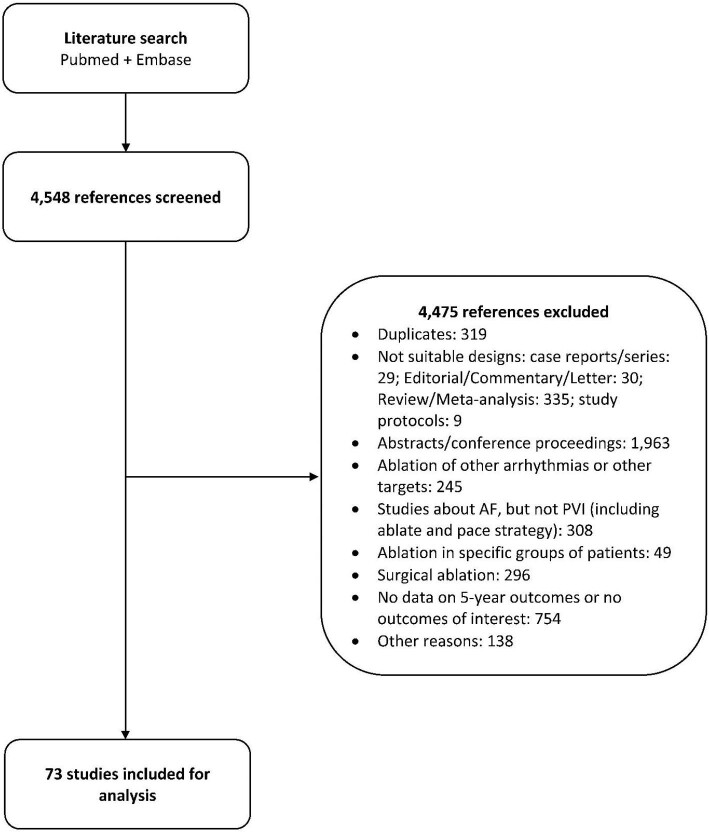
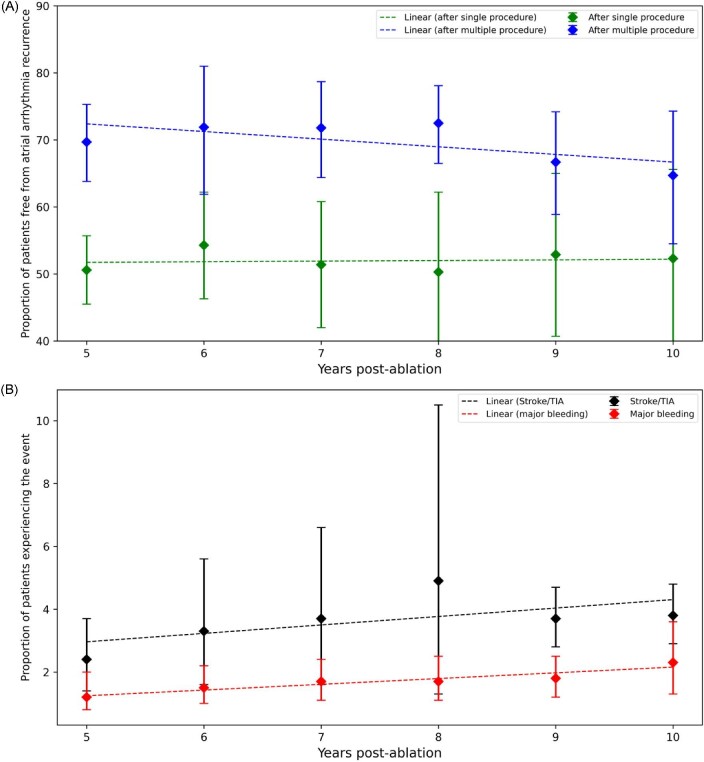
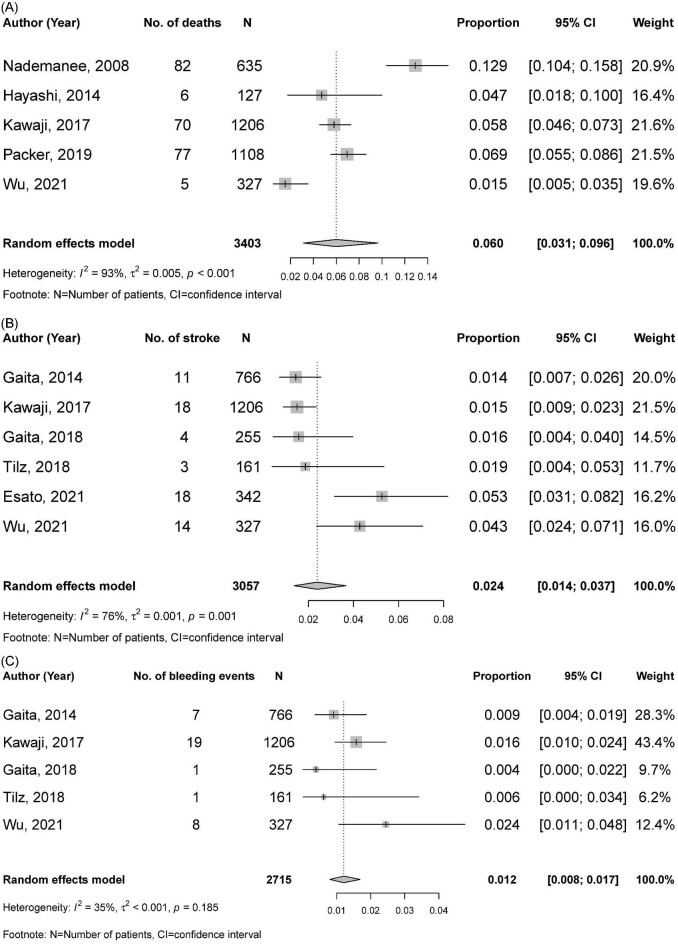
We searched PubMed and Embase and after the screening, identified 73 studies (67 159 patients) reporting freedom from atrial arrhythmia, all-cause death, stroke, and major bleeding at ≥5 years after AF ablation. The pooled mean age was 59.7y, 71.5% male, 62.2% paroxysmal AF, and radiofrequency was used in 78.1% of studies. Pooled incidence of freedom from atrial arrhythmia at 5 years was 50.6% (95%CI 45.5-55.7%) after a single ablation and 69.7% [95%CI (confidence interval) 63.8-75.3%) after multiple procedures. The incidence was higher among patients with paroxysmal compared with non-paroxysmal AF after single (59.7% vs. 33.3%, p = 0.002) and multiple (80.8% vs. 60.6%, p < 0.001) ablations but was comparable between radiofrequency and cryoablation. Pooled incidences of other outcomes were 6.0% (95%CI 3.2-9.7%) for death, 2.4% (95%CI 1.4-3.7%) for stroke, and 1.2% (95%CI 0.8-2.0%) for major bleeding at 5 years. Beyond 5 years, freedom from arrhythmia recurrence remained largely stable (52.3% and 64.7% after single and multiple procedures at 10 years), while the risk of stroke and bleeding increased over time.
Nearly 70% of patients having multiple ablations remained free from atrial arrhythmia at 5 years, with the incidence slightly decreasing beyond this period. Risk of death, stroke, and major bleeding at 5 years were low but increased over time, emphasizing the importance of long-term thromboembolism prevention and bleeding risk management.
尽管房颤(AF)导管消融的长期疗效尚不确定,但目前它已成为一种主流治疗方法。我们对消融术后 5 年及以上的手术结果进行了系统评价和荟萃分析。
我们检索了 PubMed 和 Embase,并在筛选后,确定了 73 项研究(67159 例患者),这些研究报告了 AF 消融术后 5 年及以上时的心房心律失常、全因死亡、卒中和大出血的无事件率。汇总的平均年龄为 59.7 岁,71.5%为男性,62.2%为阵发性 AF,78.1%的研究中使用了射频消融。单次消融后 5 年的无房性心律失常发生率为 50.6%(95%置信区间 45.5-55.7%),多次消融后为 69.7%[95%置信区间(置信区间)63.8-75.3%]。与非阵发性 AF 相比,阵发性 AF 患者在单次(59.7%比 33.3%,p=0.002)和多次(80.8%比 60.6%,p<0.001)消融后无房性心律失常的发生率更高,但射频与冷冻消融之间无差异。5 年时其他结局的发生率分别为死亡 6.0%(95%置信区间 3.2-9.7%)、卒 2.4%(95%置信区间 1.4-3.7%)和大出血 1.2%(95%置信区间 0.8-2.0%)。5 年以上,心律失常复发的无事件率基本保持稳定(单次消融 10 年后为 52.3%和 64.7%,多次消融后为 52.3%和 64.7%),而卒中和出血的风险随时间而增加。
近 70%的多次消融患者在 5 年内无房性心律失常,在此期间后发生率略有下降。5 年时的死亡率、卒中和大出血风险较低,但随时间推移而增加,强调了长期血栓栓塞预防和出血风险管理的重要性。