Department of Internal Medicine and Healthcare Research Institute, Seoul National University Hospital Healthcare System Gangnam Center, Seoul, Republic of Korea.
Department of Internal Medicine and Liver Research Institute, Seoul National University College of Medicine, Seoul, Republic of Korea.
Cancer Commun (Lond). 2023 Aug;43(8):863-876. doi: 10.1002/cac2.12454. Epub 2023 Jun 19.
Although an association between metabolic dysfunction-associated fatty liver disease (MAFLD) and cardiovascular disease or overall mortality has been reported, it is unclear whether there is an association between MAFLD and cancer incidence or mortality. We aimed to investigate the differential risk of all- and site-specific cancer incidence and mortality according to MAFLD subgroups categorized by additional etiologies of liver disease.
Using the Korean National Health Insurance Service database, we stratified the participants into three groups: (1) single-etiology MAFLD (S-MAFLD) or MAFLD of pure metabolic origin; (2) mixed-etiology MAFLD (M-MAFLD) or MAFLD with additional etiological factor(s) (i.e., concomitant liver diseases and/or heavy alcohol consumption); and (3) non-MAFLD. Hepatic steatosis and fibrosis were defined using the fatty liver index and the BARD score, respectively. Cox proportional hazards regression was performed to estimate the risk of cancer events.
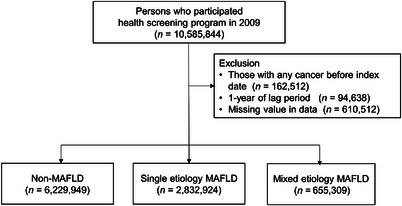
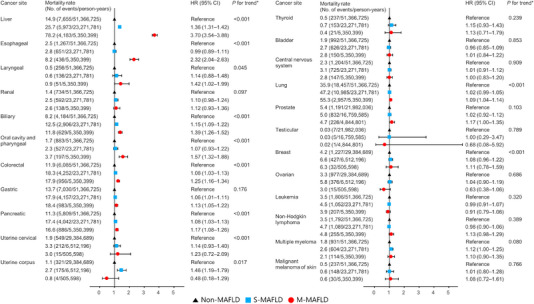
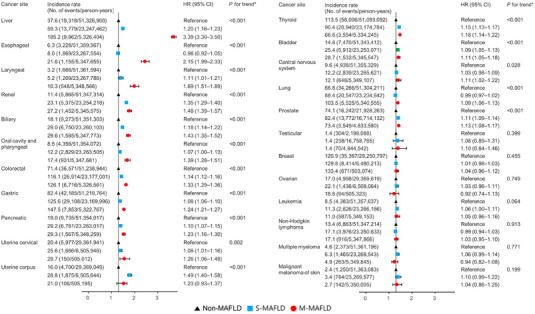
Among the 9,718,182 participants, the prevalence of S-MAFLD and M-MAFLD was 29.2% and 6.7%, respectively. During the median 8.3 years of follow-up, 510,330 (5.3%) individuals were newly diagnosed with cancer, and 122,774 (1.3%) cancer-related deaths occurred among the entire cohort. Compared with the non-MAFLD group, the risk of all-cancer incidence and mortality was slightly higher among patients in the S-MAFLD group (incidence, adjusted hazard ratio [aHR] = 1.03; 95% confidence interval [CI]: 1.02-1.04; mortality, aHR = 1.06; 95% CI: 1.04-1.08) and highest among patients with M-MAFLD group (incidence, aHR = 1.31; 95% CI: 1.29-1.32; mortality, aHR = 1.45; 95% CI: 1.42-1.48, respectively). The M-MAFLD with fibrosis group (BARD score ≥ 2) showed the highest relative risk of all-cancer incidence (aHR = 1.38, 95% CI = 1.36-1.39), followed by the M-MAFLD without fibrosis group (aHR = 1.09, 95% CI = 1.06-1.11). Similar trends were observed for cancer-related mortality.
MAFLD classification, by applying additional etiologies other than pure metabolic origin, can be used to identify a subgroup of patients with poor cancer-related outcomes.
尽管代谢功能相关脂肪性肝病(MAFLD)与心血管疾病或全因死亡率之间存在关联,但 MAFLD 与癌症发病率或死亡率之间是否存在关联尚不清楚。本研究旨在根据肝病的其他病因对 MAFLD 亚组进行分类,探讨所有和特定部位癌症发病率和死亡率的差异风险。
我们使用韩国国家健康保险服务数据库,将参与者分为三组:(1)单一病因 MAFLD(S-MAFLD)或纯代谢起源的 MAFLD;(2)混合病因 MAFLD(M-MAFLD)或伴有其他病因因素(即合并肝脏疾病和/或大量饮酒)的 MAFLD;以及(3)非 MAFLD。使用脂肪肝指数和 BARD 评分分别定义肝脂肪变性和纤维化。使用 Cox 比例风险回归估计癌症事件的风险。
在 9718182 名参与者中,S-MAFLD 和 M-MAFLD 的患病率分别为 29.2%和 6.7%。在中位 8.3 年的随访期间,整个队列中有 510330 名(5.3%)新诊断患有癌症,有 122774 名(1.3%)癌症相关死亡。与非 MAFLD 组相比,S-MAFLD 组的全癌发病率和死亡率略高(发病率,调整后的危险比[aHR] = 1.03;95%置信区间[CI]:1.02-1.04;死亡率,aHR = 1.06;95%CI:1.04-1.08),M-MAFLD 组最高(发病率,aHR = 1.31;95%CI:1.29-1.32;死亡率,aHR = 1.45;95%CI:1.42-1.48)。纤维化 BARD 评分≥2 的 M-MAFLD 组(aHR = 1.38,95%CI = 1.36-1.39)的全癌发病率相对风险最高,其次是无纤维化 M-MAFLD 组(aHR = 1.09,95%CI = 1.06-1.11)。癌症相关死亡率也呈现出类似的趋势。
MAFLD 分类,通过应用除纯代谢起源以外的其他病因,可以用于识别癌症预后不良的亚组患者。