Clinical Laboratory Center, The Affiliated Hospital of Guizhou Medical University, 28, Guiyi Street, Guiyang, Guizhou, China.
Department of Clinical Trials Centre, The Affiliated Hospital of Guizhou Medical University, 28, Guiyi Street, Guiyang, Guizhou, China.
BMC Infect Dis. 2023 Jun 20;23(1):417. doi: 10.1186/s12879-023-08384-9.
Previous studies found minimal evidence and raised controversy about the link between hemoglobin and 28-day mortality in sepsis patients. As a result, the purpose of this study was to examine the association between hemoglobin and 28-day death in sepsis patients by analyzing the Medical Intensive Care IV (MIMIC-IV) database from 2008 to 2019 at an advanced medical center in Boston, Massachusetts.
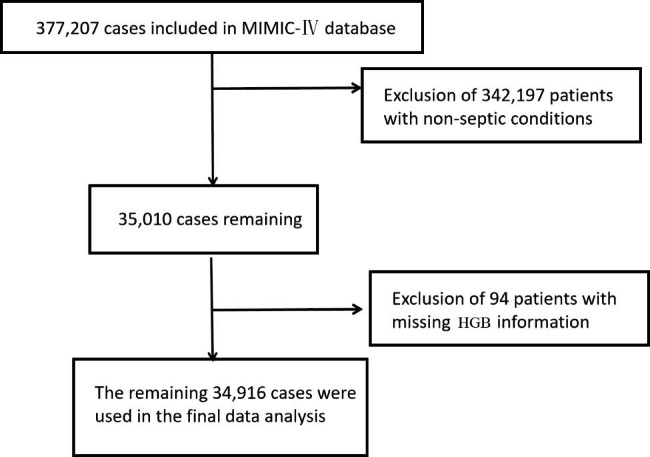
We extracted 34,916 sepsis patients from the MIMIC-IV retrospective cohort database, using hemoglobin as the exposure variable and 28-day death as the outcome variable, and after adjusting for confounders (demographic indicators, Charlson co-morbidity index, SOFA score, vital signs, medication use status (glucocorticoids, vasoactive drugs, antibiotics, and immunoglobulins, etc.)), we investigated the independent effects of hemoglobin and 28-day risk of death by binary logistic regression as well as two-piecewise linear model, respectively.
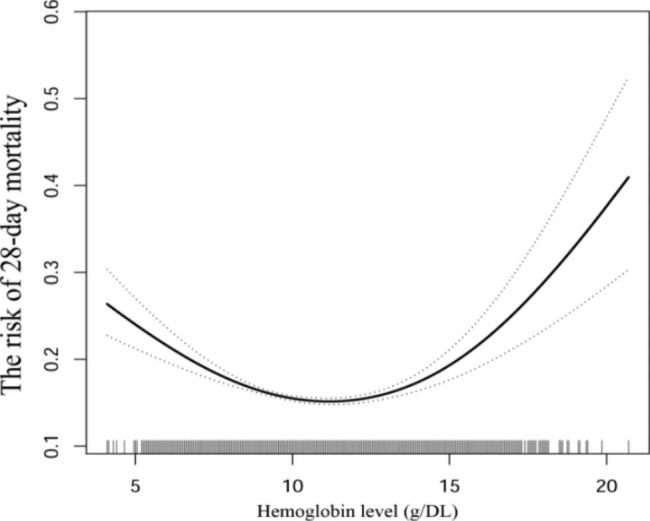
Hemoglobin levels and 28-day mortality were shown to be non-linearly related.The inflection points were 104 g/L and 128 g/L, respectively. When HGB levels were between 41 and 104 g/L, there was a 10% decrease in the risk of 28-day mortality (OR: 0.90; 95% CI: 0.87 to 0.94, p-value = 0.0001). However, in the range of 104-128 g/L, we did not observe a significant association between hemoglobin and 28-day mortality (OR: 1.17; 95% CI: 1.00 to 1.35, P value = 0.0586). When HGB was in the range of 128-207 g/L, there was a 7% increase in the risk of 28-day mortality for every 1 unit increase in HGB (OR: 1.07; 95% CI: 1.01 to 1.15, P value = 0.0424).
In patients with sepsis, baseline hemoglobin was related to a U-shaped risk of 28-day death. When HGB was in the range of 12.8-20.7 g/dL, there was a 7% increase in the risk of 28-day mortality for every 1 unit increase in HGB.
先前的研究发现,血红蛋白与脓毒症患者 28 天死亡率之间的关联证据很少,存在争议。因此,本研究旨在通过分析马萨诸塞州波士顿一家先进医疗中心 2008 年至 2019 年的医疗重症监护 IV(MIMIC-IV)数据库,研究血红蛋白与脓毒症患者 28 天死亡之间的关系。
我们从 MIMIC-IV 回顾性队列数据库中提取了 34916 名脓毒症患者,以血红蛋白为暴露变量,28 天死亡为结局变量,并在调整混杂因素(人口统计学指标、Charlson 合并症指数、SOFA 评分、生命体征、药物使用状态(糖皮质激素、血管活性药物、抗生素和免疫球蛋白等))后,分别使用二元逻辑回归和两段线性模型来研究血红蛋白和 28 天死亡风险的独立影响。
血红蛋白水平和 28 天死亡率呈非线性相关。拐点分别为 104 g/L 和 128 g/L。当 HGB 水平在 41-104 g/L 之间时,28 天死亡率的风险降低了 10%(OR:0.90;95%CI:0.87-0.94,p 值=0.0001)。然而,在 104-128 g/L 范围内,血红蛋白与 28 天死亡率之间没有显著关联(OR:1.17;95%CI:1.00-1.35,P 值=0.0586)。当 HGB 在 128-207 g/L 范围内时,HGB 每增加 1 个单位,28 天死亡率的风险增加 7%(OR:1.07;95%CI:1.01-1.15,P 值=0.0424)。
在脓毒症患者中,基线血红蛋白与 28 天死亡的 U 形风险相关。当 HGB 在 12.8-20.7 g/dL 范围内时,HGB 每增加 1 个单位,28 天死亡率的风险增加 7%。