St. Anna Children's Cancer Research Institute (CCRI), Vienna, Austria; Labdia Labordiagnostik, Vienna.
St. Anna Children's Cancer Research Institute (CCRI), Vienna.
Haematologica. 2024 Mar 1;109(3):740-750. doi: 10.3324/haematol.2022.282424.
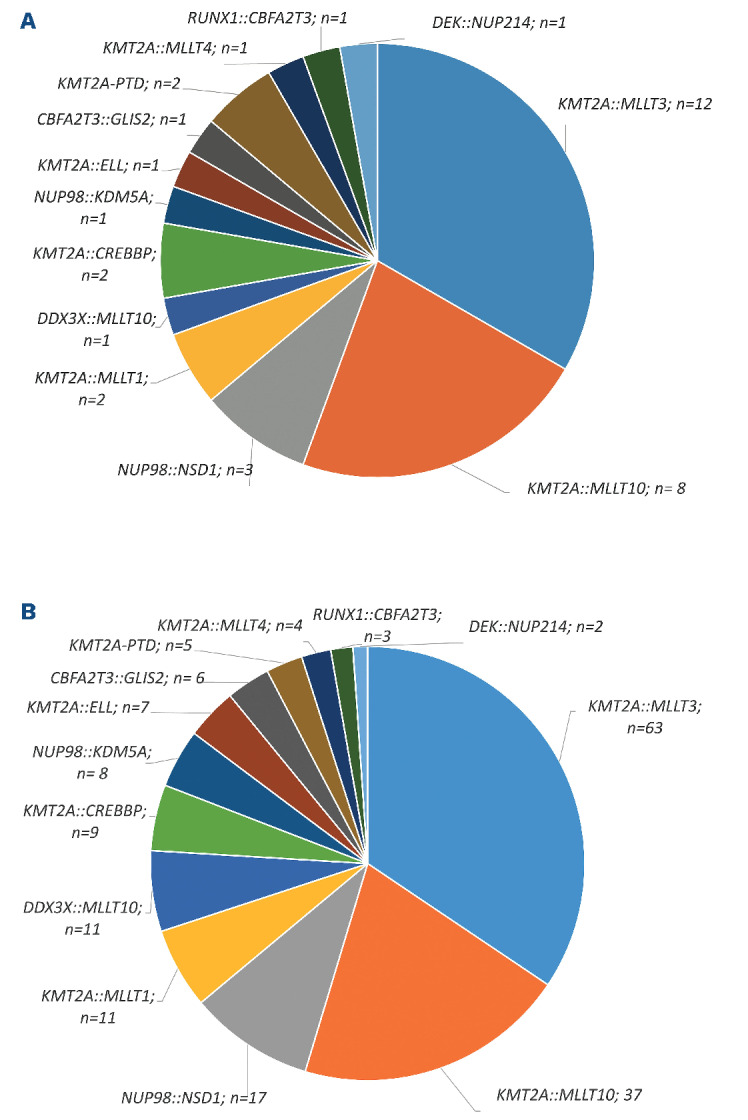
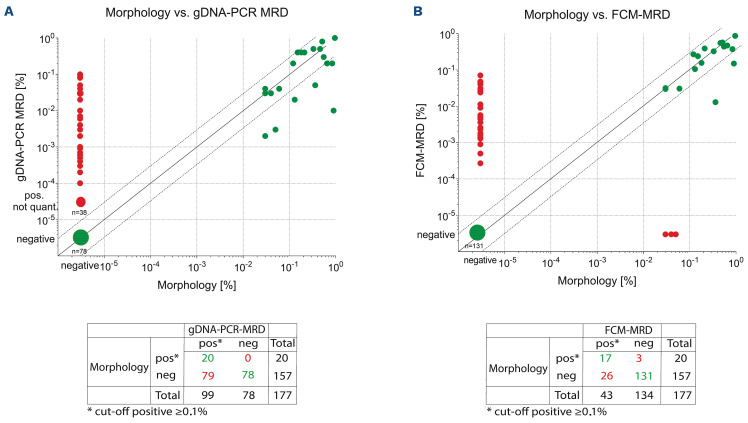
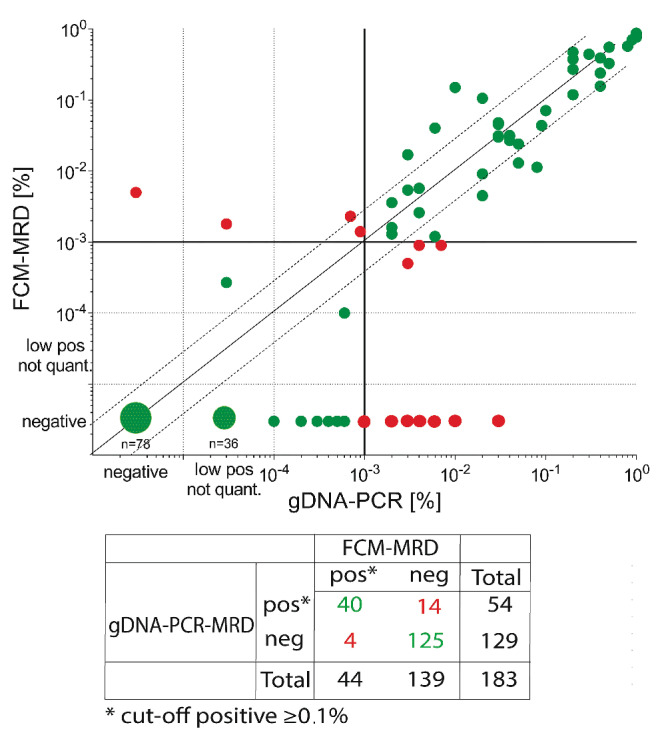
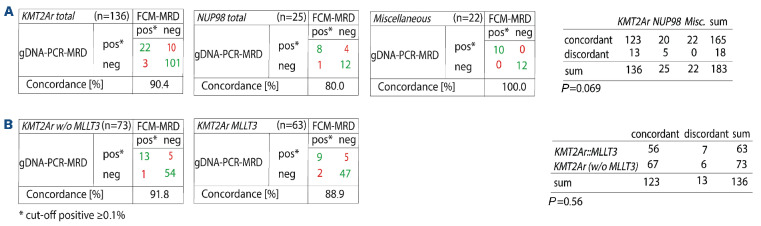
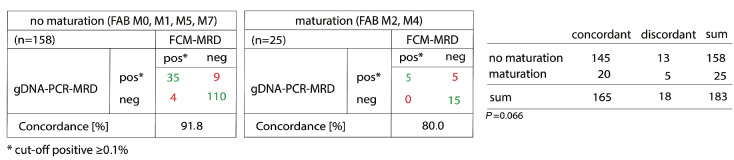
Pediatric acute myeloid leukemia (AML) is a highly heterogeneous disease making standardized measurable residual disease (MRD) assessment challenging. Currently, patient-specific DNA-based assays are only rarely applied for MRD assessment in pediatric AML. We tested whether quantification of genomic breakpoint-specific sequences via quantitative polymerase chain reaction (gDNA-PCR) provides a reliable means of MRD quantification in children with non-standardrisk AML and compared its results to those obtained with state-of-the-art ten-color flow cytometry (FCM). Breakpointspecific gDNA-PCR assays were established according to Euro-MRD consortium guidelines. FCM-MRD assessment was performed according to the European Leukemia Network guidelines with adaptations for pediatric AML. Of 77 consecutively recruited non-standard-risk pediatric AML cases, 49 (64%) carried a chromosomal translocation potentially suitable for MRD quantification. Genomic breakpoint analysis returned a specific DNA sequence in 100% (41/41) of the cases submitted for investigation. MRD levels were evaluated using gDNA-PCR in 243 follow-up samples from 36 patients, achieving a quantitative range of at least 10-4 in 231/243 (95%) of samples. Comparing gDNA-PCR with FCM-MRD data for 183 bone marrow follow-up samples at various therapy timepoints showed a high concordance of 90.2%, considering a cut-off of ≥0.1%. Both methodologies outperformed morphological assessment. We conclude that MRD monitoring by gDNA-PCR is feasible in pediatric AML with traceable genetic rearrangements and correlates well with FCM-MRD in the currently applied clinically relevant range, while being more sensitive below that. The methodology should be evaluated in larger cohorts to pave the way for clinical application.
儿童急性髓系白血病(AML)是一种高度异质性疾病,使得标准化的可测量残留疾病(MRD)评估具有挑战性。目前,基于患者特异性 DNA 的检测方法仅很少应用于儿科 AML 的 MRD 评估。我们测试了通过定量聚合酶链反应(gDNA-PCR)定量基因组断裂点特异性序列是否为非标准风险 AML 儿童提供了可靠的 MRD 定量方法,并将其结果与最先进的十色流式细胞术(FCM)的结果进行了比较。根据 Euro-MRD 联合会指南建立了针对断裂点特异性的 gDNA-PCR 检测方法。根据欧洲白血病网络指南进行 FCM-MRD 评估,并对儿科 AML 进行了调整。在连续招募的 77 例非标准风险儿科 AML 病例中,有 49 例(64%)存在潜在适合 MRD 定量的染色体易位。在提交进行分析的 41 例病例中,100%(41/41)的病例中返回了特定的 DNA 序列。在 36 例患者的 243 个随访样本中使用 gDNA-PCR 评估了 MRD 水平,在 231/243(95%)的样本中实现了至少 10-4 的定量范围。在各种治疗时间点的 183 个骨髓随访样本中,将 gDNA-PCR 与 FCM-MRD 数据进行比较,考虑到≥0.1%的截止值,具有 90.2%的高度一致性。两种方法均优于形态学评估。我们得出结论,gDNA-PCR 可用于儿科 AML 中可追踪的遗传重排的 MRD 监测,与当前应用的临床相关范围内的 FCM-MRD 相关性良好,而在该范围内则更为敏感。该方法应在更大的队列中进行评估,为临床应用铺平道路。