Toffolutti Federica, Guzzinati Stefano, De Paoli Angela, Francisci Silvia, De Angelis Roberta, Crocetti Emanuele, Botta Laura, Rossi Silvia, Mallone Sandra, Zorzi Manuel, Manneschi Gianfranco, Bidoli Ettore, Ravaioli Alessandra, Cuccaro Francesco, Migliore Enrica, Puppo Antonella, Ferrante Margherita, Gasparotti Cinzia, Gambino Maria, Carrozzi Giuliano, Stracci Fabrizio, Michiara Maria, Cavallo Rossella, Mazzucco Walter, Fusco Mario, Ballotari Paola, Sampietro Giuseppe, Ferretti Stefano, Mangone Lucia, Rizzello Roberto Vito, Mian Michael, Cascone Giuseppe, Boschetti Lorenza, Galasso Rocco, Piras Daniela, Pesce Maria Teresa, Bella Francesca, Seghini Pietro, Fanetti Anna Clara, Pinna Pasquala, Serraino Diego, Dal Maso Luigino
Cancer Epidemiology Unit, Centro di Riferimento Oncologico di Aviano (CRO) Istituto di Ricovero e Cura a Carattere Scientifico (IRCCS), Aviano, Italy.
Epidemiological Department, Azienda Zero, Padua, Italy.
Front Oncol. 2023 Jun 6;13:1168325. doi: 10.3389/fonc.2023.1168325. eCollection 2023.
To describe the procedures to derive complete prevalence and several indicators of cancer cure from population-based cancer registries.
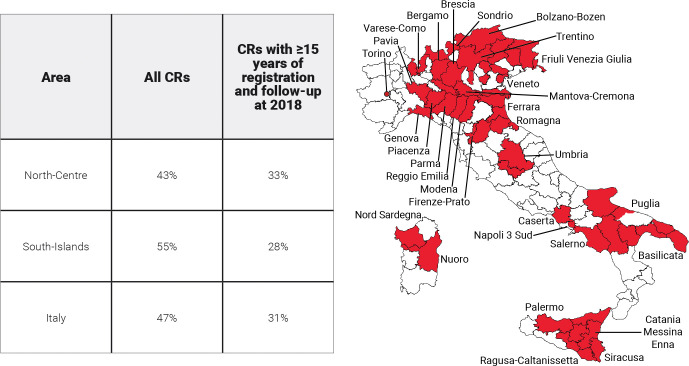
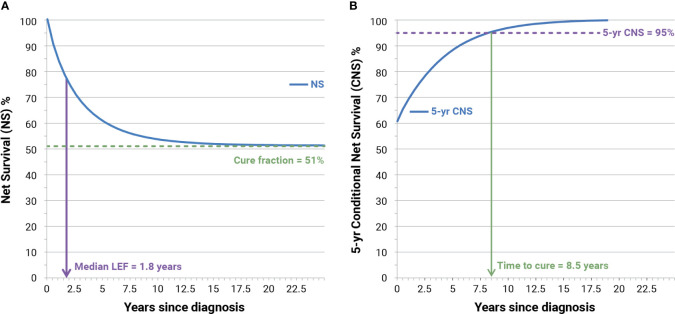
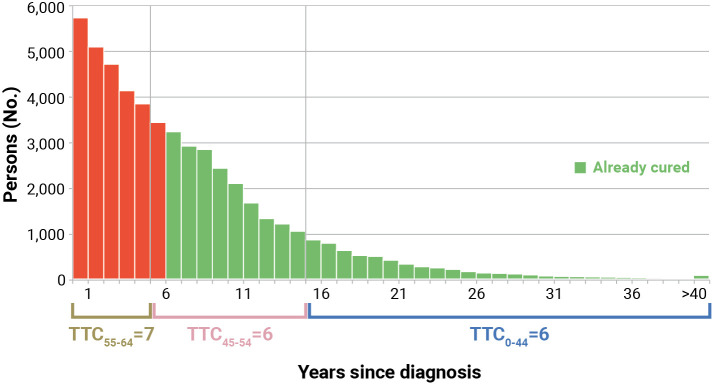
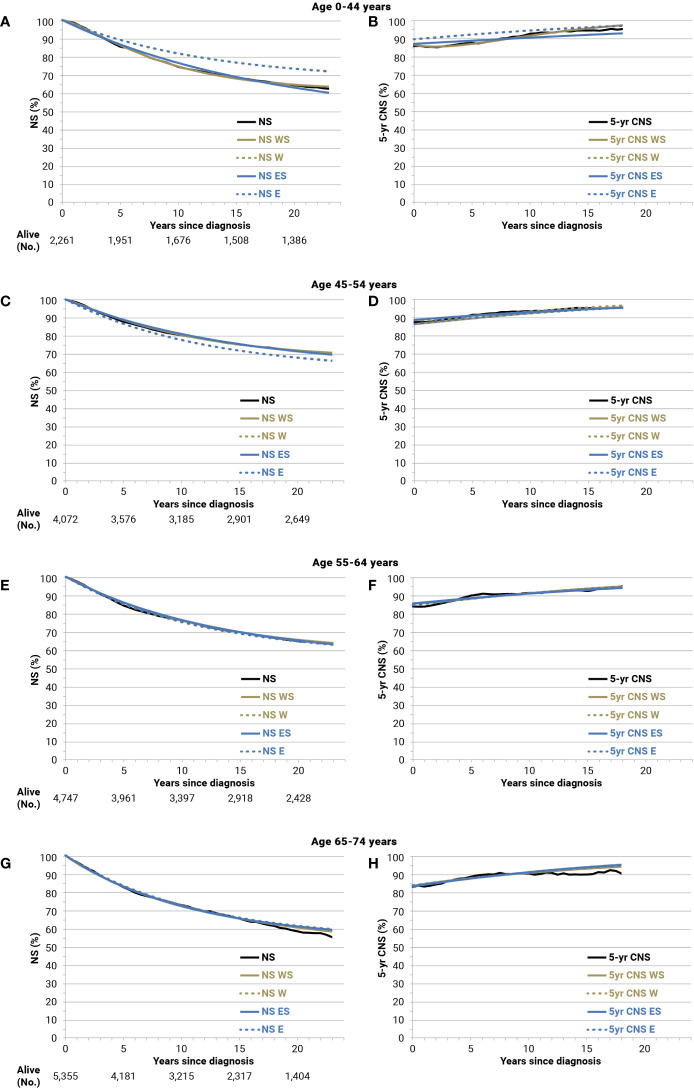
Cancer registry data (47% of the Italian population) were used to calculate limited duration prevalence for 62 cancer types by sex and registry. The incidence and survival models, needed to calculate the completeness index () and complete prevalence, were evaluated by likelihood ratio tests and by visual comparison. A sensitivity analysis was conducted to explore the effect on the complete prevalence of using different indexes. Mixture cure models were used to estimate net survival (NS); life expectancy of fatal (LEF) cases; cure fraction (CF); time to cure (TTC); cure prevalence, prevalent patients who were not at risk of dying as a result of cancer; and already cured patients, those living longer than TTC at a specific point in time. CF was also compared with long-term NS since, for patients diagnosed after a certain age, CF (representing asymptotical values of NS) is reached far beyond the patient's life expectancy.
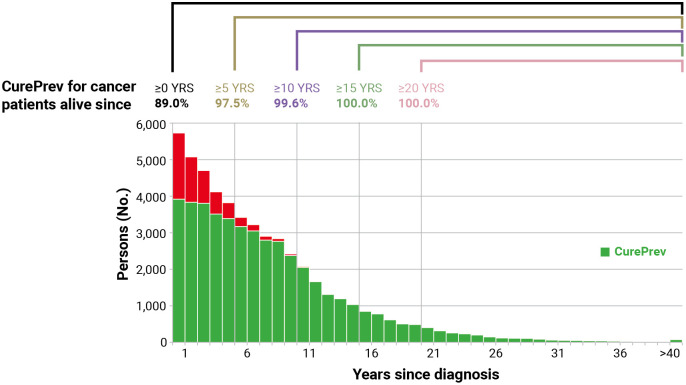
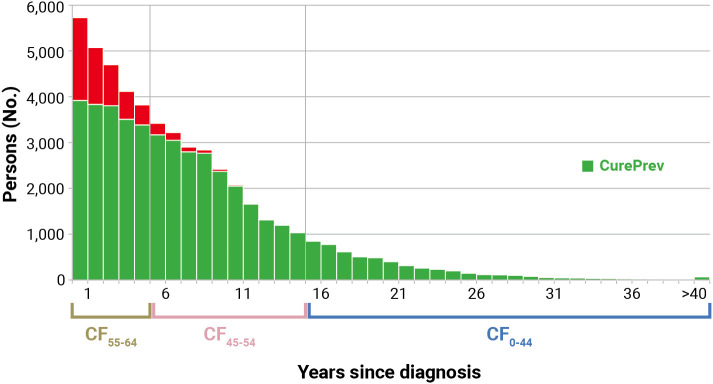
For the most frequent cancer types, the Weibull survival model stratified by sex and age showed a very good fit with observed survival. For men diagnosed with any cancer type at age 65-74 years, CF was 41%, while the NS was 49% until age 100 and 50% until age 90. In women, similar differences emerged for patients with any cancer type or with breast cancer. Among patients alive in 2018 with colorectal cancer at age 55-64 years, 48% were already cured (had reached their specific TTC), while the cure prevalence (lifelong probability to be cured from cancer) was 89%. Cure prevalence became 97.5% (2.5% will die because of their neoplasm) for patients alive >5 years after diagnosis.
This study represents an addition to the current knowledge on the topic providing a detailed description of available indicators of prevalence and cancer cure, highlighting the links among them, and illustrating their interpretation. Indicators may be relevant for patients and clinical practice; they are unambiguously defined, measurable, and reproducible in different countries where population-based cancer registries are active.
描述从基于人群的癌症登记处得出癌症的完整患病率及几种癌症治愈指标的程序。
利用癌症登记数据(覆盖意大利47%的人口),按性别和登记处计算62种癌症类型的有限期患病率。通过似然比检验和直观比较,评估计算完整性指数()和完整患病率所需的发病率和生存模型。进行敏感性分析,以探讨使用不同指数对完整患病率的影响。采用混合治愈模型估计净生存率(NS)、致命病例的预期寿命(LEF)、治愈比例(CF)、治愈时间(TTC)、治愈患病率(因癌症无死亡风险的现患患者)以及已治愈患者(在特定时间点存活超过TTC的患者)。还将CF与长期NS进行比较,因为对于特定年龄后诊断的患者,CF(代表NS的渐近值)在患者预期寿命之后很久才会达到。
对于最常见的癌症类型,按性别和年龄分层的威布尔生存模型与观察到的生存率拟合良好。对于65 - 74岁被诊断患有任何癌症类型的男性,CF为41%,而直到100岁NS为49%,直到90岁为50%。在女性中,对于患有任何癌症类型或乳腺癌的患者也出现了类似差异。在2018年存活的55 - 64岁结直肠癌患者中,48%已治愈(已达到其特定的TTC),而治愈患病率(从癌症中治愈的终身概率)为89%。诊断后存活超过5年的患者,治愈患病率为97.5%(2.5%将因肿瘤死亡)。
本研究为该主题的现有知识增添了内容,详细描述了患病率和癌症治愈的可用指标,突出了它们之间的联系,并说明了其解释。这些指标可能对患者和临床实践具有相关性;它们在基于人群的癌症登记处活跃的不同国家中定义明确、可测量且可重复。