Center for Social Medicine and Humanities, University of California, Los Angeles, United States.
The Action Lab, Center for Health Policy and Law, Northeastern University, United States.
Drug Alcohol Depend. 2023 Aug 1;249:110819. doi: 10.1016/j.drugalcdep.2023.110819. Epub 2023 Jun 9.
Fentanyl- and methamphetamine-based counterfeit prescription drugs have driven escalating overdose death rates in the US, however their presence in Mexico has not been assessed. Our ethnographic team has conducted longitudinal research focused on illicit drug markets in Northern Mexico since 2018. In 2021-2022, study participants described the arrival of new, unusually potent tablets sold as ostensibly controlled substances, without a prescription, directly from pharmacies that cater to US tourists.
To characterize the availability of counterfeit and authentic controlled substances at pharmacies in Northern Mexico available to English-speaking tourists without a prescription.
We employed an iterative, exploratory, mixed methods design. Longitudinal ethnographic data was used to characterize tourist-oriented micro-neighborhoods and guide the selection of n=40 pharmacies in n=4 cities in Northern Mexico. In each pharmacy, samples of "oxycodone", "Xanax", and "Adderall" were sought as single pills, during English-language encounters, after which detailed ethnographic accounts were recorded. We employed immunoassay-based testing strips to check each pill for the presence of fentanyls, benzodiazepines, amphetamines, and methamphetamines. We used Fourier-Transform Infrared Spectroscopy to further characterize drug contents.
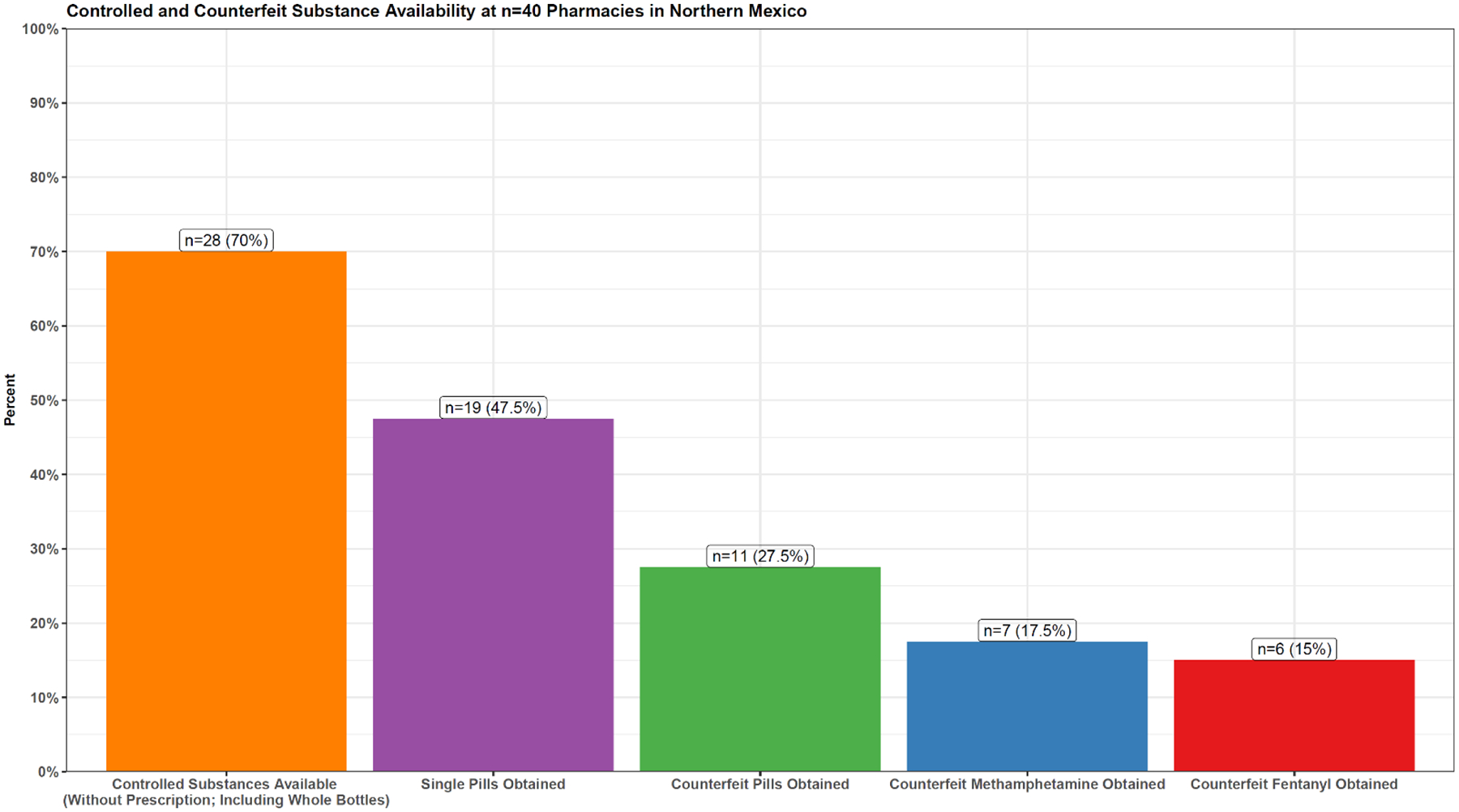
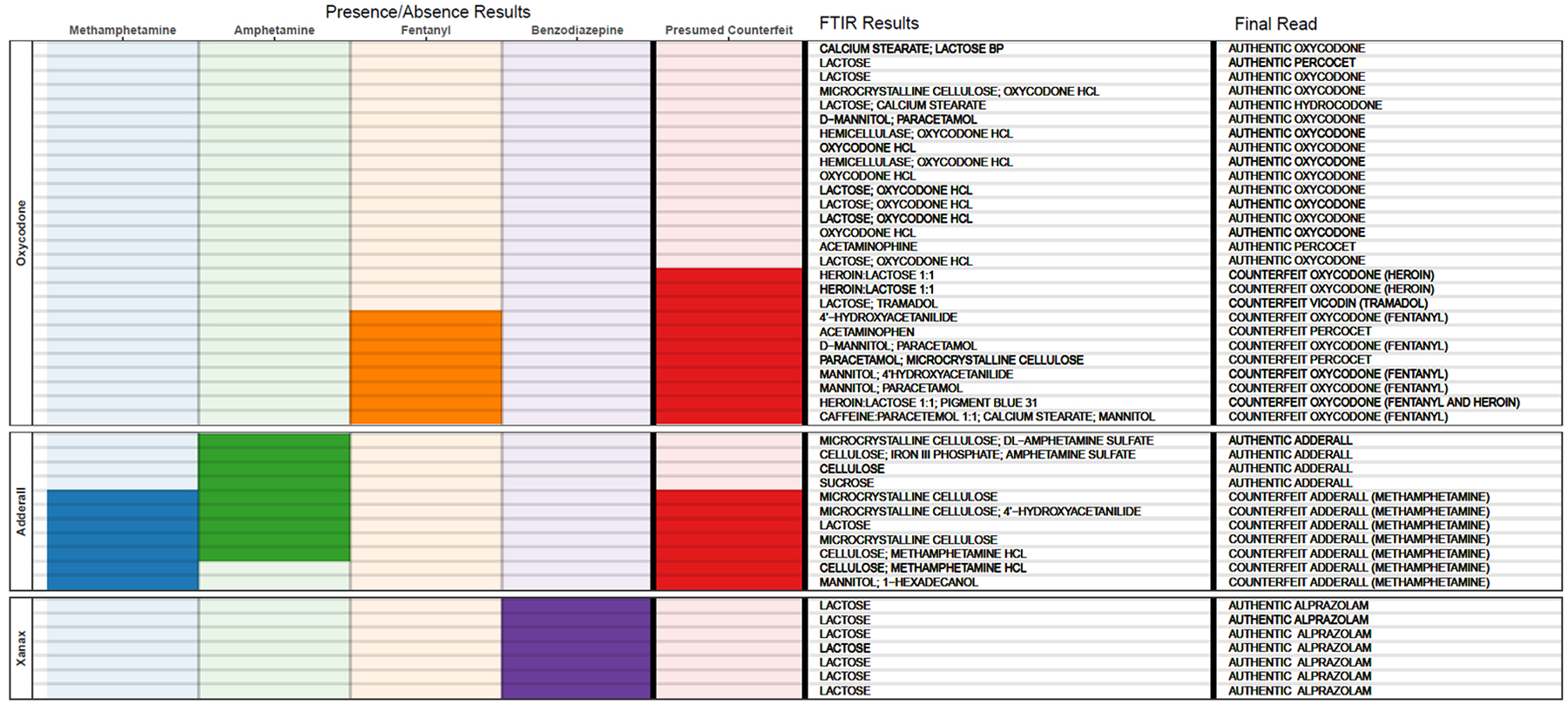
Of n=40 pharmacies, one or more of the requested controlled substances could be obtained with no prescription (as single pills or in bottles) at 28 (70.0%) and as single pills at 19 (47.5%). Counterfeit pills were obtained at 11 pharmacies (27.5%). Of n=45 samples sold as one-off controlled substances, 18 were counterfeit. 7 of 11 (63.6%) samples sold as "Adderall" contained methamphetamine, 8 of 27 (29.6%) samples sold as "Oxycodone" contained fentanyl, and 3 "Oxycodone" samples contained heroin. Pharmacies providing counterfeit drugs were uniformly located in tourist-serving micro-neighborhoods, and generally featured English-language advertisements for erectile dysfunction medications and "painkillers". Pharmacy employees occasionally expressed concern about overdose risk and provided harm reduction guidance.
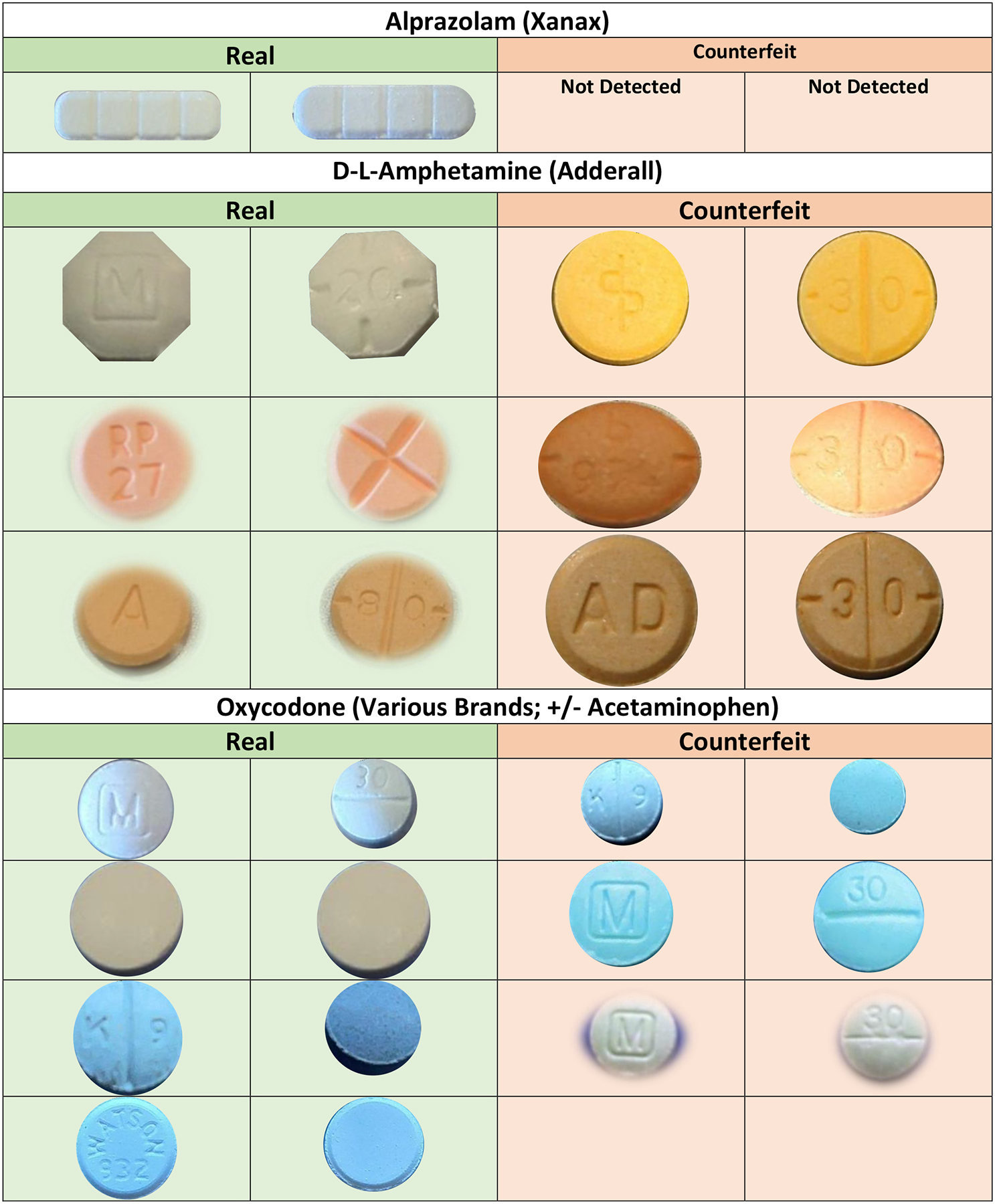
The availability of fentanyl-, heroin-, and methamphetamine-based counterfeit medications in tourist-oriented independent pharmacies in Northern Mexico represents a public health risk, and occurs in the context of 1) the normalization of medical tourism as a response to rising unaffordability of healthcare in the US, 2) plummeting rates of opioid prescription in the US, affecting both chronic pain patients and the availability of legitimate pharmaceuticals on the unregulated market, 3) the rise of fentanyl-based counterfeit opioids as a key driver of the fourth, and deadliest-to-date, wave of the opioid crisis. It was not possible to distinguish counterfeit medications based on appearance of pills or geography of pharmacies, because identically-appearing authentic and counterfeit versions were often sold in close geographic proximity. Nevertheless, people who consume drugs may be more trusting of controlled substances purchased directly from pharmacies. Due to Mexico's limited opioid overdose surveillance infrastructure, the current death rate from these substances remains unknown.
芬太尼和冰毒为基础的假冒处方药物导致美国的过量用药致死率不断上升,然而,它们在墨西哥的存在尚未得到评估。自 2018 年以来,我们的民族志团队一直在对墨西哥北部的非法毒品市场进行长期研究。2021-2022 年,研究参与者描述了新的、异常有效的片剂的出现,这些片剂被作为表面上的受控物质出售,无需处方,直接从迎合美国游客的药店购买。
描述在墨西哥北部对英语游客无需处方即可获得的假冒和真实受控物质的供应情况。
我们采用了迭代、探索性、混合方法设计。长期民族志数据用于描述面向游客的微观社区,并指导在墨西哥北部 4 个城市选择了 40 家药店。在每家药店,我们都在英语交流中寻找“奥施康定”、“阿普唑仑”和“安非他命”的单粒样本,之后详细记录民族志描述。我们使用免疫测定法检测条带检查每片药物中是否存在芬太尼、苯二氮䓬类、苯丙胺和甲基苯丙胺。我们使用傅里叶变换红外光谱进一步分析药物成分。
在 40 家药店中,有 28 家(70.0%)和 19 家(47.5%)可以在无需处方的情况下获得一种或多种所需的受控物质(作为单粒或瓶装)。在 11 家药店(27.5%)中获得了假冒药物。在 45 个作为一次性受控物质出售的样本中,有 18 个是假冒的。11 个被标记为“安非他命”的样本中有 7 个含有甲基苯丙胺,27 个被标记为“奥施康定”的样本中有 8 个含有芬太尼,3 个“奥施康定”样本含有海洛因。提供假冒药物的药店都位于面向游客的微型社区内,通常有针对勃起功能障碍药物和“止痛药”的英文广告。药店员工偶尔会对用药过量的风险表示担忧,并提供减少伤害的指导。
在墨西哥北部面向游客的独立药店中,出现了芬太尼、海洛因和甲基苯丙胺为基础的假冒药物,这是一个公共卫生风险,其发生的背景是:1)随着美国医疗保健费用的不断上涨,医疗旅游已变得常态化;2)美国阿片类药物处方数量骤降,这不仅影响了慢性疼痛患者,也影响了不受监管市场上合法药物的供应;3)芬太尼为基础的假冒阿片类药物成为第四波也是迄今为止致命程度最高的阿片类药物危机的主要驱动因素。由于墨西哥对阿片类药物过量监测的基础设施有限,目前尚不清楚这些物质的死亡率。