Makerere University College of Health Sciences, Kampala, Uganda.
Population Services International Uganda, Kampala, Uganda.
Glob Health Sci Pract. 2023 Jun 21;11(3). doi: 10.9745/GHSP-D-22-00332.
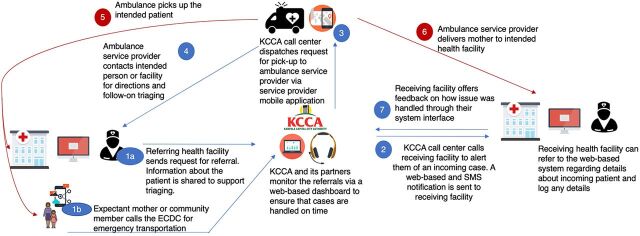
Most pregnant women living in urban slum communities in Uganda deliver at public health centers that are not equipped to provide emergency obstetric and newborn care. When obstetric emergencies occur, pregnant women are referred to a higher-level facility and are responsible for arranging and paying for their own transport. The Kampala Slum Maternal Newborn (MaNe) project developed and tested an emergency call and ambulance dispatch center and a mobile application to request, deploy, and track ambulances. We describe the development of these 2 interventions and findings on the feasibility, acceptability, and sustainability of the interventions.
MaNe conducted a mixed-method feasibility study that included an assessment of the acceptability and demand of the interventions. In-depth interviews (N=26) were conducted with facility proprietors, health providers, ambulance drivers, Kampala Capital City Authority officers, and community members to understand the successes and challenges of establishing the call center and developing the mobile application. Thematic content analysis was done. Quantitative data from the call center dispatch logs were analyzed descriptively to complement the qualitative findings.
Between April 2020 and June 2021, 10,183 calls were made to the emergency call and dispatch center. Of these, 25% were related to maternal and newborn health emergencies and 14% were COVID-19 related. An ambulance was dispatched to transfer or evacuate a patient in 35% of the calls. Participants acknowledged that the call center and mobile application allowed for efficient communication, coordination, and information flow between health facilities. Supportive district leadership facilitated the establishment of the call center and has taken over the operating costs of the center.
The call center and referral application improved the coordination of drivers and ambulances and allowed facilities to prepare for and treat cases more efficiently.
大多数居住在乌干达城市贫民窟社区的孕妇都在公共卫生中心分娩,而这些中心没有提供紧急产科和新生儿护理的设备。当出现产科紧急情况时,孕妇会被转介到更高一级的医疗机构,并且需要自行安排和支付交通费用。坎帕拉贫民窟母婴新生命(MaNe)项目开发并测试了一个紧急呼叫和救护车派遣中心以及一个移动应用程序,用于请求、部署和跟踪救护车。我们描述了这两项干预措施的开发情况,以及对干预措施的可行性、可接受性和可持续性的研究结果。
MaNe 进行了一项混合方法可行性研究,包括评估干预措施的可接受性和需求。通过深入访谈(N=26),与医疗机构所有人、卫生服务提供者、救护车司机、坎帕拉首都城市管理局官员和社区成员进行了交流,了解了建立呼叫中心和开发移动应用程序的成功经验和挑战。进行了主题内容分析。对呼叫中心调度日志中的定量数据进行了描述性分析,以补充定性研究结果。
在 2020 年 4 月至 2021 年 6 月期间,紧急呼叫和派遣中心接到了 10,183 个电话。其中,25%与产妇和新生儿健康紧急情况有关,14%与 COVID-19 有关。在 35%的电话中,救护车被派去转移或疏散病人。参与者承认呼叫中心和移动应用程序允许医疗机构之间进行高效的沟通、协调和信息流动。支持性的地区领导层促进了呼叫中心的建立,并承担了中心的运营成本。
呼叫中心和转介应用程序改善了司机和救护车的协调,使医疗机构能够更有效地准备和治疗病例。