Andersson Sarah R, Hassanen Sarah, Momanyi Amos M, Onyango Danielson K, Gatwechi Daniel K, Lutukai Mercy N, Aura Karen O, Mungai Alex M, Chandani Yasmin K
Murdoch Children's Research Institute, Melbourne, Australia.
Human-Centered Design Corner, Nairobi, Kenya.
Glob Health Sci Pract. 2021 Mar 15;9(Suppl 1):S151-S167. doi: 10.9745/GHSP-D-20-00378.
Unreliable and nonexistent supply chain procedures and processes are one of the primary barriers to achieving functional community health units in nomadic communities in the arid/semiarid counties of Kenya.
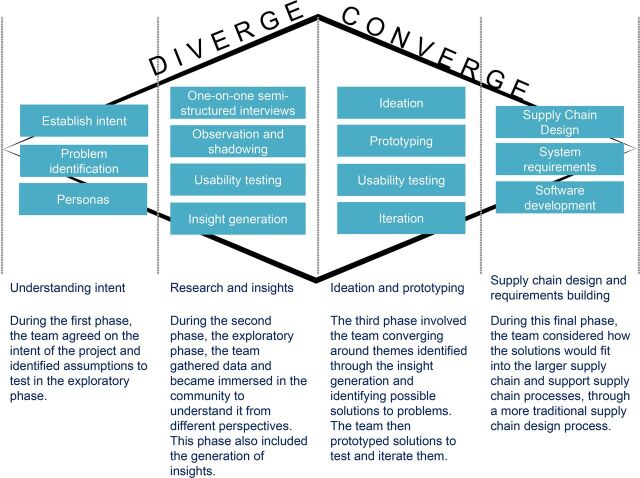
We used a human-centered design (HCD) approach to engage communities and community health volunteers (CHVs) in redesigning a proven data-centric supply chain approach that included a digital solution, called cStock, for this challenging context. We conducted the HCD process in 4 phases: (1) understanding intent, (2) research and insights, (3) ideation and prototyping, and (4) supply chain design and requirements building. Data collection used qualitative methods and involved a range of stakeholders including CHVs, supervisors, and local beneficiaries. CHVs and their supervisors also participated in cStock usability testing. Drawing on insights and personas generated from the research, stakeholders ideated and codesigned supply chain tools.
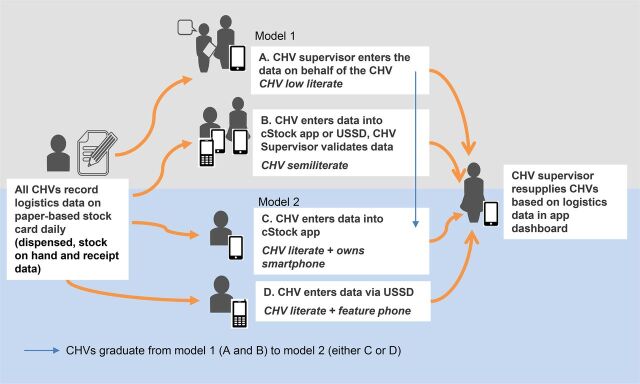
The research identified critical insights for informing the redesign of cStock for nomadic communities. These insights were categorized into supply chain, information systems, human resources, behaviors, service delivery infrastructure, and connectivity. Four supply chain data solutions were designed, prototyped, tested, and iterated: a stock recording paper-based form, a user-friendly cStock application, a supervisor cStock application, and an unstructured supplementary service data reporting system using feature phones.
Using the HCD process incorporated the perspective of CHVs and their communities and provided key insights to inform the design of the supply chain and adapt cStock. The process helped make cStock to be inclusive and have the potential to have a meaningful impact on strengthening the supply chain for seminomadic and nomadic communities in northern Kenya. A strong supply chain for these CHVs will increase access to essential and reproductive health commodities and contribute to improving the overall health and well-being of these communities, especially women and children.
不可靠且不存在的供应链程序和流程是在肯尼亚干旱/半干旱县的游牧社区实现功能完备的社区卫生单位的主要障碍之一。
我们采用以人为本的设计(HCD)方法,让社区和社区卫生志愿者(CHV)参与重新设计一种经过验证的以数据为中心的供应链方法,该方法包括一种针对这一具有挑战性的环境的数字解决方案,称为cStock。我们分四个阶段进行HCD过程:(1)理解意图,(2)研究与洞察,(3)构思与原型制作,以及(4)供应链设计与需求构建。数据收集采用定性方法,涉及一系列利益相关者,包括CHV、监督员和当地受益者。CHV及其监督员还参与了cStock可用性测试。利用研究中产生的洞察和人物角色,利益相关者构思并共同设计了供应链工具。
该研究确定了为游牧社区重新设计cStock的关键洞察。这些洞察分为供应链、信息系统、人力资源、行为、服务提供基础设施和连接性。设计、制作原型、测试并迭代了四种供应链数据解决方案:一种基于纸张的库存记录表格、一个用户友好的cStock应用程序、一个监督员cStock应用程序,以及一个使用功能手机的非结构化补充服务数据报告系统。
使用HCD过程纳入了CHV及其社区的观点,并提供了关键洞察,为供应链设计提供信息并使cStock适应需求。该过程有助于使cStock具有包容性,并有可能对加强肯尼亚北部半游牧和游牧社区的供应链产生有意义的影响。为这些CHV建立强大的供应链将增加获得基本和生殖健康商品的机会,并有助于改善这些社区,特别是妇女和儿童的整体健康和福祉。