
科特迪瓦中部格贝凯地区按蚊媒介分布与疟疾传播动力学。
Anopheles vector distribution and malaria transmission dynamics in Gbêkê region, central Côte d'Ivoire.
机构信息
Institut Pierre Richet (IPR)/Institut National de Santé Publique (INSP), Bouaké, Côte d'Ivoire.
Vector Control Product Evaluation Centre (VCPEC), Institut Pierre Richet (VCPEC-IPR)/INSP, Bouaké, Côte d'Ivoire.
出版信息
Malar J. 2023 Jun 22;22(1):192. doi: 10.1186/s12936-023-04623-1.
BACKGROUND
A better understanding of vector distribution and malaria transmission dynamics at a local scale is essential for implementing and evaluating effectiveness of vector control strategies. Through the data gathered in the framework of a cluster randomized controlled trial (CRT) evaluating the In2Care (Wageningen, Netherlands) Eave Tubes strategy, the distribution of the Anopheles vector, their biting behaviour and malaria transmission dynamics were investigated in Gbêkê region, central Côte d'Ivoire.
METHODS
From May 2017 to April 2019, adult mosquitoes were collected monthly using human landing catches (HLC) in twenty villages in Gbêkê region. Mosquito species wereidentified morphologically. Monthly entomological inoculation rates (EIR) were estimated by combining the HLC data with mosquito sporozoite infection rates measured in a subset of Anopheles vectors using PCR. Finally, biting rate and EIR fluctuations were fit to local rainfall data to investigate the seasonal determinants of mosquito abundance and malaria transmission in this region.
RESULTS
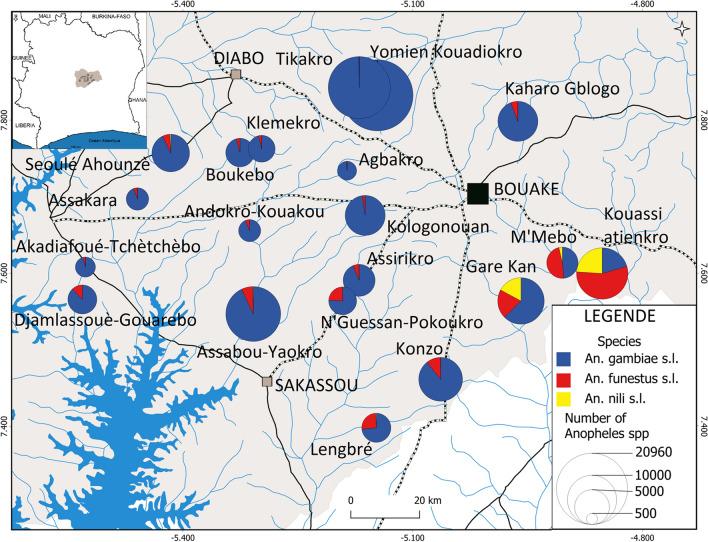
Overall, Anopheles gambiae, Anopheles funestus, and Anopheles nili were the three vector complexes found infected in the Gbêkê region, but there was a variation in Anopheles vector composition between villages. Anopheles gambiae was the predominant malaria vector responsible for 84.8% of Plasmodium parasite transmission in the area. An unprotected individual living in Gbêkê region received an average of 260 [222-298], 43.5 [35.8-51.29] and 3.02 [1.96-4] infected bites per year from An. gambiae, An. funestus and An. nili, respectively. Vector abundance and malaria transmission dynamics varied significantly between seasons and the highest biting rate and EIRs occurred in the months of heavy rainfall. However, mosquitoes infected with malaria parasites remained present in the dry season, despite the low density of mosquito populations.
CONCLUSION
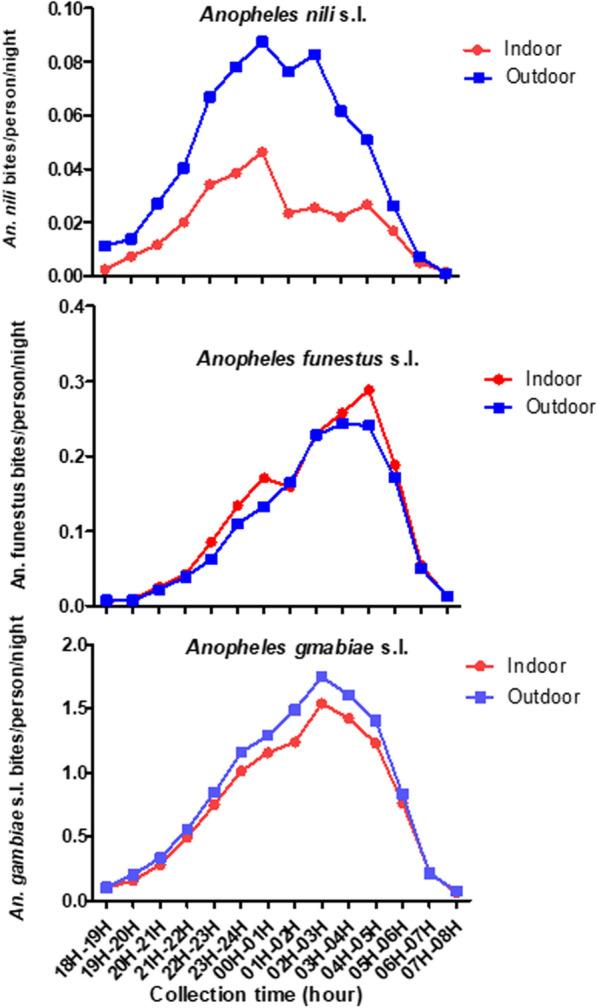
These results demonstrate that the intensity of malaria transmission is extremely high in Gbêkê region, especially during the rainy season. The study highlights the risk factors of transmission that could negatively impact current interventions that target indoor control, as well as the urgent need for additional vector control tools to target the population of malaria vectors in Gbêkê region and reduce the burden of the disease.
背景
更好地了解当地范围内的病媒分布和疟疾传播动态,对于实施和评估病媒控制策略的有效性至关重要。通过在评估 In2Care(荷兰瓦赫宁根)屋檐管策略的整群随机对照试验(CRT)框架内收集的数据,对科特迪瓦中部 Gbêkê 地区的疟蚊分布、叮咬行为和疟疾传播动态进行了研究。
方法
2017 年 5 月至 2019 年 4 月,每月使用人体诱蚊灯(HLC)在 Gbêkê 地区的 20 个村庄采集成年蚊子。通过形态学鉴定蚊子种类。通过 HLC 数据与 PCR 测量的蚊媒感染率相结合,计算每月的昆虫学接种率(EIR)。最后,根据当地降雨数据拟合叮咬率和 EIR 波动,以研究该地区蚊子数量和疟疾传播的季节性决定因素。
结果
总体而言,在 Gbêkê 地区发现三种病媒复合体感染的疟蚊,包括冈比亚按蚊、致倦库蚊和奈氏按蚊,但村庄之间的疟蚊组成存在差异。冈比亚按蚊是该地区主要的疟疾传播媒介,占寄生虫传播的 84.8%。居住在 Gbêkê 地区的未受保护个体每年平均分别从冈比亚按蚊、致倦库蚊和奈氏按蚊感染 260(222-298)、43.5(35.8-51.29)和 3.02(1.96-4)次感染性叮咬。蚊媒数量和疟疾传播动态在季节之间有显著差异,最高的叮咬率和 EIR 发生在降雨量较大的月份。然而,尽管蚊子数量较少,在旱季仍有感染疟原虫的蚊子存在。
结论
这些结果表明,Gbêkê 地区的疟疾传播强度极高,尤其是在雨季。该研究强调了传播的风险因素,这可能对当前以室内控制为目标的干预措施产生负面影响,以及迫切需要额外的病媒控制工具来针对 Gbêkê 地区的疟疾媒介种群并减轻疾病负担。



 Zotero 插件