Swiss Tropical and Public Health Institute, Basel, Switzerland.
University of Basel, Basel, Switzerland.
J Infect Dis. 2021 Apr 27;223(12 Suppl 2):S171-S186. doi: 10.1093/infdis/jiaa402.
Malaria transmission is currently resurging in Papua New Guinea (PNG). In addition to intervention coverage, social and cultural factors influence changes in epidemiology of malaria in PNG. This study aimed to better understand the role of human behavior in relation to current malaria control efforts.
A mixed-method design was used in 2 sites in PNG. In-depth interviews, focus group discussions, cross-sectional malaria indicator survey, and population census were implemented.
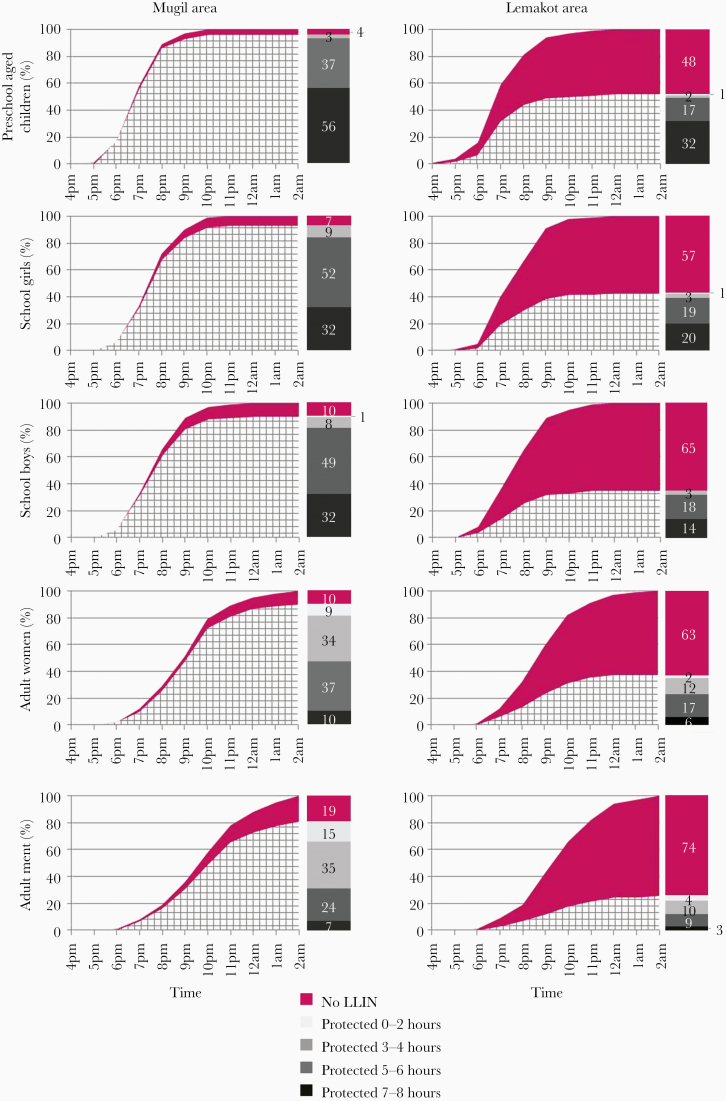
We identified 7 population groups based on demographics and behavioral patterns with potential relevance to Anopheles exposure. People spend a substantial amount of time outdoors or in semiopen structures. Between 4 pm and 8 am, all types of activities across all groups in both study sites may be exposing individuals to mosquito bites; sleeping under a long-lasting insecticidal net was the exception. The later in the night, the more outdoor presence was concentrated in adult men.
Our findings highlight the potential of outdoor exposure to hamper malaria control as people spend a remarkable amount of time outdoors without protection from mosquitoes. To prevent ongoing transmission, targeting of groups, places, and activities with complementary interventions should consider setting-specific human behaviors in addition to epidemiological and entomological data.
疟疾在巴布亚新几内亚(PNG)的传播目前正在卷土重来。除了干预措施的覆盖范围外,社会和文化因素也会影响 PNG 疟疾的流行病学变化。本研究旨在更好地了解人类行为在当前疟疾控制工作中的作用。
在 PNG 的两个地点采用了混合方法设计。实施了深入访谈、焦点小组讨论、疟疾指标横断面调查和人口普查。
我们根据人口统计学和行为模式确定了 7 个人群组,这些人群组可能与疟蚊接触有关。人们花费大量时间在户外或半开放式结构中。在 4 点至 8 点之间,两个研究地点的所有群体都可能从事各种活动,使个人面临蚊子叮咬的风险;睡在长效驱虫蚊帐下是例外。时间越晚,户外停留的成年男性就越集中。
我们的研究结果强调了户外暴露的潜在影响,因为人们在户外花费大量时间而没有免受蚊子的侵害。为了防止疟疾的持续传播,除了流行病学和昆虫学数据外,针对特定群体、地点和活动的补充干预措施,还应考虑具体的人类行为。