Ha Eun Kyo, Kim Ju Hee, Han Man Yong
Department of Pediatrics, Hallym University Kangnam Sacred Heart Hospital, Seoul, Korea.
Department of Pediatrics, Kyung Hee University Medical Center, Seoul, Korea.
Clin Exp Pediatr. 2023 Nov;66(11):465-474. doi: 10.3345/cep.2023.00472. Epub 2023 Jun 19.
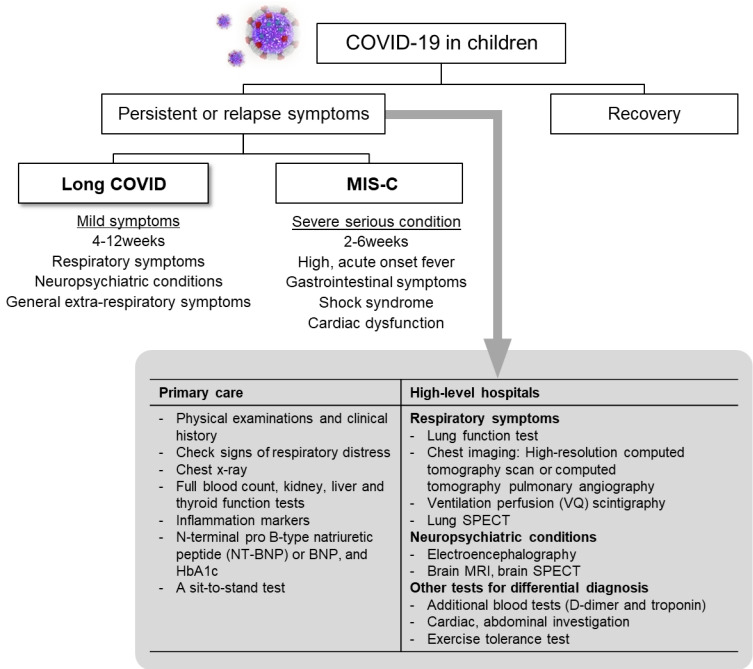
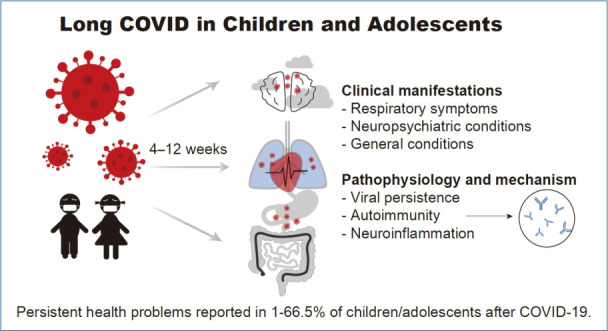
Long coronavirus disease (COVID), also known as postacute sequelae of severe acute respiratory syndrome coronavirus 2 infection, has been defined as signs and symptoms which persist for 4 weeks or even lasting for 6 months after the initial infection. Although the prevalence of long COVID in children is currently unknown, epidemiological investigations have reported cases in pediatric populations. Clinical manifestations of long COVID in children include respiratory symptoms, such as cough and dyspnea, as well as neuropsychiatric and general conditions, including fatigue, headache, and muscle weakness. The pathophysiology of long COVID in children is still being investigated, but potential mechanisms include viral persistence, autoimmunity, and neuroinflammation. Risk factors for long COVID in children are not yet well understood, but studies have suggested that children with a history of severe acute COVID-19 infection or comorbidities may be at increased risk. Evaluation for respiratory symptoms of long COVID in children is essential, including spirometry and imaging studies to assess lung function and any potential damage. Furthermore, long COVID in children has been associated with a higher prevalence of mental health problems than in adults, emphasizing the importance of monitoring and addressing these aspects in pediatric patients. Although our understanding of long COVID in children and adolescents is still evolving, it is clear that the condition can have significant impacts on their health and well-being. The aim of this review is to synthesize the current knowledge on the prevalence, risk factors, and pathophysiology of long COVID in children and adolescents, and to discuss potential management strategies based on existing evidence.
长期新冠病毒病(COVID),也称为严重急性呼吸综合征冠状病毒2感染的急性后遗症,被定义为在初次感染后持续4周甚至持续6个月的体征和症状。尽管目前儿童长期新冠病毒病的患病率尚不清楚,但流行病学调查已报告了儿科人群中的病例。儿童长期新冠病毒病的临床表现包括呼吸道症状,如咳嗽和呼吸困难,以及神经精神和一般状况,包括疲劳、头痛和肌肉无力。儿童长期新冠病毒病的病理生理学仍在研究中,但潜在机制包括病毒持续存在、自身免疫和神经炎症。儿童长期新冠病毒病的危险因素尚未完全了解,但研究表明,有严重急性新冠病毒病感染史或合并症的儿童可能风险增加。对儿童长期新冠病毒病的呼吸道症状进行评估至关重要,包括进行肺功能测定和影像学检查以评估肺功能和任何潜在损伤。此外,与成人相比,儿童长期新冠病毒病与心理健康问题的患病率更高有关,这凸显了在儿科患者中监测和处理这些方面的重要性。尽管我们对儿童和青少年长期新冠病毒病的理解仍在不断发展,但很明显这种疾病会对他们的健康和幸福产生重大影响。本综述的目的是综合当前关于儿童和青少年长期新冠病毒病的患病率、危险因素和病理生理学的知识,并根据现有证据讨论潜在的管理策略。