Department of Biomedical and Clinical Sciences (BKV), BKH/Obstetrics and Gynecology, Faculty of Medicine and Health Sciences, Linköping University, Linköping, Sweden.
Department of Animal Reproduction, Instituto Nacional de Investigación Agraria y Alimentaria (INIA)-CSIC, Madrid, Spain.
Front Endocrinol (Lausanne). 2023 Jun 7;14:1042176. doi: 10.3389/fendo.2023.1042176. eCollection 2023.
Mating induces large changes in the female genital tract, warranting female homeostasis and immune preparation for pregnancy, including the preservation of crucial oxidative status among its pathways. Being highly susceptible to oxidative stress, sperm survival and preserved function depend on the seminal plasma, a protection that is removed during sperm handling but also after mating when spermatozoa enter the oviduct. Therefore, it is pertinent to consider that the female sperm reservoir takes up this protection, providing a suitable environment for sperm viability. These aspects have not been explored despite the increasing strategies in modulating the female status through diet control and nutritional supplementation.
To test the hypothesis that mating modifies the expression of crucial oxidative-reductive transcripts across the entire pig female genital tract (cervix to infundibulum) and, particularly in the sperm reservoir at the utero-tubal junction, before ovulation, a period dominated by estrogen stimulation of ovarian as well as of seminal origin.
The differential expression of estrogen (ER) and progesterone (PR) receptors and of 59 oxidative-reductive transcripts were studied using a species-specific microarray platform, in specific segments of the peri-ovulatory sow reproductive tract in response to mating.
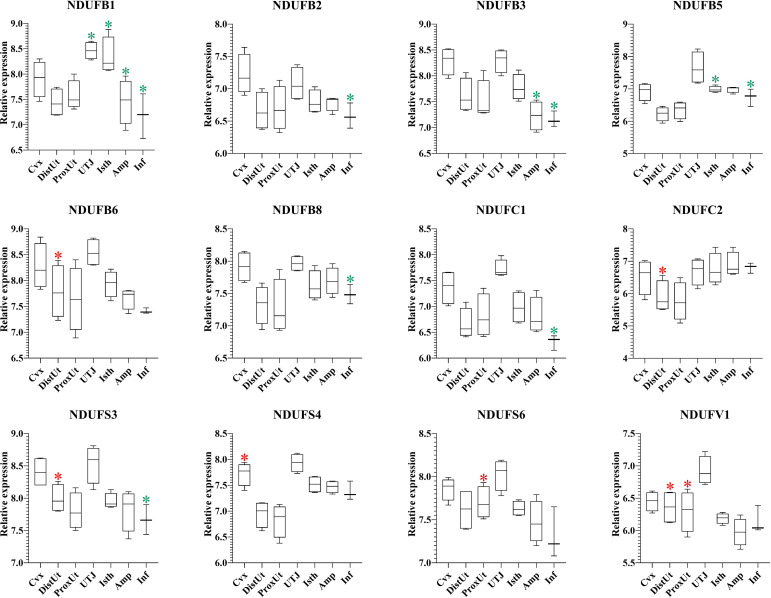
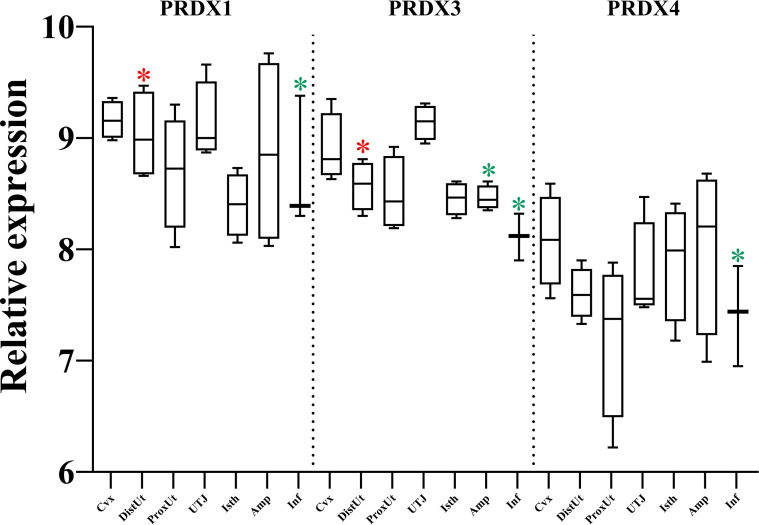
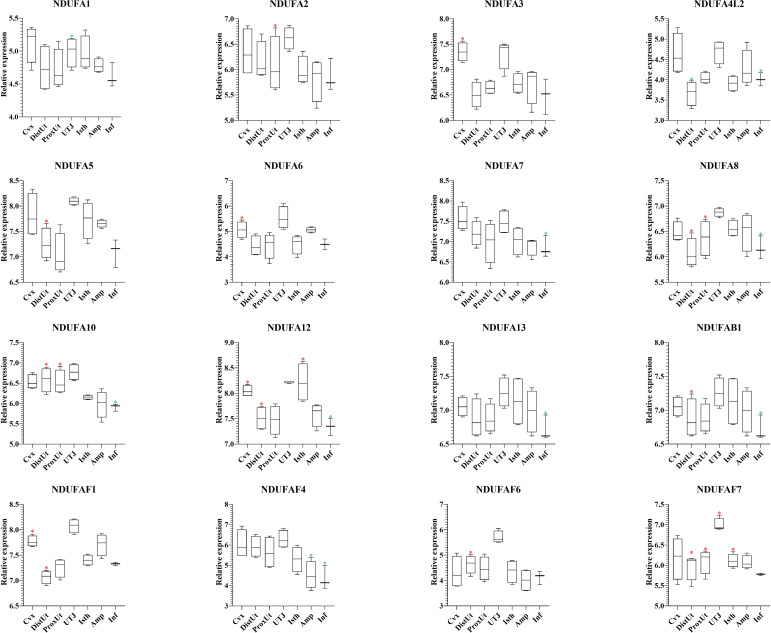
Mating induced changes along the entire tract, with a conspicuous downregulation of both ER and PR and an upregulation of superoxide dismutase 1 (, glutaredoxin (), and peroxiredoxin 1 and 3 (, , among other NADH Dehydrogenase Ubiquinone Flavoproteins, in the distal uterus segment. These changes perhaps helped prevent oxidative stress in the area adjacent to the sperm reservoir at the utero-tubal junction. Concomitantly, there were a downregulation of catalase () and NADH dehydrogenase (ubiquinone) oxidoreductases 1 beta subcomplex, subunit 1 () in the utero-tubal junction alongside an overall downregulation of , , and in the ampullar and infundibulum segments.
Natural mating is an inducer of changes in the expression of female genes commanding antioxidant enzymes relevant for sperm survival during sperm transport, under predominant estrogen influence through the bloodstream and semen. The findings could contribute to the design of new therapeutics for the female to improve oxidative-reductive balance.
交配会引起雌性生殖道的巨大变化,这需要雌性保持体内平衡并为怀孕做好免疫准备,包括维持生殖道内关键的氧化状态。精子对氧化应激非常敏感,其存活和功能的保持依赖于精液,而在精液处理过程中以及精子进入输卵管后,这种保护作用都会被去除。因此,考虑到雌性的精子库会承担这种保护作用,为精子的存活提供合适的环境是很重要的。尽管人们越来越多地通过饮食控制和营养补充来调节女性的身体状况,但这些方面仍未得到探索。
检验以下假设,即交配会改变整个猪雌性生殖道(从宫颈到壶腹)的关键氧化还原转录本的表达,特别是在排卵前的输卵管-子宫连接处的精子库中,这个时期受到卵巢和精液来源的雌激素刺激的支配。
使用一种种属特异性的微阵列平台,研究了发情母猪生殖管道的特定部位在交配后对雌激素(ER)和孕激素(PR)受体以及 59 个氧化还原转录本的差异表达。
交配沿整个生殖道诱导了变化,导致 ER 和 PR 明显下调,同时超氧化物歧化酶 1()、谷胱甘肽还原酶()和过氧化物酶 1 和 3()上调,以及其他 NADH 脱氢酶泛醌黄素蛋白上调,在远端子宫段。这些变化可能有助于防止紧邻输卵管-子宫连接处精子库的区域发生氧化应激。同时,在输卵管-子宫连接处,过氧化氢酶()和 NADH 脱氢酶(泛醌)氧化还原酶 1β亚基,亚单位 1()下调,以及在壶腹部和漏斗部的整体下调,同时伴随着,和的下调。
自然交配是诱导雌性基因表达变化的一个因素,这些基因指挥着抗氧化酶的活性,对于精子在运输过程中的存活至关重要,这主要是通过血液中的雌激素和精液中的雌激素来实现的。这些发现可能有助于设计新的女性治疗方法,以改善氧化还原平衡。