Guo Guanglun, Zhou Tiantian, Ren Fengyun, Sun Jingzhan, Deng Dun, Huang Xingguo, Wassie Teketay, Qazi Izhar Hyder, Wu Xin
College of Animal Science and Technology, Hunan Agricultural University, Changsha 410128, China.
Key Laboratory of Agro-Ecological Processes in Subtropical Region, Institute of Subtropical Agriculture, The Chinese Academy of Sciences, Changsha 410125, China.
Animals (Basel). 2022 Mar 24;12(7):828. doi: 10.3390/ani12070828.
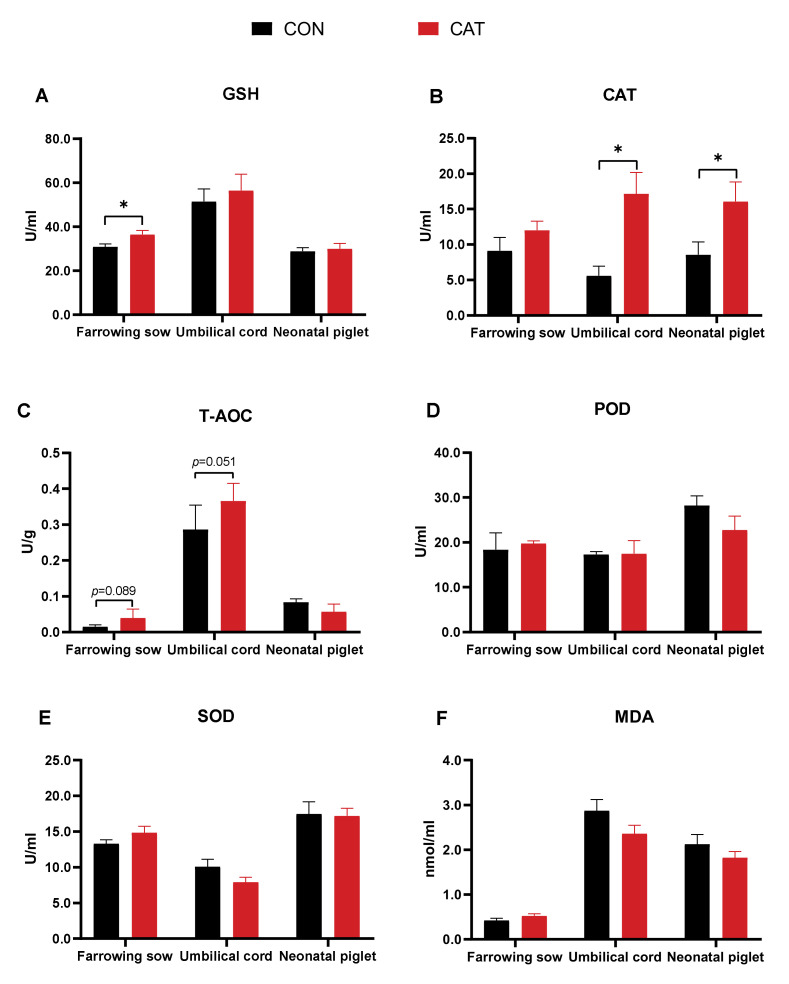
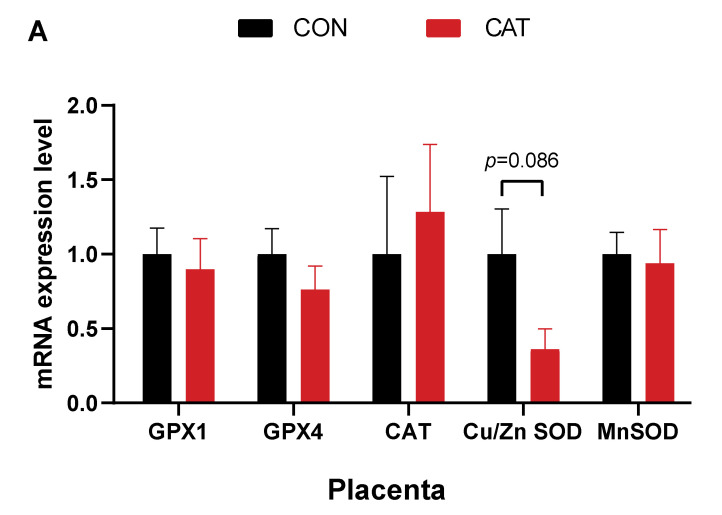
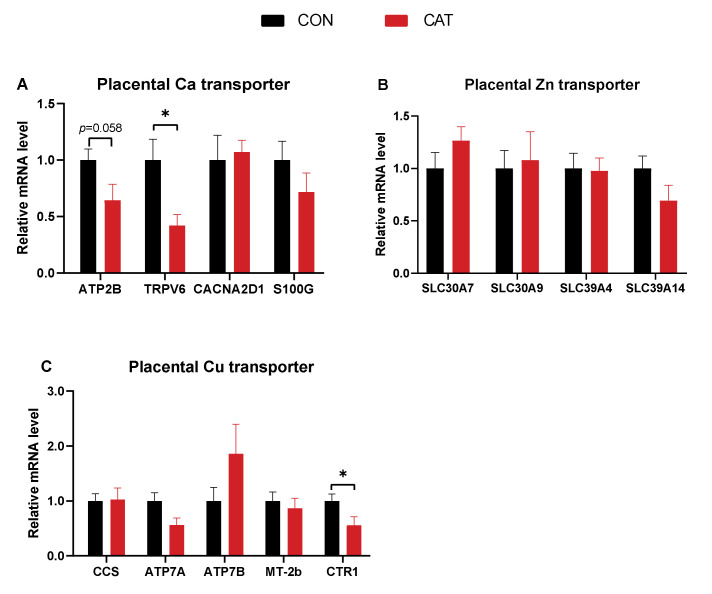
This experiment was conducted to investigate the effects of maternal catalase (CAT) supplementation on reproductive performance, antioxidant enzyme activities, mineral transport, and mRNA expression of related genes in sows and offspring. A total of 40 pregnant sows at 95 days of gestation with similar parity (3−5 parities) and back-fat thickness were assigned randomly and equally into the control (CON) group (fed a basal diet) and CAT group (fed a basal diet supplemented with 660 mg/kg CAT; CAT activity, 280 U/g). The reproductive performance was recorded, and the placenta and blood samples of sows and neonatal piglets, as well as the jejunum and ileum samples from neonatal boars (eight replicates per group), were collected. Results showed that dietary supplementation with CAT significantly decreased the intrauterine growth restriction (IUGR) rate and increased the activity of serum CAT in neonatal piglets and umbilical cords (p < 0.05). In addition, CAT supplementation tended to improve total antioxidant capacity (T-AOC) levels in the maternal serum (p = 0.089) and umbilical cords of piglets (p = 0.051). The serum calcium (Ca), manganese (Mn), and zinc (Zn) of farrowing sows and Mn concentration in the umbilical cord, and serum Ca, magnesium (Mg), copper (Cu), and Mn of neonatal piglets were significantly increased (p < 0.05) in the CAT group. CAT supplementation downregulated mRNA expression of TRPV6 and CTR1 (p < 0.05), Cu/Zn SOD (p = 0.086) in the placenta and tended to increase the mRNA expression of the glutathione peroxidase 1 (GPX1) (p = 0.084), glutathione peroxidase 4 (GPX4) (p = 0.063), and CAT (p = 0.052) genes in the ileum of piglets. These results showed that the maternal CAT supplementation improved fetal growth by decreasing the IUGR rate, and modulated antioxidant activity, as well as mineral elements in the pregnant sows and their piglets.
本试验旨在研究母猪日粮中添加过氧化氢酶(CAT)对母猪及其后代繁殖性能、抗氧化酶活性、矿物质转运以及相关基因mRNA表达的影响。选取40头妊娠95天、胎次相近(3-5胎)且背膘厚度相近的妊娠母猪,随机平均分为对照组(CON组,饲喂基础日粮)和CAT组(饲喂添加660 mg/kg CAT的基础日粮;CAT活性为280 U/g)。记录繁殖性能,并采集母猪和新生仔猪的胎盘及血液样本,以及新生公猪的空肠和回肠样本(每组8个重复)。结果表明,日粮中添加CAT可显著降低新生仔猪和脐带的宫内生长受限(IUGR)率,并提高血清CAT活性(p<0.05)。此外,添加CAT有提高母体血清(p=0.089)和仔猪脐带总抗氧化能力(T-AOC)水平的趋势(p=0.051)。CAT组产仔母猪血清钙(Ca)、锰(Mn)和锌(Zn)以及脐带中Mn浓度,和新生仔猪血清Ca、镁(Mg)、铜(Cu)和Mn均显著升高(p<0.05)。添加CAT可下调胎盘TRPV6和CTR1的mRNA表达(p<0.05)、Cu/Zn SOD的mRNA表达(p=0.086),并倾向于提高仔猪回肠中谷胱甘肽过氧化物酶1(GPX1)(p=0.084)、谷胱甘肽过氧化物酶4(GPX4)(p=0.063)和CAT(p=0.052)基因的mRNA表达。这些结果表明,母猪日粮中添加CAT可通过降低IUGR率改善胎儿生长,并调节妊娠母猪及其仔猪的抗氧化活性和矿物质元素。