Department of Psychology, University of Portsmouth, UK; Canadian Institute for Substance Use Research, University of Victoria, Victoria, Canada.
School of Pharmacy and Biomedical Science, University of Portsmouth, Portsmouth, UK.
J Psychiatr Res. 2023 Aug;164:140-149. doi: 10.1016/j.jpsychires.2023.06.020. Epub 2023 Jun 16.
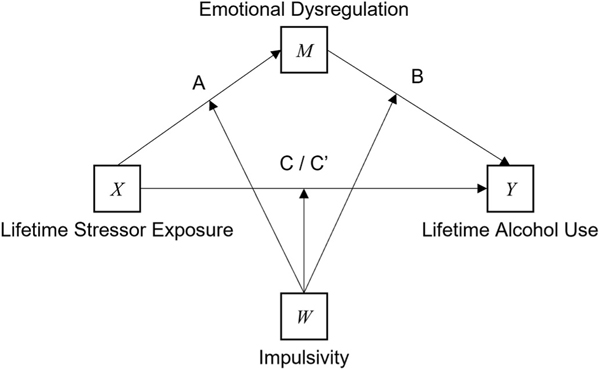
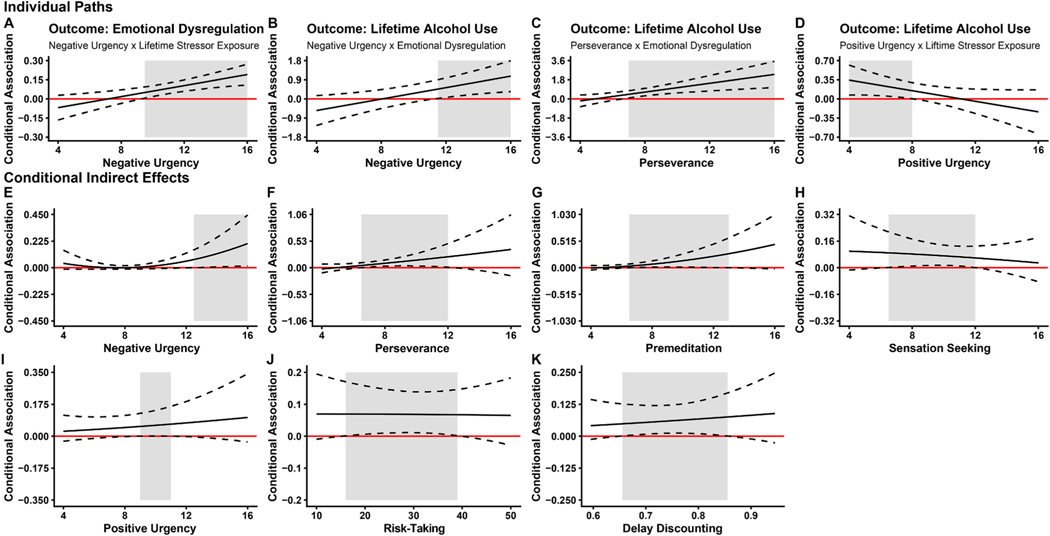
Stress, trait impulsivity, and emotional dysregulation are independent predictors of alcohol use and misuse, but little is known about the potential mechanisms that link these risk factors together. To address this issue, we carried out an exploratory cross-sectional study, on UK-based participants. Our preregistered, hypothesised theoretical framework was that emotional dysregulation mediates the association between cumulative lifetime stressor exposure and lifetime alcohol use. We also hypothesised that heightened impulsivity would strengthen these relations. As hypothesised, emotional dysregulation fully mediated the relation between cumulative lifetime stressor exposure and lifetime alcohol use. Several facets of impulsivity moderated these associations. For example, as levels of negative urgency increased, the associations between cumulative lifetime stressor exposure and emotional dysregulation, emotional dysregulation and lifetime alcohol use, and lifetime stress exposure and lifetime alcohol use, via emotional dysregulation, strengthened. These preliminary findings propose a theoretically framed model which integrates several prominent risk-factors for alcohol misuse, extending prior research and generating interesting and novel lines of enquiry for longitudinal and cross-cultural analyses. The findings also highlight the potential clinical utility of screening for lifetime stress exposure while tailoring personalised treatment interventions.
压力、特质冲动和情绪调节障碍是饮酒和滥用的独立预测因素,但人们对将这些风险因素联系在一起的潜在机制知之甚少。为了解决这个问题,我们在英国的参与者中进行了一项探索性的横断面研究。我们预先注册的假设理论框架是,情绪调节中介了累积终生压力暴露与终生饮酒之间的关联。我们还假设,冲动性增强会加强这些关系。正如假设的那样,情绪调节完全中介了累积终生压力暴露与终生饮酒之间的关系。冲动性的几个方面调节了这些关联。例如,随着负性冲动水平的升高,累积终生压力暴露与情绪调节、情绪调节与终生饮酒以及终生压力暴露与通过情绪调节的终生饮酒之间的关联增强。这些初步发现提出了一个理论框架模型,该模型整合了几种与酒精滥用相关的主要风险因素,扩展了先前的研究,并为纵向和跨文化分析产生了有趣和新颖的研究方向。这些发现还强调了在针对个人进行治疗干预的同时,筛查终生压力暴露的潜在临床效用。