Research Unit, Elective Surgery Center, Silkeborg Regional Hospital, Silkeborg, 8600, Denmark.
Department of Clinical Medicine, Aarhus University, Aarhus, 8000, Denmark.
F1000Res. 2023 Jun 26;10:382. doi: 10.12688/f1000research.51684.4. eCollection 2021.
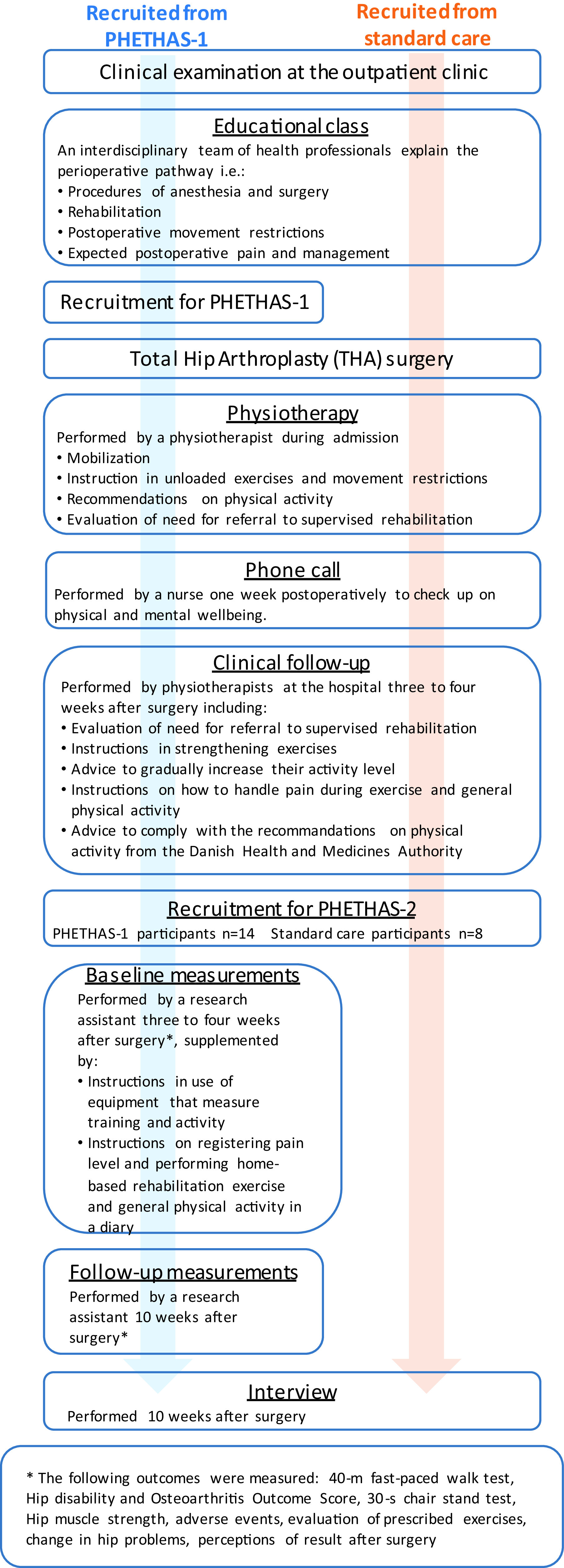
Home-based rehabilitation exercise following Total Hip Arthroplasty (THA) shows similar outcomes compared to supervised outpatient rehabilitation exercise. Little is known about patients' experiences with home-based rehabilitation, and this study aimed to investigate how patients perceived home-based rehabilitation exercise and general physical activity after THA, focusing on facilitators and barriers. Semi-structured interviews of qualitative design were conducted with 22 patients who had undergone THA and who had performed home-based rehabilitation exercise. The study took place in a regional hospital in Denmark between January 2018 and May 2019. Data were analyzed using an interpretive thematic analysis approach, with theoretical underpinning from the concept 'conduct of everyday life'. The study is embedded within the Pragmatic Home-Based Exercise Therapy after Total Hip Arthroplasty-Silkeborg trial (PHETHAS-1). The main theme, 'wishing to return to the well-known everyday life', and four subthemes were identified. Generally, participants found the home-based rehabilitation exercise boring but were motivated by the goal of returning to their well-known everyday life and performing their usual general physical activities, though some lacked contact to physiotherapist. Participants enrolled in the PHETHAS-1 study used the enrollment as part of their motivation for doing the exercises. Both pain and the absence of pain were identified as barriers for doing home-based rehabilitation exercise. Pain could cause insecurity about possible medical complications, while the absence of pain could lead to the rehabilitation exercise being perceived as pointless. The overall goal of returning to the well-known everyday life served as a facilitator for undertaking home-based rehabilitation exercise after THA along with the flexibility regarding time and place for performing exercises. Boring exercises as well as both pain and no pain were identified as barriers to the performance of home-based rehabilitation exercise. Participants were motivated towards performing general physical activities which were part of their everyday life.
髋关节置换术后的家庭康复锻炼与监督门诊康复锻炼相比具有相似的效果。然而,对于患者对家庭康复锻炼的体验,我们知之甚少,本研究旨在调查患者在髋关节置换术后如何感知家庭康复锻炼和一般身体活动,重点关注促进因素和障碍因素。本研究采用定性半结构式访谈设计,对 22 名接受过髋关节置换术并进行家庭康复锻炼的患者进行了访谈。研究于 2018 年 1 月至 2019 年 5 月在丹麦一家地区医院进行。数据采用解释性主题分析方法进行分析,理论基础来自“日常生活行为”的概念。本研究嵌入在丹麦锡尔克堡的髋关节置换术后实用家庭锻炼治疗(PHETHAS-1)试验中。研究确定了一个主要主题,“希望回到熟悉的日常生活”,以及四个副主题。一般来说,参与者发现家庭康复锻炼很无聊,但他们的动机是回到熟悉的日常生活,进行他们通常的一般身体活动,尽管有些人缺乏与物理治疗师的联系。参加 PHETHAS-1 研究的参与者将注册作为他们进行锻炼的动机的一部分。疼痛和没有疼痛都被认为是进行家庭康复锻炼的障碍。疼痛可能导致对可能出现的医疗并发症感到不安,而没有疼痛可能导致康复锻炼被认为是没有意义的。回到熟悉的日常生活的总体目标是髋关节置换术后进行家庭康复锻炼的促进因素,同时还具有灵活的时间和地点进行锻炼。无聊的锻炼以及疼痛和没有疼痛都被认为是进行家庭康复锻炼的障碍。参与者有动力进行他们日常生活中的一般身体活动。