Hernández-Posadas Alejandrina, Lommen Miriam J J, de la Rosa Gómez Anabel, Bouman Theo K, Mancilla-Díaz Juan Manuel, Del Palacio González Adriana
Faculty of Behavioural and Social Sciences, University of Groningen, Groningen, Netherlands.
Faculty of Higher Studies Iztacala, National Autonomous University of Mexico, Av. De los Barrios Núm. 1, Los Reyes Iztacala, Torre de Tutorías, 2do. Piso, Cubículo 22, Edo. de Mexico 54090 Tlalnepantla, Mexico.
Curr Psychol. 2023 May 29:1-16. doi: 10.1007/s12144-023-04792-x.
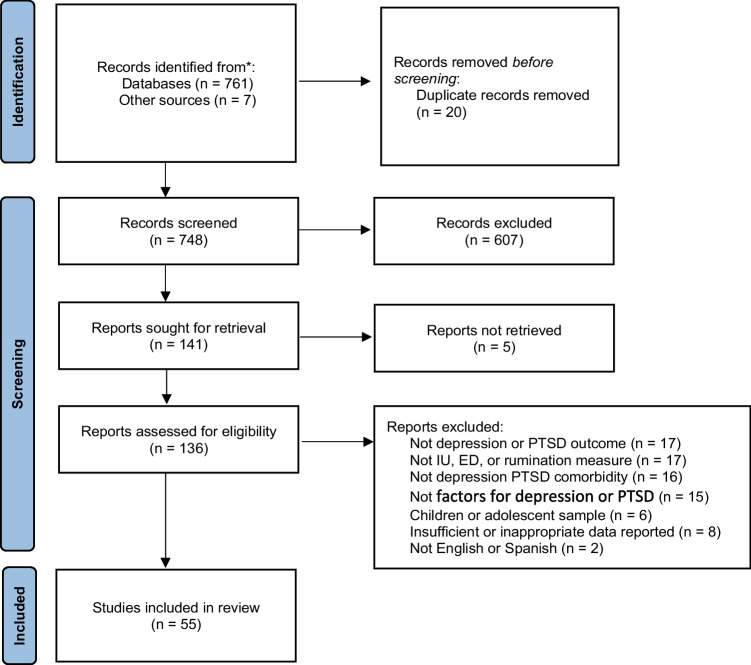
The current systematic review sought to identify quantitative empirical studies that focused on the transdiagnostic factors of intolerance of uncertainty, emotional dysregulation and rumination, and their relation with depression and post-traumatic stress disorder (PTSD). The overall research aim was to examine the relationship between these transdiagnostic factors and their relation with depression and PTSD symptoms. The systematic review was conducted in accordance with the Preferred Reporting Items for Systematic Review and Meta-Analyses (PRISMA) guidelines. Out of the 768 articles initially identified, 55 met the inclusion criteria for the current review. The results determined that intolerance of uncertainty is indirectly related to depression and PTSD symptoms, mainly through other factors including emotion dysregulation and rumination. Additionally, emotional dysregulation is a significant predictor of both depression and PTSD symptoms. Rumination is a robust factor related to depression and PTSD symptoms, this relationship was significant in cross-sectional and longitudinal studies. This review provides evidence on the transdiagnostic factors of intolerance of uncertainty, emotional dysregulation and rumination in the relationship with depression and PTSD symptoms.
当前的系统评价旨在识别聚焦于不确定性不耐受、情绪失调和反复思考这些跨诊断因素,以及它们与抑郁症和创伤后应激障碍(PTSD)之间关系的定量实证研究。总体研究目标是检验这些跨诊断因素之间的关系及其与抑郁症和创伤后应激障碍症状的关系。该系统评价是按照系统评价与Meta分析的首选报告项目(PRISMA)指南进行的。在最初识别出的768篇文章中,有55篇符合当前评价的纳入标准。结果确定,不确定性不耐受与抑郁症和创伤后应激障碍症状间接相关,主要通过包括情绪失调和反复思考在内的其他因素。此外,情绪失调是抑郁症和创伤后应激障碍症状的重要预测因素。反复思考是与抑郁症和创伤后应激障碍症状相关的一个有力因素,这种关系在横断面研究和纵向研究中都很显著。本评价为不确定性不耐受、情绪失调和反复思考这些跨诊断因素与抑郁症和创伤后应激障碍症状之间的关系提供了证据。