Cheek Joshua, Fox Sara Shuger, Lehmler Hans-Joachim, Titcomb Tyler J
Department of Kinesiology, Central College, Pella, IA USA.
Department of Internal Medicine, Roy J. and Lucille A. Carver College of Medicine, University of Iowa, 200 Hawkins Drive, Room SE 232 GH, Iowa City, IA 52242 USA.
Expo Health. 2023 Jun 8:1-9. doi: 10.1007/s12403-023-00579-4.
Laboratory studies have linked nickel with the pathogenesis of cardiovascular disease (CVD); however, few observational studies in humans have confirmed this association.
This study aimed to use urinary nickel concentrations, as a biomarker of environmental nickel exposure, to evaluate the cross-sectional association between nickel exposure and CVD in a nationally representative sample of U.S. adults.
Data from a nationally representative sample ( = 2702) in the National Health and Nutrition Examination Survey 2017-20 were used. CVD ( = 326) was defined as self-reported physicians' diagnoses of coronary heart disease, angina, heart attack, or stroke. Urinary nickel concentrations were determined by inductively coupled plasma mass spectrometry. Logistic regression with sample weights was used to estimate the odds ratios (ORs) and 95% confidence intervals (CIs) of CVD.
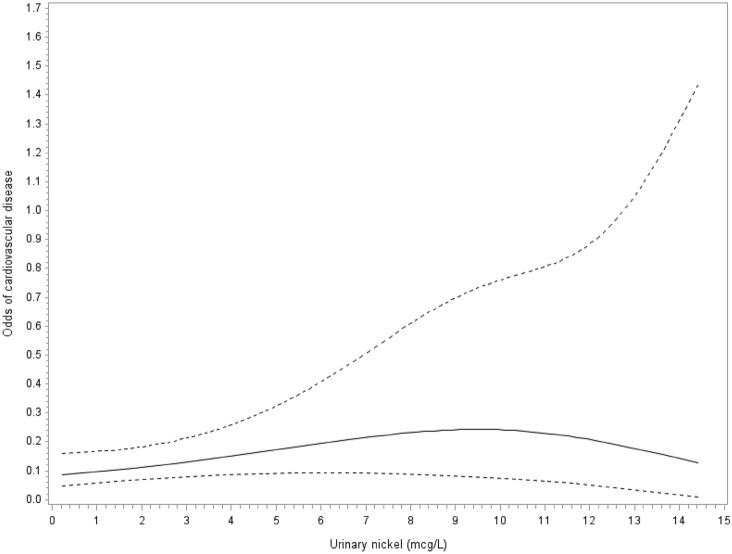
Urinary nickel concentrations were higher in individuals with CVD (weighted median 1.34 μg/L) compared to those without CVD (1.08 μg/L). After adjustment for demographic, socioeconomic, lifestyle, and other risk factors for CVD, the ORs (95% CIs) for CVD compared with the lowest quartile of urinary nickel were 3.57 (1.73-7.36) for the second quartile, 3.61 (1.83-7.13) for the third quartile, and 2.40 (1.03-5.59) for the fourth quartile. Cubic spline regression revealed a non-monotonic, inverse U-shaped, association between urinary nickel and CVD (P < 0.001).
Nickel exposure is associated with CVD in a non-monotonic manner among U.S. adults independent of well-known CVD risk factors.
The online version contains supplementary material available at 10.1007/s12403-023-00579-4.
实验室研究已将镍与心血管疾病(CVD)的发病机制联系起来;然而,很少有针对人类的观察性研究证实这种关联。
本研究旨在使用尿镍浓度作为环境镍暴露的生物标志物,在美国成年人的全国代表性样本中评估镍暴露与CVD之间的横断面关联。
使用了2017 - 2020年国家健康与营养检查调查中全国代表性样本(n = 2702)的数据。CVD(n = 326)定义为医生自我报告诊断的冠心病、心绞痛、心脏病发作或中风。尿镍浓度通过电感耦合等离子体质谱法测定。使用带样本权重的逻辑回归来估计CVD的优势比(OR)和95%置信区间(CI)。
与无CVD的个体相比,CVD个体的尿镍浓度更高(加权中位数1.34μg/L对1.08μg/L)。在调整了人口统计学、社会经济、生活方式和其他CVD风险因素后,与尿镍最低四分位数相比,CVD的OR(95%CI)在第二四分位数为3.57(1.73 - 7.36),第三四分位数为3.61(1.83 - 7.13),第四四分位数为2.40(1.03 - 5.59)。三次样条回归显示尿镍与CVD之间存在非单调的倒U形关联(P < 0.001)。
在美国成年人中,镍暴露与CVD以非单调方式相关,且独立于已知的CVD风险因素。
在线版本包含可在10.1007/s12403 - 023 - 00579 - 4获取的补充材料。