National Clinical Research Center for Metabolic Diseases, Metabolic Syndrome Research Center, Key Laboratory of Diabetes Immunology, Ministry of Education, and Department of Metabolism and Endocrinology, The Second Xiangya Hospital of Central South University, Changsha, Hunan, China.
Xiangya School of Public Health, Central South University, Changsha, China.
Front Cell Infect Microbiol. 2023 Jun 9;13:1217383. doi: 10.3389/fcimb.2023.1217383. eCollection 2023.
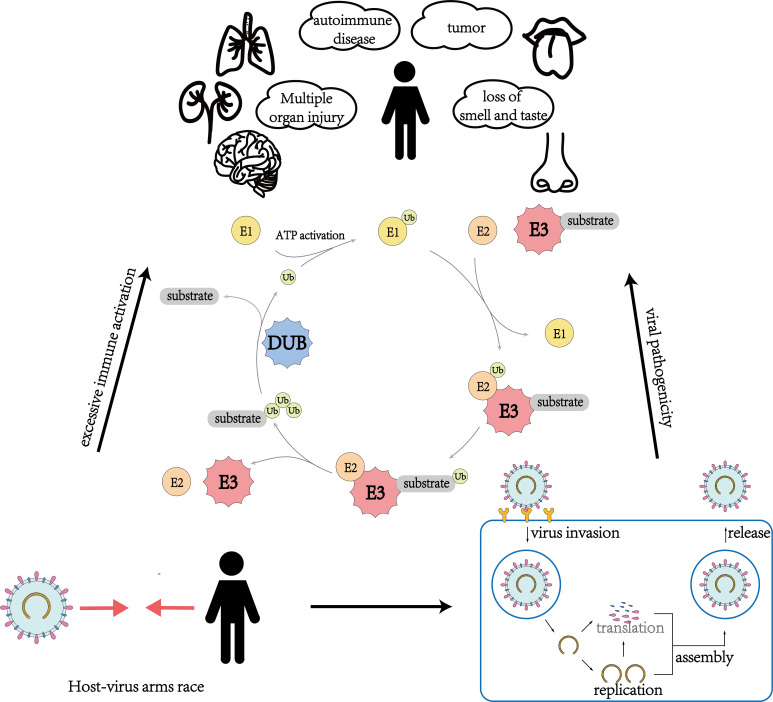
Ever since its emergence in 2019, COVID-19 has rapidly disseminated worldwide, engendering a pervasive pandemic that has profoundly impacted healthcare systems and the socio-economic milieu. A plethora of studies has been conducted targeting its pathogenic virus, SARS-CoV-2, to find ways to combat COVID-19. The ubiquitin-proteasome system (UPS) is widely recognized as a crucial mechanism that regulates human biological activities by maintaining protein homeostasis. Within the UPS, the ubiquitination and deubiquitination, two reversible modifications, of substrate proteins have been extensively studied and implicated in the pathogenesis of SARS-CoV-2. The regulation of E3 ubiquitin ligases and DUBs(Deubiquitinating enzymes), which are key enzymes involved in the two modification processes, determines the fate of substrate proteins. Proteins associated with the pathogenesis of SARS-CoV-2 may be retained, degraded, or even activated, thus affecting the ultimate outcome of the confrontation between SARS-CoV-2 and the host. In other words, the clash between SARS-CoV-2 and the host can be viewed as a battle for dominance over E3 ubiquitin ligases and DUBs, from the standpoint of ubiquitin modification regulation. This review primarily aims to clarify the mechanisms by which the virus utilizes host E3 ubiquitin ligases and DUBs, along with its own viral proteins that have similar enzyme activities, to facilitate invasion, replication, escape, and inflammation. We believe that gaining a better understanding of the role of E3 ubiquitin ligases and DUBs in COVID-19 can offer novel and valuable insights for developing antiviral therapies.
自 2019 年出现以来,COVID-19 在全球迅速传播,引发了广泛的大流行,对医疗保健系统和社会经济环境产生了深远影响。针对其病原体 SARS-CoV-2 进行了大量研究,以寻找对抗 COVID-19 的方法。泛素-蛋白酶体系统(UPS)被广泛认为是通过维持蛋白质内稳态来调节人类生物活动的重要机制。在 UPS 中,底物蛋白的泛素化和去泛素化这两种可逆修饰已被广泛研究,并与 SARS-CoV-2 的发病机制有关。E3 泛素连接酶和 DUB(去泛素化酶)的调节,它们是这两个修饰过程中的关键酶,决定了底物蛋白的命运。与 SARS-CoV-2 发病机制相关的蛋白可能被保留、降解甚至激活,从而影响 SARS-CoV-2 与宿主对抗的最终结果。换句话说,从泛素修饰调节的角度来看,SARS-CoV-2 与宿主之间的冲突可以看作是对 E3 泛素连接酶和 DUB 的争夺。本综述主要旨在阐明病毒利用宿主 E3 泛素连接酶和 DUB 以及具有类似酶活性的自身病毒蛋白来促进入侵、复制、逃逸和炎症的机制。我们相信,更好地了解 E3 泛素连接酶和 DUB 在 COVID-19 中的作用,可以为开发抗病毒疗法提供新的有价值的见解。