Institute of Chemical Biology, National Hellenic Research Foundation, 11635 Athens, Greece.
Department of Chemistry, University of Patras, Patras 26504, Greece.
J Trace Elem Med Biol. 2023 Jan;75:127089. doi: 10.1016/j.jtemb.2022.127089. Epub 2022 Oct 4.
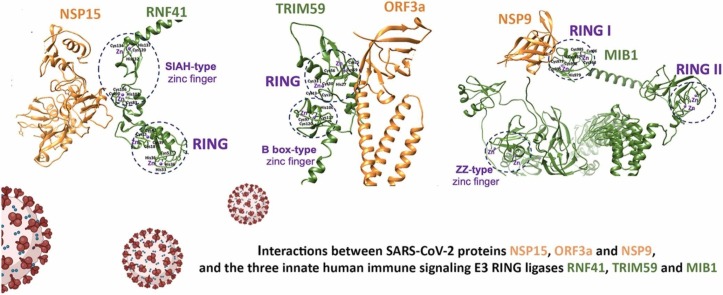
The ubiquitin system is a modification process with many different cellular functions including immune signaling and antiviral functions. E3 ubiquitin ligases are enzymes that recruit an E2 ubiquitin-conjugating enzyme bound to ubiquitin in order to catalyze the transfer of ubiquitin from the E2 to a protein substrate. The RING E3s, the most abundant type of ubiquitin ligases, are characterized by a zinc (II)-binding domain called RING (Really Interesting New Gene). Viral replication requires modifying and hijacking key cellular pathways within host cells such as cellular ubiquitination. There are well-established examples where a viral proteins bind to RING E3s, redirecting them to degrade otherwise long-lived host proteins or inhibiting E3's ubiquitination activity. Recently, three binary interactions between SARS-CoV-2 proteins and innate human immune signaling Ε3 RING ligases: NSP15-RNF41, ORF3a-TRIM59 and NSP9-MIB1 have been experimentally established.
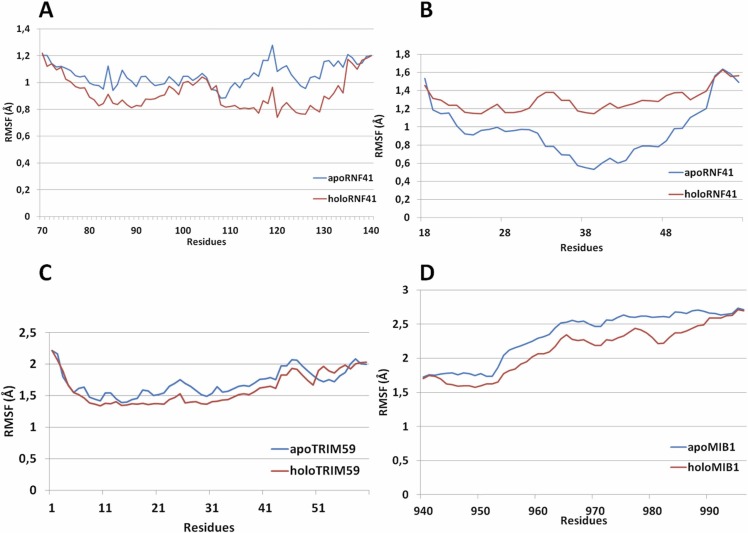
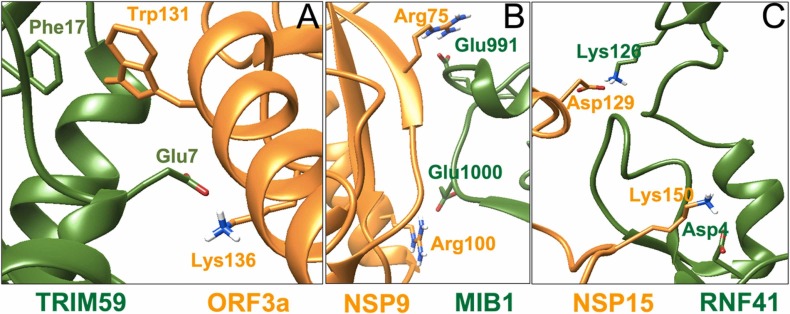
In this work, we have investigated the mode of the previous experimentally supported NSP15-RNF41, ORF3a,-TRIM59 and NSP9-MIB1 binary interactions by in silico methodologies intending to provide structural insights of E3-virus interplay that can help identify potential inhibitors that could block SARS-CoV-2 infection of immune cells.
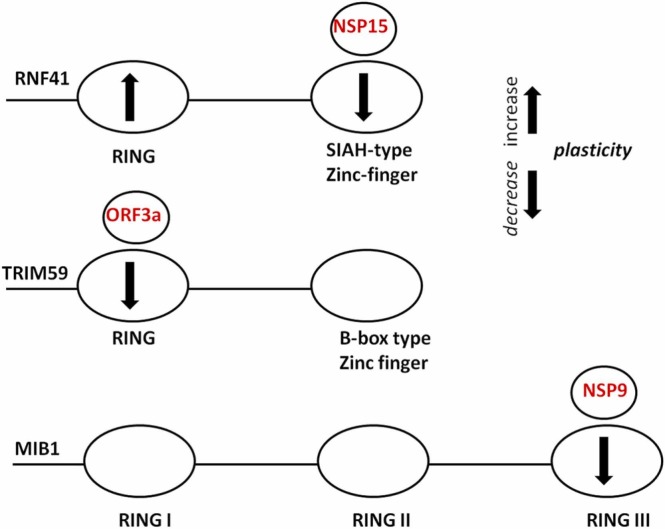
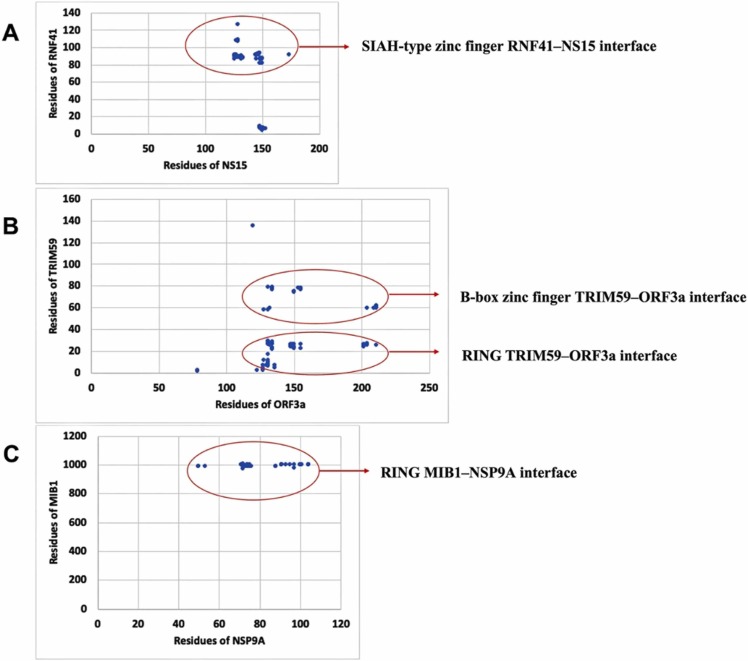
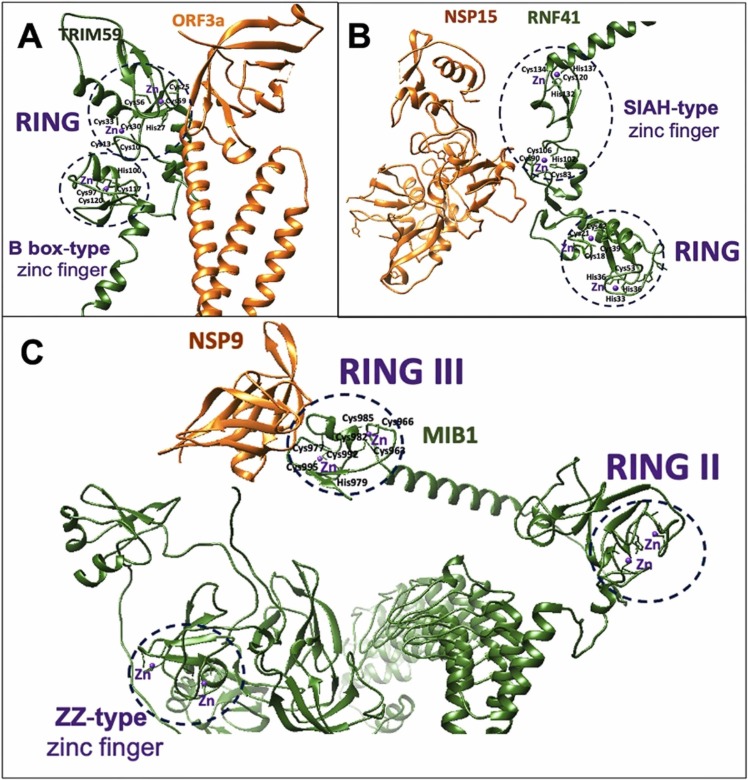
In silico methodologies have shown that the above human E3 ligases interact with viral partners through their Zn(II) binding domains. This RING mediated formation of stable SARS-CoV-2-E3 complexes indicates a critical structural role of RING domains in immune system disruption by SARS-CoV-2-infection.
The data used to support the findings of this research are included within the article and are labeled with references.
泛素系统是一个具有多种不同细胞功能的修饰过程,包括免疫信号和抗病毒功能。E3 泛素连接酶是一种酶,它招募与泛素结合的 E2 泛素连接酶,以催化泛素从 E2 转移到蛋白质底物上。RING E3s 是最丰富的泛素连接酶类型,其特征是具有一个称为 RING(真正有趣的新基因)的锌(II)结合域。病毒复制需要修饰和劫持宿主细胞内的关键细胞途径,如细胞泛素化。有许多已确立的例子表明,病毒蛋白与 RING E3s 结合,将其重定向以降解原本寿命较长的宿主蛋白,或抑制 E3 的泛素化活性。最近,已通过实验证实了 SARS-CoV-2 蛋白与先天人类免疫信号 Ε3 RING 连接酶之间的三种二元相互作用:NSP15-RNF41、ORF3a-TRIM59 和 NSP9-MIB1。
在这项工作中,我们通过计算方法研究了先前实验支持的 NSP15-RNF41、ORF3a-TRIM59 和 NSP9-MIB1 二元相互作用的模式,旨在提供 E3-病毒相互作用的结构见解,这些见解可以帮助识别可能阻止 SARS-CoV-2 感染免疫细胞的潜在抑制剂。
计算方法表明,上述人类 E3 连接酶通过其 Zn(II)结合域与病毒伙伴相互作用。这种 RING 介导的稳定 SARS-CoV-2-E3 复合物的形成表明,RING 结构域在 SARS-CoV-2 感染破坏免疫系统方面具有关键的结构作用。
用于支持本研究发现的数据包含在文章中,并带有参考文献进行标记。